Wayground logo

Free Printable Worksheets

Font size

S
M
L
XL
Worksheets

Unit 1 - Tools of the Biologist Review

Total questions: 80

Worksheet time: 3600secs

Name
Class
Date
1.
A series of steps used by scientists to solve a problem or answer a question. 
a)
scientific method
b)
recipe
c)
data collection
d)
metric system
2.
Which is NOT a step in the scientific method?
a)
Make observation
b)
Form a theory
c)
Collect data
d)
Form a hypothesis
3.
A testable explanation to a problem that has not yet been tested. 
a)
data
b)
theory
c)
hypothesis
d)
fact
4.
This variable in an experiment is the one being changed by the scientist. 
a)
dependent variable
b)
independent variable
c)
data
d)
control group
5.
Testing a hypothesis often involves a(n):
a)
answer
b)
experiment
c)
problem
d)
safety check
6.
What is a hypothesis?
a)
A hypothesis is the right answer to an experiment.
b)
A hypothesis is the wrong answer to an experiment.
c)
A hypothesis is an educated guess.
d)
I don't know.
7.
The summary at the end of an experiment that explains the results. 
a)
conclusion
b)
procedures
c)
materials
d)
responding variable
8.
The name of the information that you get from your experiment (you organize it into charts and graphs).
a)
observations
conclusion
b)
data
c)
variables
d)
hypothesis
9.
An experiment is performed on plants to see how different liquids affect plant growth. Each plant in the experiment is given a different liquid; water, apple juice, or milk. Each plant has the same amount of soil, sunlight, and listens to the same music. In this investigation, the independent variable is ...
a)
The type of plant
b)
The amount of sunlight
c)
The type of music
d)
The type of liquid
10.
Dependent variable means
a)
the scientist controls what to test
b)
educated guess
c)
ask a question
d)
what is being measured
11.
If you increase the amount of spinach you eat, then you will increase the iron in your blood. 
What's the dependent variable?
a)
increase the amount of iron in your blood
b)
spinach you eat
12.
What is the first step in the scientific method?
a)

Ask a question

b)

Conclusion

c)

No Horse Play

d)

Make Observations

13.
If I ride my bike to school instead of walking, then I will get to school faster. What is the dependent variable?
a)
True
b)
How fast you get to school
c)
Riding a bike or walking
d)
False
14.
Will a construction paper air plane fly faster than an airplane made from notebook paper? Choose the best hypothesis.
a)
If I make a paper airplane from notebook paper, then it will fly faster than construction paper.
b)
Yes.
c)
No.
d)
I think the construction paper air plane will fly faster.
15.
Which side of a penny will hold more drops of water? Choose the best hypothesis.
a)
If I use the heads side of a penny, then it will hold more drops of water than tails.
b)
Heads
c)
Tails
d)
Tails will hold more drops of water.
16.
If I study for my scientific method test, then I will have a better test score. What is the dependent variable?
a)
Scientific Method
b)
Studying
c)
Independent variable
d)
Test score
17.
If I listen to Mr. Castro's instructions, then I will have less accidents in the lab. What is the independent variable?
a)
Yes
b)
Maybe
c)
Listening or not listening to instructions
d)
Likelihood of having an accident in lab 
18.
If I read this question carefully, then I will answer it correctly. What is the independent variable?
a)
I hope so
b)
Yes
c)
Reading or not reading carefully
d)
Likelihood of a correct answer
19.
Before beginning an experiment you must first make a ____.
a)

Hypothesis

b)

Conclusion

c)

Graph

d)

Experiment

20.
What are the first two steps of the scientific method in order?
a)
1, 2
b)
Observation, Ask a question
c)
Ask a question, For a hypothesis
d)
Make a plan, Experiment
21.

Observation or Inference

a)

observation

b)

inference

22.

Observation or Inference

a)

observation

b)

inference

23.

Observation or Inference

a)

observation

b)

inference

24.

Observation or Inference

a)

observation

b)

inference

25.

Observation or inference?

a)

observation

b)

inference

26.

The ball is white.

a)

observation

b)

Inference

27.

Phineas and Ferb are in the ocean.

a)

observation

b)

inference

28.

Which statement is an observation?

a)

The second chick is curious.

b)

The chicks are yellow.

c)

The first two chicks weigh the same as the last two.

d)

The chicks all have the same mom.

29.

Which statement is an observation?

a)

The cat is hypnotized.

b)

This cat saw a ghost.

c)

The cat looks adorable.

d)

They cat has two eyes.

30.

Observation or Inference: The people are fighting with each other because there are dishes in the sink.

a)

observation

b)

inference

31.
What is an observation for this picture?
a)
The man is scared
b)
The man is going to get eaten
c)
There is a man in a kayak
d)
The man is paddling fast
32.
There are 8 birthdays in October
a)
observation
b)
Inference
33.

Which of the following is an observation about the man in this picture:

a)

The man hates his purple shirt.

b)

The man has a purple shirt.

c)

The man is having a bad day.

d)

This man is upset because he's hungry

34.

The ball rolls down the ramp in 4.2 seconds. If I increase the height of the ramp, the ball will roll down in less time. This is an example of a

a)

Observation

b)

Inference

35.

Statements about the color or texture of an object are ________________.

a)

Observations

b)

Inferences

36.

Observation or Inference?

I believe he must have hit a pothole in the road.

a)

observation

b)

inference

37.

There are 10 puppies in the picture. This is an example of a

a)

observation

b)

inference

38.

There are 3 giraffes and 1 zebra. This is an example of a

a)

observation

b)

inference

39.
If the boy crawled out of the water, the goat would push him in.
a)
inference
b)
observation
40.

What is an inference?

a)

Just a guess.

b)

A statement based off of your observations and prior knowledge.

c)

The same as an observation.

d)

Examples of something.

41.

How many eggs were measured altogether in this experiment?

a)

25

b)

40

c)

90

d)

100

42.

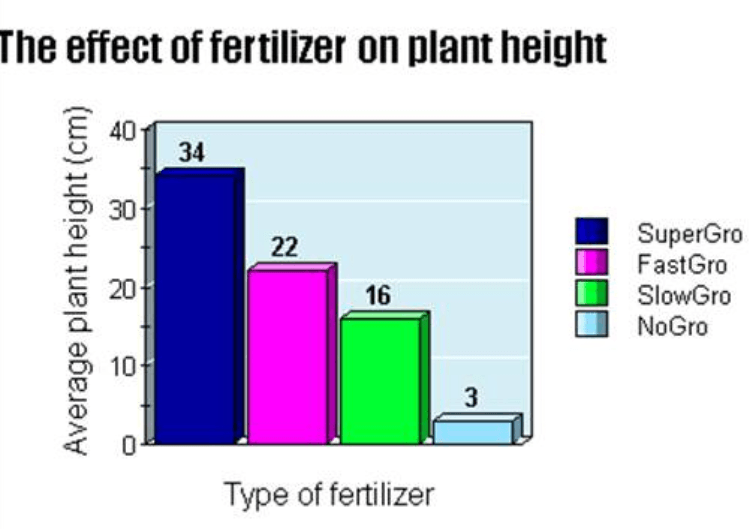
What is the independent variable?

a)

Type of fertilizer

b)

Average plant height

c)

The effect of fertilizer on plant height

d)

The effect of plant height on fertilizer

43.

What is the title of this graph?

a)

Type of fertilizer

b)

Average plant height

c)

The effect of fertilizer on plant height

d)

The effect of plant height on fertilizer

44.

What is the dependent variable?

a)

Type of fertilizer

b)

Average plant height

c)

The effect of fertilizer on plant height

d)

The effect of plant height on fertilizer

45.

What is the BEST title for this graph?

a)

The Relationship between Time Spent Studying and Test Grades

b)

The effect of Time Spent Studying and Test Grades

c)

Time Spent Studying

d)

Test Grades

46.

What is the independent variable for this graph?

a)

The Relationship between Time Spent Studying and Test Grades

b)

The effect of Time Spent Studying and Test Grades

c)

Time Spent Studying

d)

Test Grades

47.

Which discipline division awarded the least degrees?

a)

Pyschology

b)

Business

c)

Engineering

d)

Education

e)

Visual & Performing Arts

48.

What is the best TITLE for this graph?

a)

The effect of missed free throws on wins

b)

The relationship between missed free throws and wins

c)

Number of missed free throws

d)

Number of wins

49.

Which variable always goes on the y-axis (vertical)?

a)

Independent

b)

Dependent

c)

Constant

d)

Control

50.

What is the independent variable on this graph?

a)

Year

b)

Number of Visitors

c)

Visitors to a Park

d)

none of these

51.

How many people visited the park in 1997?

a)

20

b)

40

c)

60

d)

50

e)

35

52.
In which year did exactly 60 students have scholarships?
a)
2010
b)
2011
c)
2012
d)
2013
53.
In August, how many metric tons did Clark's Paper Mill and Tyler Paper Mill produce all together?
a)
10
b)
70
c)
80
d)
90
54.
After the refrigerator, which appliance is used the most on weekdays?
a)
Television
b)
Heater
c)
Lights
d)
Computer
55.
Which appliance is used twice as many hours on the weekends as it is on weekdays?
a)
Lights
b)
Computer
c)
Refrigerator
d)
Television
56.
What is this graph showing you?
a)
The worlds population is staying the same.
b)
The worlds population is going down (decreasing).
c)
The worlds population was growing but now is decreasing.
d)
The worlds population has been growing and will continue to grow. 
57.
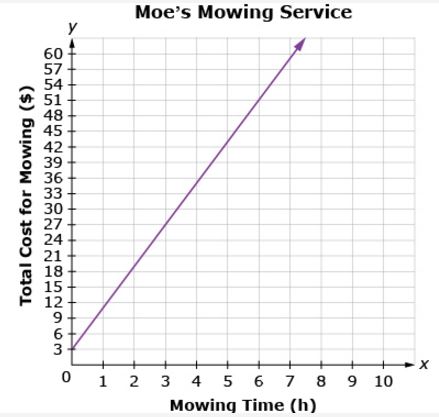
What is the general trend of this line graph?
a)
The more you mow, the less money you make.
b)
You make the same amount of money regardless of how long you mow.
c)
The more you mow, the more money you make.
d)
Mowing is dangerous.
58.

Which month had the biggest difference between the high and low temperatures?

a)

January

b)

April

c)

October

d)

November

59.

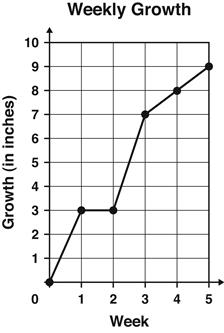
The graph shows the number of inches a plant grew each week.

Between which 2 weeks did the plant grow the MOST?

a)

Week 1 and Week 2

b)

Week 2 and Week 3

c)

Week 3 and Week 4

d)

Week 4 and Week 5

60.
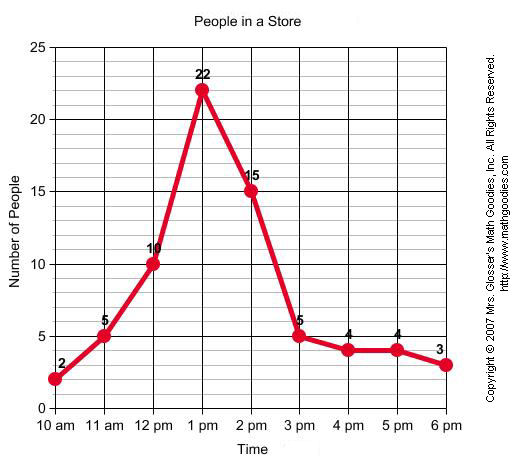
Between which two times was the greatest increase in number of shoppers?
a)
12pm and 1pm
b)
1pm and 2pm
c)
2pm and 3pm
d)
10am and 11am
61.

A variable that stays the same is called....

a)

control

b)

independent variable

c)

dependent variable

d)

responding variable

62.
In a controlled experiment, how many independent variables can be worked with at a time? 
a)
one
b)
none
c)
two or more
d)
how ever many makes sense.
63.

When experimenting with the growth of a plant, a scientist uses three (of the same type of) plants, two different fertilizers, equal light, and equal water. What type of variable is the fertilizer?

a)

Dependent

b)

Independent

c)

Control

d)

All of the above

64.
An experiment is performed on plants to see how different liquids affect plant growth. Each plant in the experiment is given a different liquid; water, apple juice, or milk. Each plant has the same amount of soil, sunlight, and listens to the same music. In this investigation, what is the dependent variable?
a)
Type of plant
b)
Water, apple juice, milk
c)
Plant growth
d)
Color of the plant's leaves
65.
Something that is changed or tested in an experiment.
a)
independent variable
b)
dependent variable
c)
controlled variable
66.
Something that changes as a result of the experiment.
a)
independent variable
b)
dependent variable
c)
controlled variable
67.
A student wants to test the effects of type of exercise on heart rate.  What is the independent variable?
a)
type of exercise
b)
heart rate
c)
amount of time exercise occurs
d)
gender of person that exercises
68.
A student wants to test the effects of type of exercise on heart rate.  What is the dependent variable?
a)
heart rate
b)
type of exercise
c)
amount of exercise
d)
time of day exercise occurs
69.
A good testable question and a good hypothesis must be..
a)
Approved by the National Science Committee
b)
Based on prior knowledge
c)
Written in present tense
d)
Testable & measurable (independent & dependent variables)
70.

In the year 1990, tadpole populations began to ___________________ rapidly.

a)

decrease

b)

increase

c)

stayed the same

d)

first decreased, then increaed

71.
Based on the graph, what is the optimum temperature for sprout weight?
a)
30 degrees Celsius
b)
35 degrees Celsius
c)
13 degrees Celsius
d)
18 degrees Celsius
72.
THE CHART SHOW STEPS A STUDENT USES TO TEST THE EFFECT OF FERTILIZER ON A PLANT.
STEP 1
GATHER FOUR OF THE SAME PLANTS IN THE SAME LOCATION
STEP 2 MEASURE THE HEIGHT OF EACH PLANT
STEP 3 ?
STEP 4 MEASURE THE HEIGHT OF EACH PLANT AFTER A WEEK
WHICH STATEMENT IS MOST LIKELY STEP 3?
a)
MOVE THE PLANTS TO A DIFFERENT PLACE.
b)
CHANGE THE TYPE OF SOIL IN EACH POT.
c)
CUT EACH PLANT SO THEY ARE ALL THE SAME HEIGHT.
d)
ADD DIFFERENT AMOUNTS OF FERTILIZER TO EACH PLANT.
73.
It was raining outside. Sue got out of bed and got dressed for school. Then, she ate breakfast and grabbed her backpack.  Before Sue left the house, she probably ___________________.
a)
got her sunglasses
b)
made a sandwich
c)
picked up her umbrella
d)
put on sandals
74.
Amy opened the door to the bathroom. “What is that dripping sound? Why is the carpet wet and squishy all around the bathtub? The rest of the carpet is dry. Oh no!”
What is the problem?
a)
The TV is broken.
b)
The bathtub is overflowing.
c)
There is no soap in the bathroom.
d)
The stove was left turned on.
75.
Due to their incredible force and unpredictability, floods can cause tremendous damage. They can ruin houses, roads and buildings. Floods can take down trees and cause mudslides. It often leaves mud, sand and debris behind. It can take months to clean up after a flood.
Based on what you have read, you can INFER that:
a)
Cleaning up after a flood can be expensive and take time.
b)
Floods only occur along the coast.
c)
Floods are not that dangerous.
d)
After flood waters dry up then the problem is over.
76.
What is the independent variable?
a)
cost of mowing
b)
Moe's Mowing Service
c)
$18
d)
Mowing Time
77.

What should you do if there is lab equipment in the room when you enter?

a)

Do not touch anything.

b)

Start an independent experiment.

c)

Immediately start playing with everything.

78.

If you spill something in a lab, what should you do first?

a)

Tell the teacher

b)

Do nothing

c)

Clean it up 

79.

Before starting an investigation or lab procedure, you should

a)

try an experiment on your own

b)

open all containers and packages

c)

read all directions and make sure you understand them

d)

handle all the equipment to become familiar with it

80.

Paula was not careful and knocked over a beaker. She notices a small chip in the glass. What should Paula do?

a)

Ignore the situation. A small chip will not hurt anybody.

b)

Finish what she was working on and then tell the teacher.

c)

Inform the teacher immediately.