wayground logo

Free Printable Worksheets

Font size

S
M
L
XL
Worksheets

Y10 Chapter 3

Total questions: 30

Worksheet time: 34mins

Name
Class
Date
1.

Which statement is false about osmosis ?

a)

Requires a semipermeable membrane

b)

Only the solvent molecules can diffuse

c)

The flow of particles occurs only in one direction

d)

The flow of particles occurs in all the directions.

2.

What is the similarities of diffusion and osmosis ?

a)

The movement is through a semipermeable membrane

b)

Solvent and solute particles move to equalize concentration

c)

Equalizes the concentration of two solutions

d)

Not equalizes the concentration of two solutions

3.

Does diffusion required energy/ ATP ?

a)
b)
4.

In osmosis, between solvent and solute particles, which particle is move and which particle does not move ?

a)

Only solvent particles move. Solute particles do not move

b)

Only solute particles move. Solvent particles do not move

c)

No particles is move

5.

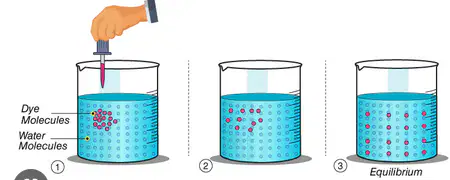
What would not speed up the process of the dye spreading out?

a)

Putting in more concentrated dye

b)

Increasing the temperature

c)

Diluting the dye before putting it in the beaker

d)

Stirring the mixture

6.
What will happen to the dye molecules in the beaker over time?
a)
all stay at top 
b)
all sink to the bottom
c)
spread out evenly (equilibrium)
d)
nothing will happen
7.
An animal cell placed in a hypertonic (salty) solution will
a)
Shrink
b)
Swell
c)
Stay the same
8.
In the image, the water will move 
a)
into the cell.
b)
out of the cell.
c)
both in and out of the cell.
9.
In the image, the water will move 
a)
into the cell.
b)
out of the cell.
c)
both in and out of the cell.
10.
Active transport requires energy because...
a)
The cell is moving something against a concentration gradient
b)
The cell is moving something with a concentration gradient
11.
Diffusion and Osmosis are examples of...
a)
Active Transport
b)
Passive Transport
12.
The movement of atoms, ions, or molecules from an area of high concentration to an area of low concentration.
a)
osmosis
b)
active transport
c)
diffusion
d)
hypertonic
13.
The diffusion of water across a semi-permeable membrane
a)
hypotonic
b)
concentration gradient
c)
homeostasis
d)
osmosis
14.
Which of the following substances passes through the plasma membrane   through the process of osmosis?
a)
glucose
b)
water
c)
protein
d)
sodium
15.
Which is true about active transport?
a)
It requires energy
b)
it does not require energy
c)
It moves substances down the concentration gradient
d)
it moves material from high to low concentration
16.
What is Osmosis?
a)
equal concentration
b)
diffusion of water through a selectively-permeable membrane
c)
high to low concentration
d)
non-polar tail
17.
Energy produced through respiration using oxygen is called _____ respiration
a)
aerobic
b)
anaerobic
18.

Another word for a dilute solution is...

a)

A high concentration of water molecules

b)

A high concentration of sugar molecules

19.

What will happen if a plant cell is placed in a very dilute solution?

a)

Stay the same

b)

Shrink- get smaller

c)

Swell- get bigger

20.

What could happen to a plant cell if it loses too much water?

a)

plasmolysis

b)

crenation

c)

lysis

21.
The picture is an example of...
a)
active tranport
b)
passive transport
c)
diffusion
d)
osmosis
22.

What does a cell need in order to transport particles by active transport?

a)

Sun

b)

Wind

c)

Energy

d)

Channels

23.
Permeable means
a)
things can pass through
b)
the concentration levels are different
c)
it is permanent
d)
things are stuck
24.
The picture below is an example of _________________.
a)
osmosis
b)
isotonic
c)
diffusion
d)
active transport
25.

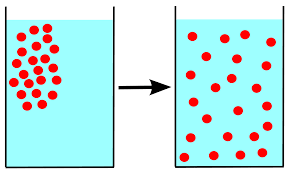
What is diffusion?

a)

when molecules move

b)

when molecules move randomly from a high concentration to a low concentration

c)

no movement

d)

molecules rush to fill every space

26.

Which part of the cell can control what goes in and out of the cell?

a)

Cell Membrane

b)

cell wall

c)

Mitochondria

d)

Cytoplasm

27.

The movement of molecules against a concentration gradient (using energy)

a)

simple diffusion

b)

osmosis

c)

active transport

28.

In a solution, salt is considered the _______.

a)

solvent

b)

solute

c)

solution

29.

What will happen if an animal cell is placed in a very salty solution?

a)

Stay the same

b)

Shrink- get smaller

c)

Swell- get bigger

30.

Osmosis is the diffusion of _____ across a partially permeable membrane.

a)

food

b)

air

c)

water

d)

oxygen