wayground logo

Free Printable Worksheets

NEW

Font size

S
M
L
XL
Worksheets

Newton's Laws Quiz

Total questions: 57

Worksheet time: 2hrs 4mins

Name
Class
Date
1.

What is another name for Newton’s 1st law?

a)

Law of Inertia

b)

Law of Acceleration

c)

Law of Action/Reaction

2.

What is the formula for the law of acceleration?

a)

M = F x A

b)

F = M x A

c)

A = F x M

3.
What is a PUSH or PULL of an object?
a)
Motion
b)
Force
c)
Friction
d)
Gravity
4.
For every action, there is an equal and opposite reaction.
a)
Newton's
1st
Law of Motion
b)
Newton's
2nd
Law of Motion
c)
Newton's
3rd
Law of Motion
5.
If an object is stationary (not moving) the forces acting upon it are _____________
a)
unbalanced
b)
weak
c)
balanced
d)
Hulk Smash!
6.

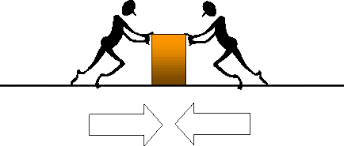
Which of Newton's laws is shown

a)

1st law

b)

3rd law

c)

2nd law

7.

What force slows objects down and keeps them from moving?

a)

Acceleration

b)

Gravity

c)

Friction

d)

Net Force

8.
Which one is balanced?
a)
top
b)
bottom
c)
both
d)
neither
9.
What Unit do we Measure Force in? 
a)
Newtons
b)
Joules
c)
Force
d)
Kilograms
10.

Letting go of a balloon full of air is demonstrating Newton's ______ _______ ________ _________ because the air comes out of the back and the balloon moves forward.

a)

1st law of motion

b)

2nd law of motion

c)

3rd law of motion

d)

13th law of motion

11.
A 20 kg bike accelerates at 10 m/s2.  What was the force?
a)
25 Newtons
b)
20 Newtons
c)
200 Newtons
d)
10 Newtons
12.

The more mass an object has, the _______ force it takes to accelerate it.

a)

more

b)

less

13.

Which one of Newton's laws is shown

a)

3rd law

b)

2nd law

c)

1st law

14.

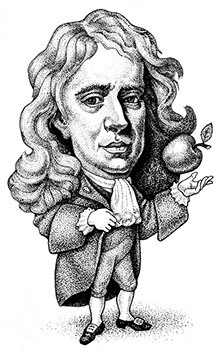
What does this picture represent

a)

Force,magnetism,acceleration

b)

Force, money, Apples

c)

Force, Mass, Acceleration

d)

Funny, monkeys, Arrive

15.

Which one of Newton's laws are displayed

a)

2nd law

b)

1st law

c)

3rd law

16.

This is Newton's 3rd law

a)

True

b)

False

17.

This is Newton's 2nd law

a)

True

b)

False

18.

An object in motion will stay in motion and an object at rest will stay at rest unless acted upon by an outside force. Which law does this describe

a)

2nd law

b)

1st law

c)

3rd law

19.

If there is a big mass, it would need a stronger force to accelerate it. Which law does this describe?

a)

3rd law

b)

1st law

c)

2nd law

20.

When there is a change in motion?

a)

When forces are balanced

b)

When the forces are unbalanced

c)

Whe forces are equal

d)

Never

21.
With unbalanced forces, the object will move in the direction that the _______ force is being applied.
a)
larger 
b)
smaller 
c)
equal 
d)
less
22.
Newton's third law states that any action will have a(n) _______ and ______ reaction
a)
Equal and similar
b)
Equal and opposite
c)
Equal and different
d)
Greater and opposite
23.
You hit a wall with a stick.  The equal but opposite reaction is _____
a)
the wall pushes against you
b)
the stick pushes against you
c)
you push against the stick
d)
the wall pushes against the stick
24.
What is Newton's First Law known as? The Law of
a)
Friction
b)
Mass
c)
Inertia
d)
Gravity
25.
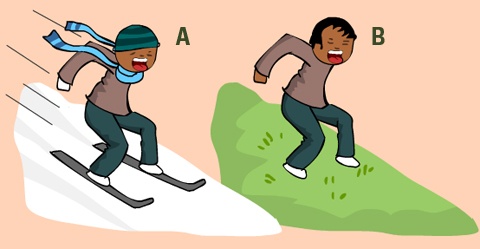
Why is it harder for the boy in Image B to get down the hill?
a)
Motion
b)
Friction
c)
Work
d)
Displacement
26.
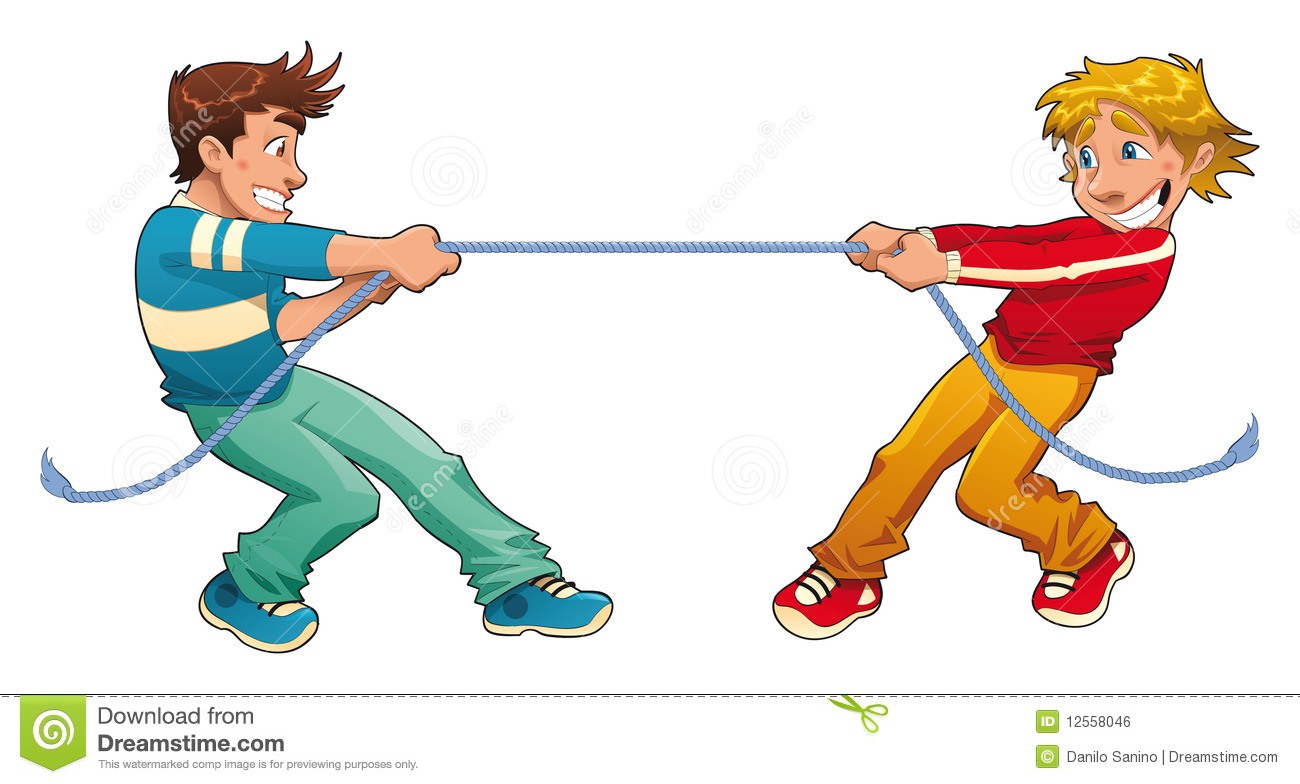
If these boys are pulling with the same amount of force.  What will happen?
a)
The boy in blue will win.
b)
They will not move at all.
c)
The boy in red will win.
d)
Both will fall down.
27.
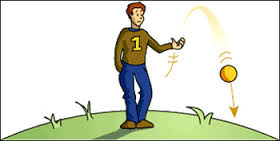
The formula 
? = mass x acceleration
or 
? = m x a 
is used to find 
a)
Force
b)
Velocity
c)
Momentum
d)
Gravity
28.
What is the attractive force that exists between all objects that have mass?
a)
Weight
b)
Mass 
c)
Gravity
d)
Viscosity
29.
If an object is stationary (not moving) the forces acting upon it are _____________
a)
unbalanced
b)
weak
c)
balanced
d)
Hulk Smash!
30.

When a student runs and kicks a ball, they have applied an ___________ force to move the ball.

a)

Balanced

b)

Magnetic

c)

Spring

d)

Unbalanced

31.
Wheels on a skateboard most likely experiences-
a)
Rolling Friction
b)
Sliding Friction
c)
Fluid Friction
d)
Static Friction
32.
Objects balanced on Timmy's head experiences-
a)
Rolling Friction
b)
Sliding Friction
c)
Fluid Friction
d)
Static Friction
33.
A Newton is a unit of...
a)
force
b)
inertia
c)
acceleration
d)
velocity
34.
This person bought coffee and put it on the seat next to them. If they stopped quickly and the coffee spilled which law would that represent?
a)
Newton's 1st Law
b)
Newton's 2nd Law
c)
Newton's 3rd Law
35.
What is the net force?
a)
400 N Up
b)
400 N Down
c)
- 400 N Down
d)
800 N Down
36.
What is the net force?
a)
65 N left
b)
65 N right
c)
35 N left
d)
35 N right
37.
What is the net force?
a)
5.5 N left
b)
5.5 N right
c)
2.5 N left
d)
2.5 N right
38.
An object with a mass of 2.0 kg accelerates 2.0 m/s2 when an unknown force is applied to it. What is the amount of the force?
a)
4 N
b)
0.4 N
c)
1 N
d)
0.1 N
39.
An object with a mass of 5.0 kg accelerates 8.0 m/s2 when an unknown force is applied to it. What is the amount of the force?
a)
40 N
b)
4 N
c)
10 N
d)
0.1 N
40.

An object accelerates 12 m/s2 when a force of 6.0 newtons is applied to it. What is the mass of the object?

a)

2 kg

b)

18 kg

c)

0.5 kg

d)

0.05 kg

41.

An object accelerates 5 m/s2 when a force of 20 newtons is applied to it. What is the mass of the object?

a)

4 kg

b)

20 kg

c)

0.5 kg

d)

2 kg

42.

An object with a mass of 2.0 kg has a force of 4.0 newtons applied to it. What is the resulting acceleration of the object?

a)

2 m/s2

b)

8 m/s2

c)

0.5 m/s2

d)

6 m/s2

43.

An object with a mass of 5 kg has a force of 20 newtons applied to it. What is the resulting acceleration of the object?

a)

2 m/s2

b)

8 m/s2

c)

4 m/s2

d)

6 m/s2

44.
If a 10 kilogram object accelerates suddenly at 15 m/s2, how much force was applied to the object? (watch for proper units on this answer!)
a)
150 Newtons
b)
15 Newtons
c)
150 kilograms
d)
100 kilograms
45.

According to Newton's second Law, which would take more force to slow down?

a)

The silver car

b)

The green car

c)

They would both take the same force

46.

Which of these best states Newton's Second Law?

a)

The greater the mass of an object the greater the force needed to change its motion.

b)

The greater the mass of an object the less force needed to change its motion.

c)

The mass of an object does not effect the force needed to change its motion

47.
Accelerations are produced by
a)
forces.
b)
 velocities.
c)
 accelerations.
d)
 masses.
48.
F=MA
An object of mass 10 kg is accelerated upward at 2 m/s2.  What force is required? 
a)
20 N
b)
2 N
c)
5 N
d)
0 N
49.
20 N is the
a)
mass
b)
weight
c)
force
d)
acceleration 
50.
45 m/s2 is the... 
a)
Mass
b)
Force 
c)
Acceleration
d)
weight
51.

Football A has a greater mass than football B. Which football will have greater acceleration when both are thrown with the same force in the same direction?

a)

Football A

b)

Football B

c)

They will have the same acceleration

d)

Mass has no effect on acceleration

52.
How much force is needed to accelerate a 2 kg physics book to an acceleration of 6 m/s/s?
a)
36 N
b)
12 N
c)
3 N
d)
0.33 N
53.

Forces can change an object's motion by changing its ------, its direction, or both.

a)

speed

b)

velocity

c)

gravity

d)

net force

54.

The pull of the earth is known as

a)

force

b)

mass

c)

speed

d)

gravity

55.
Newton's second law of motion describes acceleration as force divided by __________.
a)
mass
b)
inertia
c)
speed
d)
direction
56.
According to Newton's second law, if you increase the force applied to an object :
a)
it accelerates more
b)
it doesn't move
c)
you get more inertia
d)
it decelerates
57.
What is Newtons 2nd law of motion?
a)
Pancakes 
b)
Force= Mass multiplied by acceleration
c)
For every action there is a equal and opposite  re-action.
d)
Law of gravity