wayground logo

Free Printable Worksheets

NEW

Font size

S
M
L
XL
Worksheets

8th Grade Science semester 1 Study Guide

Total questions: 75

Worksheet time: 47mins

Name
Class
Date
1.
1.If a fire erupts, immediately
a)
notify the teacher.
b)
run for the fire extinguisher.
c)
throw water on the fire.
d)
open the windows.
2.
Approved eye protection devices (such asgoggles) are worn in the laboratory
a)
to avoid eye strain.
b)
to improve your vision.
c)
only if you do not have corrective glasses.
d)
any time chemicals, heat, or glassware areused.
3.
If you do not understand a direction or partof a laboratory procedure, you should
a)
figure it out as you do the lab.
b)
try several methods until something works.
c)
ask the teacher before proceeding.
d)
skip it and go on to the next part.
4.

After completing an experiment, all chemical wastes should be

a)
left at your lab station for the next class.
b)
disposed of according to your teacher’sdirections.
c)
dumped in the sink.
d)
taken home.
5.
You have been injured in the laboratory (cut,burned, etc.). First you should
a)
visit the school nurse after class.
b)
see a doctor after school.
c)
tell the teacher at once.
d)
apply first aid yourself.
6.
Long hair in the laboratory must be
a)
cut short.
b)
held away from the experiment with one hand.
c)
always neatly groomed.
d)
tied back or kept entirely out of the waywith a hair band, etc.
7.
Which of the following should NOT be worn during a laboratory activity?
a)
loose clothing
b)
dangling jewelry
c)
sandals
d)
All of the above.
8.
Horseplay, practical jokes, or pranks in the classroom are
a)
always against the rules.
b)
okay.
c)
not dangerous.
d)
okay if you are working alone.
9.
If a piece of equipment is not working properly, stop, turn it off, and tell
a)
the principal.
b)
your lab partner.
c)
your best friend in the class.
d)
the teacher.
10.

When you finish working with chemicals, biological specimens, and other lab substances, always

a)
treat your hands with skin lotion.
b)
wash your hands thoroughly with soapand water.
c)
wipe your hands on a towel.
d)
wipe your hands on your clothes.
11.
The following activity is permitted in the laboratory
a)
chewing gum
b)
eating
c)
drinking
d)
None of the above.
12.
When using a razor blade or scalpel, always cut material
a)
away from you.
b)
toward you.
c)
in your hand.
d)
perpendicular.
13.
All chemicals in the lab (including foodstuffs and store-bought chemicals)should be treated as if they could be hazardous.
a)
True
b)
False
14.
Work areas should be kept clean and tidy.
a)
True
b)
False
15.
Never remove chemicals, specimens, or other equipment from the laboratory.
a)
True
b)
False
16.
Always carry a microscope using both hands.
a)
True
b)
False
17.
Read all procedures thoroughly before performing a laboratory investigation.
a)
True
b)
False
18.
All unauthorized experiments are prohibited.
a)
True
b)
False
19.
It is okay to pick up broken glass with your bare hands as long as the glass is placed in the trash can.
a)
True
b)
False
20.
Do not leave a lit burner unattended.
a)
True
b)
False
21.

This is an "if...., then....." statement.

a)

hypothesis

b)

procedures

c)

testable question

d)

conclusion

22.
Steps you follow to conduct an experiment
a)
conclusion
b)
procedures
c)
experiment
d)
data
23.
The factor in an experiment that is changed.
a)
independent variable
b)
dependent variable
c)
conclusion
d)
observation
24.
The factor that depends on the independent variable. 
a)
conclusion
b)
dependent variable
c)
Bubbles
d)
independent variable
25.

Information and measurements collected during an experiment.

a)

controlled variable

b)

independent variable

c)

predictions

d)

data

26.
Breaking down data to find patterns or answers to the testable question. 
a)
graphs
b)
hypothesis
c)
analyze data
d)
testable question
27.

The results of an experiment.

a)

conclusion

b)

observation

c)

prediction

d)

hypothesis

28.
The setup to which all other setups are compared (nothing is changed)
a)
variable
b)
classify
c)
experiment
d)
control
29.
numbers, values, and observations
a)
inference
b)
order
c)
analysis
d)
data
30.
an investigation used to test a hypothesis in which all the conditions are controlled
a)
experiment
b)
control
c)
investigation
d)
Scientific method
31.
any information collected with the senses
a)
variable
b)
observation
c)
Scientific Method
d)
classify
32.
ways that scientists perform investigations.  It uses logic and reasoning.
a)
Scientific Method
b)
science
c)
experiment
d)
hypothesis
33.
any factor or condition in an experiment that can be changed
a)
variable
b)
control
c)
classify
d)
conclusion
34.

This is the variable that is manipulated or changed by the scientist.

a)

Constant Variable

b)

Independent Variable

c)

Dependent Variable

d)

Control Group

35.

This is the factor in an experiment that is allowed to change on its own in response to the independent variable.

a)

Constant Variable

b)

Independent Variable

c)

Dependent Variable

d)

Control Group

36.

What is the electron configuration of oxygen?

a)

1s2 2s2 2p3

b)

1s2 2s2 2p6

c)

1s2 2s2 2p4

d)

1s2 2s2 2p2

37.

What is the electron configuration of sodium?

a)

1s2 2s2 2p6 3s2 3p6

b)

1s2 2s2 2p6 3s2 3p1

c)

1s2 2s2 2p6 3s2

d)

1s2 2s2 2p6 3s1

38.

What is the electron configuration of chlorine?

a)

1s2 2s2 2p6 3s2 3p4

b)

1s2 2s2 2p6 3s2 3p6

c)

1s2 2s2 2p6 3s2 3p5

d)

1s2 2s2 2p6 3s2 3p3

39.

Which two subatomic particles are found in the nucleus of an atom?

a)

Neutrons and Protons

b)

Shells and Electrons

c)

Electrons and Protons

d)

Electrons and Neutrons

40.

Which subatomic part of an atom gives it a positive charge?

a)

Neutron

b)

Proton

c)

Electron

d)

Nucleus

41.

What is the smallest 'building block' of the elements that make up the universe?

a)

An atom

b)

An electron

c)

A proton

d)

A cell

42.

An atom of carbon has 6 protons and 7 neutrons in its nucleus. If the atom is neutral, how many electrons does it have?

a)

0

b)

7

c)

6

d)

13

43.

In the periodic table of elements, the periods are shown

a)

horizontally

b)

vertically

c)

diagonally

d)

upside down

44.

Some molecules are compounds, but not ALL molecules are compounds.

a)

True

b)

False

45.

H2O

a)

is a compound but not a molecule

b)

is only a molecule and not a compound

c)

is a compound and also a molecule

d)

is neither a compound or molecule

46.

O2 Gas

a)

is a compound

b)

is not a molecule

c)

is a solid

d)

is an example of a molecule, but not a compound

47.

Which unit is used to measure mass in the metric system?

a)

Pound

b)

Slug

c)

Ounce

d)

Gram

48.

Based on the image, what is the mass of the object being measured?

a)

500.10 grams

b)

501.00 grams

c)

510.00 grams

d)

600 grams

49.

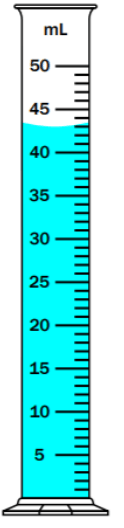
How much volume is in the graduated cylinder?

a)

40.3 mL

b)

43 mL

c)

20 mL

d)

100 mL

50.

50 ml of water was added to the graduated cylinder. After we drop in the object, the new water level goes up to 60 ml. What is the volume of the blocks?

a)

8 ml

b)

10 ml

c)

60 ml

d)

5 ml

51.

Chemical Reaction

a)

a substance formed as a result of a chemical reaction

b)

a change in matter that produces one or more new substances

c)

the process in which substances undergo chemical changes that result in the formation of new substances

d)

a substance that enters into a chemical reaction

52.

Chemical Equation

a)

A representation of a chemical reaction

b)

the starting materials in a chemical reaction

c)

the new substances that are formed in a chemical reaction

d)

tells how many atoms, molecules, or formula units take part in a reaction

53.

The Law of Conservation of Matter

a)

tells how many atoms of an element are contained in one molecule or formula unit.

b)

the starting materials in a chemical reaction

c)

the new substances that are formed in a chemical reaction

d)

A law stating that atoms are not created or destroyed during a chemical reaction.

54.

Is the equation balanced?: 2H2O + O2 --> 4MgO + 3Fe

a)

yes

b)

no

55.

Balance this equation

_Al +_HCl --> _H2 +_AlCl3

a)

2,6,3,2

b)

it's already balanced

c)

4,12,3,4

d)

2,1,4,5

56.

The coefficient in 3H2O is

a)

6

b)

5

c)

2

d)

3

57.
How many atoms of carbon (C) are in C6H12O6?
a)
3
b)
6
c)
12
d)
24
58.
How many Hydrogen are in 4H2O?
a)
6
b)
8
c)
2
d)
4
59.
Explain what happens when a strong acid and a strong base are poured into the same container.
a)
they form separate layers
b)
they mix physically but not chemically
c)
they break apart into separate elements
d)
they react chemically to form a salt
60.
When dissolved in water, bases produce:
a)
acids
b)
salts
c)
hydrogen ions
d)
hydroxide ions
61.
Which of these solutions is an acid?
a)
Dish Soap: pH of 12
b)
Tomato Soup: pH of 4
c)
Baking Soda: pH of 9
d)
Drain Cleaner: pH of 14
62.
The pH of vinegar is 2.5.  Vinegar is a _____________.
a)
strong acid
b)
strong base
c)
weak base
d)
weak acid
63.
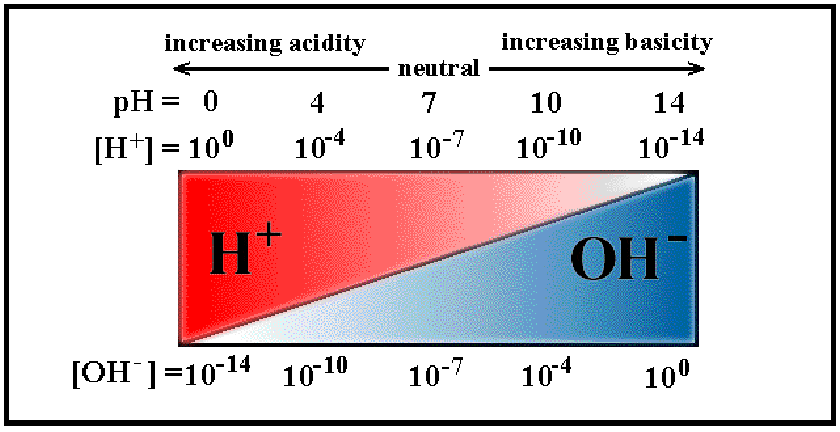
What is the pH of water?
a)
0
b)
4
c)
7
d)
14
64.

Human blood has a pH between 7.35 and 7.45. Which of the following best describes human blood?

a)

strongly acidic

b)

slightly acidic

c)

strongly basic

d)

slightly basic

65.

Many cleaning solutions are bases. Which of the following is a property of most bases?

a)

feels slippery

b)

white color

c)

can only be liquid

d)

tastes sour

66.

A pH level of 7 indicates

a)

acid

b)

base

c)

neutral

d)

non of the following

67.

The pH scale is a range from:

a)

1-7

b)

1-5

c)

0-14

d)

1-14

68.

Which property is not associated with acids?

a)

Sour taste

b)

strong acids can burn you

c)

turns litmus paper blue

d)

reacts with metals

69.

You test a solution with pH paper, and the paper turns blue. The solution is ______.

a)

neutral

b)

an acid

c)

a base

d)

an acid & a base

70.
Tastes Sour
a)
Acids
b)
Bases
c)
Salts
d)
All
71.

True or false: bases are sometimes called alkaline.

a)

True

b)

False

72.

True or false: a neutral solution has equal amounts of H+ and OH-.

a)

True

b)

False

73.

Is the following compound an acid or a base?


HCl

a)

Acid

b)

Base

74.

Which of the following is the strongest acid?

a)

oven cleaner - 13.5

b)

lemon juice - 2.5

c)

soap - 10

d)

blood - 7.4

75.

Which of the following is the strongest base?

a)

soap - 10

b)

HCL - 0

c)

blood - 7.45

d)

soft drink - 3