
 Worksheets
Ecosystem dynamic
Total questions: 20
Worksheet time: 28mins
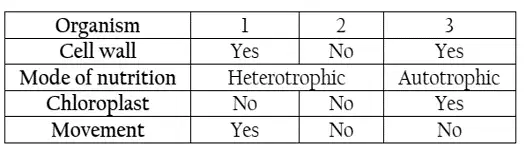
In the chart, the characteristics of three organisms belonging to the protist and fungi kingdoms are summarized. Considering the information, which of the following statements is CORRECT?
Organism 1 is a fungus, organism 2 is an alga and individual 3 is a protozoan.
Organism 1 is a protozoan, individual 2 is a fungus and individual 3 is an alga.
Organism 1 is a fungus, individual 2 is a protozoan, and individual 3 is an alga.
Organisms 1 and 2 are fungi and individual three is a protist.
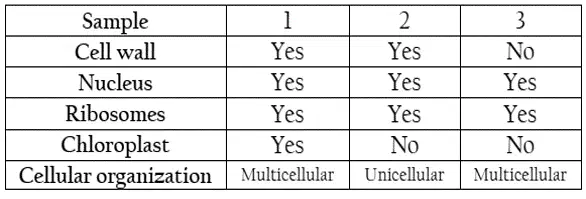
In a lab practice, eleventh-grade students observed organism samples and organized their observations in the data table shown below. According to the chart, which of the following options relates correctly the kingdoms to the organisms to which each sample belongs?
1 Fungi
2 Protist
3 Animalia
1 Protist
2 Fungi
3 Plantae
1 Plantae
2 Protist
3 Animalia
1 Fungi
2 Plantae
3 Protist
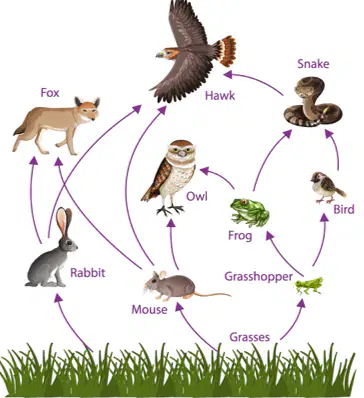
Which of the following statements about the food web shown in the picture is TRUE?
When the owl feeds on the mouse it acts as a secondary consumer and when it feeds on frogs it acts as a tertiary consumer.
When the owl feeds on the mouse it acts as a primary consumer and when it feeds on frogs it acts as a tertiary consumer.
When the fox feeds on rabbits it acts as a secondary consumer and when it feeds on the mouse it acts as a tertiary consumer.
When the snake feeds on birds it acts as a secondary consumer and when it feeds on frogs it acts as a tertiary consumer.
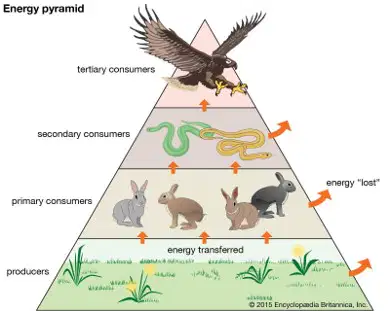
Energy flows through the trophic levels of ecosystems. As the level increases, the amount of energy available for the next level decreases. This occurs because:
photosynthesis produces chemical energy.
part of the energy is released as heat.
decomposers need energy
part of the energy is stored in tissues.
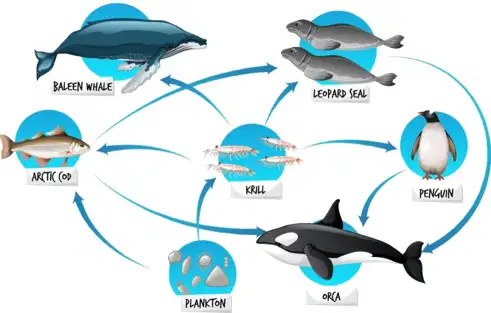
How would the ecological balance of the ecosystem be affected if the leopard seals disappeared?
The plankton population would decrease.
The penguin population would decrease.
The arctic cod and krill population would increase.
The baleen whale would disappear.
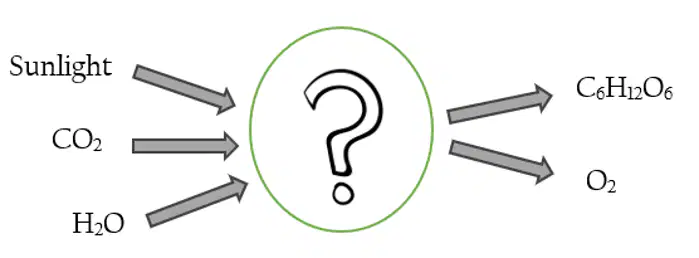
Each cell is equipped with a series of organelles that allow it to produce the substances it needs for its vital processes. Which process is shown and in which organelle is it involved?
Osmosis, cell membrane.
photosynthesis, chloroplast.
cellular respiration, mitochondria.
phagocytosis, cell membrane.
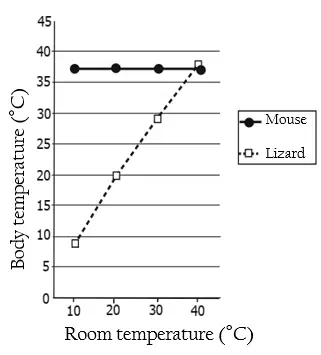
A student observes on the graph the relationship between room temperature and body temperature in two species. The conclusion made by the student is:
the mouse regulates its body temperature.
the lizard keeps its body temperature constant.
the body temperature of the two species depends on the room temperature.
high room temperature causes high body temperature in both species.

Based on the diagram, which group of organisms would be considered herbivores?
Snakes
Mice
Grasshoppers
Grasses
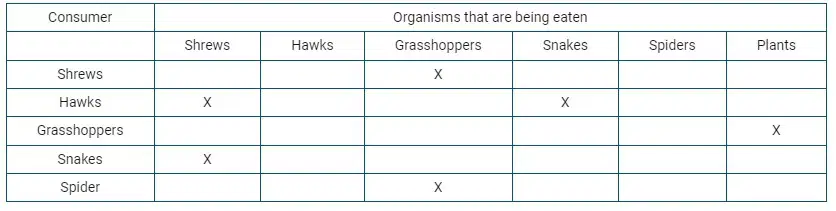
The questions are based on the following table of organisms in an ecological community. The X in a cell indicates that the organism is eaten by the consumer in the first column.
Based on the data in the table, which of the following pairs of organisms has two ecological relationships, both competition and predation?
Spiders and shrews
Hawks and snakes
Spiders and snakes
Spiders and grasshoppers
The questions are based on the following table of organisms in an ecological community. The X in a cell indicates that the organism is eaten by the consumer in the first column.
Which of the following categories of organisms, which are required for the cycling of matter in an ecosystem, is missing from the table?
Producers
Primary consumers
Secondary consumers
Decomposers
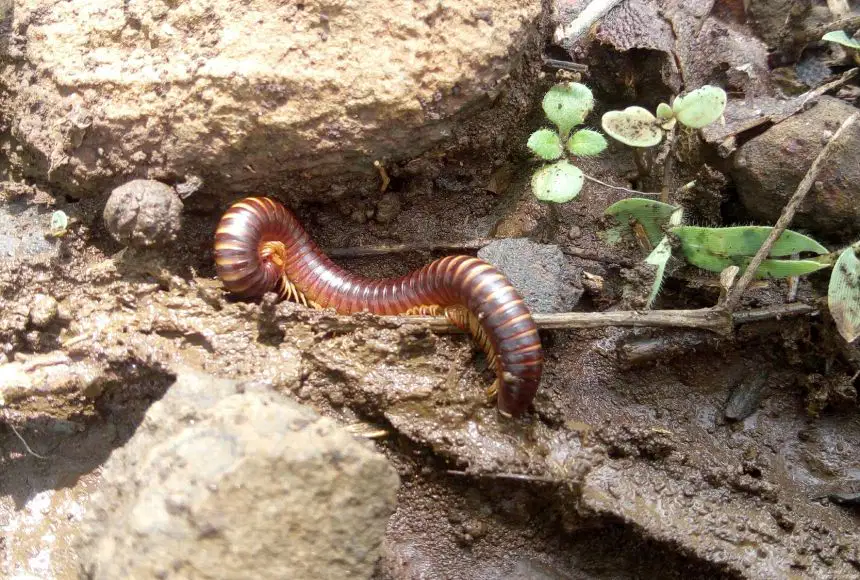
Which of the following best explains why decomposers in soils and water are important to ecosystems?
They remove heavy metals.
They store carbon dioxide.
They recycle nutrients.
They produce more oxygen than they consume.

The graph shows the relative solar energy received at local noon each day of the year at two different locations.
Assuming all other variables are constant, which of the following is the most likely conclusion about the greatest potential for gross primary productivity that can be supported by data in the graph?
Gross primary productivity is the same for both locations all year.
Gross primary productivity in Location 2 is greater than that in Location 1 in December.
Gross primary productivity in Location 1 is greater than that in Location 2 in March.
Gross primary productivity in Location 2 is greater than that in Location 1 in September.
Which of the following best describes the movement of energy in an ecosystem?
Energy is constantly recycled by decomposers for use by producers.
Energy is harnessed by producers, and available energy decreases with each trophic level transfer.
Energy is absorbed by plants through water and soil and then moves up the food chain through consumers.
Energy is magnified as it moves up the trophic levels, and tertiary consumers store the most energy in a food web.
For a primary producer, the main function of photosynthesis is to manufacture
oxygen
carbon dioxide
glucose
proteins

The feeding relationships between several marine organisms are shown in the food web below.
Based on the diagram, which of the following best describes the most likely direct effect of a decline of the small fish population on the marine food web?
The jellyfish population will experience local extinction because of a lack of food resources.
The jellyfish population will increase because of decreased predation.
The jellyfish population will migrate to an area with more available habitat for eggs.
The jellyfish population will decrease from the increase in the sea turtle and tuna populations.
Which of the following best explains why terrestrial trophic pyramids usually do not have levels higher than tertiary consumers?
Tertiary consumers are the largest organisms in an ecosystem and require the most space to survive.
Plants can only perform photosynthesis during the day, so tertiary consumers cannot get enough energy from consuming plants.
A large proportion of energy is lost as heat as it is transferred up the pyramid, so there is not enough energy available to support another level.
Tertiary consumers are often indicator species and are the first to be affected by environmental disturbances.

From the following food web, the trophic level of the Brittlebrush is a
(a)
From the following food web, the trophic level of the Antelope squirrel is a
(a)
From the following food web, the trophic level of the Mantis is a
(a)
From the following food web, the trophic level of the Red-tailed hawk is a
(a)

