
 Worksheets
Ecosystems Review
Total questions: 65
Worksheet time: 29mins
the sun


The primary consumer is the

Which of these is the tertiary consumer?
snake


According to the 10% rule
10% of the energy is passed from one level to the next. The rest is "lost" as heat.
10% of organisms in each trophic level get eaten.
10% of organisms eat other organisms.
10% of the energy is "lost" at each trophic level.
If there are 100,000 kcal available to the plants in an ecosystem, how much energy will be available to the herbivores?
1,000,000 kcal
100 kcal
10,000 kcal
1,000 kcal
This type of organism recycles nutrients back into the habitat.
carnivores
symbiotes
decomposers
autotrophs
Symbiotic relationship where one benefits and one is unaffected.
parasitism
predation
mutualism
commensalism
A symbiotic relationship where one benefits and the other is harmed.
commensalism
parasitism
mutualism
competition
Marlin and Nemo live in a sea anemone. Clownfish receive shelter and the anemone receives protection and nutrients. What type of symbiotic relationship does this represent?
mutualism
predation
commensalism
parasitism
A pearlfish lives in a sea cucumber. The sea cucumber is not affected by this interaction. This represents:
mutualism
competition
parasitism
commensalism
Which of the following is a primary consumer in an ecosystem?
lion
grass
rabbit
eagle
What is the main source of energy for producers in an ecosystem?
water
soil
sunlight
air
Which of the following is an example of a decomposer?
mushroom
grasshopper
frog
eagle
Which of these best demonstrates mutualism between certain types of bacteria and humans?
Intestinal bacteria obtain nutrients from the gut and produce vitamin K used by humans.
Bacteria become resistant to antibacterial medication that humans use for treatment.
Invasive bacteria at an area of injury produce toxins that damage healthy tissue of the human body.
Bacteria in improperly prepared food is consumed by humans, causing food poisoning.
The amount of energy the producers provide to the primary consumer is 54,000 J. How much energy was provided to secondary consumers?
53,460 J
5,400 J
540 J
54 J

Which organisms are both secondary and tertiary consumers in this food web?
Chemosynthetic bacteria and amphipods
Zooplankton and mussels
Ratfish and octopuses
Galatheid crabs and zoarcid fish
Which would be the most likely effect of a wildfire that burned a large area of a forest?
More sugars and starches would be available for animals in the area.
The availability of fossil fuels for use by industries in the area would be reduced.
Less carbon dioxide would be removed from the atmosphere in the area by plants.
An increase in animal respiration would increase the release of carbon dioxide in the area.
How does the human body return carbon to the atmosphere in the carbon cycle?
Waste products
Photosynthesis
Cellular respiration
Formation of glucose
If a forest fire occurs, what will happen to the carbon in the forest?
It will go into the soil
It will go into the atmosphere
It will runoff into nearby streams and rivers
It will be destroyed
What kind of organism takes out the most carbon from the atmosphere?
Plants
Bacteria
Animals
Humans
the variety of life in the world or in a particular habitat or ecosystem
biodiversity
demography
carrying capacity
poaching
Why are bees considered a keystone species?
The honey they make supports the bear population
They pollinate flowers that produce fruit which supports the ecosystem
They sting when threatened
They live in hives

Is water a biotic or abiotic factor?
biotic
abiotic
Biotic factors are ___________.
non-living parts of an ecosystem
living parts of an ecosystem
things that once were alive, but now are dead
not important parts of ecosystems.
What does the word root 'bio-' mean?
living
dead
science
study
all the populations of different species that live in a given area
organism
community
biosphere
molecule
a group of organisms of the same species that live in the same area at the same time
organism
population
community
atom
A relationship where one organism eats another is called
competition
commensalism
mutualism
predation
A relationship were one organism uses another to survive; often harming it in the process
parasitism
mutualism
commensalism
competition
A relationship where two organisms want the same resource
commensalism
competition
mutualism
predation

What happens to the population of a species after it reaches its carrying capacity?
Increases linearly (in a straight line) over time.
Increases exponentially (line is curved) over time.
Decreases to zero in a very short amount of time.
Remains relatively the same.
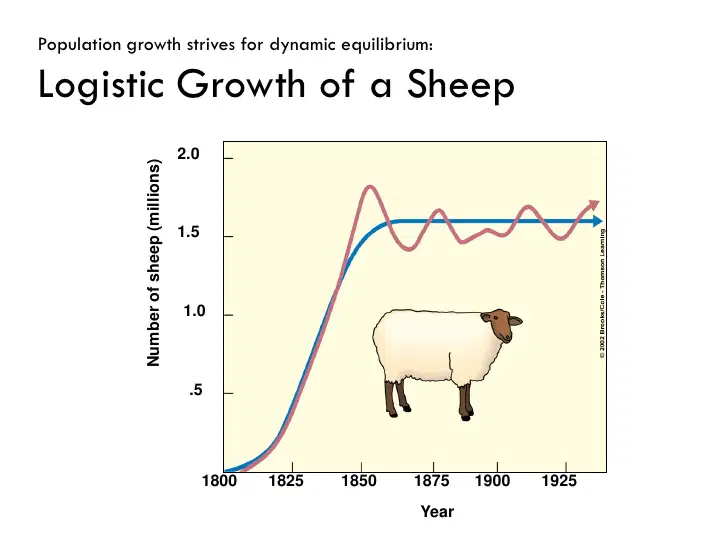
What is the carrying capacity for this sheep population?
1.8 million
1.25 million
1.6 million
1.0 million


A small island nation is tracking its total population. It started with exactly 100 people. During the year, 10 people immigrated, while 20 emigrated. The birth rate was 15, and the death rate was 5. What is the new population of the country?
115
110
90
100
What is a density-dependent factor?


Where on the graph has the population reached its carrying capacity?
A to B
B to C
A to C
Things that prevent a population from growing exponentially.
Population
Carrying Capacity
Limiting Factors
An organism that produces its own energy is called a(n)
Autotroph
Heterotroph
Detritivore
Omnivore

If there is 3500 Kcal available in trophic level 1, how much energy is available in trophic level 2?
35000 Kcal
35 Kcal
350 Kcal
0.35 Kcal

In the energy pyramid here, how much of the energy in each level gets lost as heat or used by the organism for survival?
What is an example of a density-independent limiting factor?
food
parasites
disease
pollution



