
 Worksheets
Light and Vision
Total questions: 125
Worksheet time: 2hrs 18mins
What does reflection mean?


The angle of incidence is _________ the angle of reflection


Why is the component of colour in a rainbow can be seen when light passes through a glass prism?
phenomena of scattering of light
phenomena of dispersion of light
phenomena of reflection of light
phenomena of diffraction of light
This is the example of dispersion of light
sky looks bright orange in the evening
shadow
Pool seems shallower
rainbow
Which of the following is NOT a source of light?
eyes
lit candle
sun
firefly
We are able to see the moon because it ____________
gives out light
glows
reflects light from the sun
reflects light from the earth
Light is able to pass through __________________ materials
transparent
shiny
dull
opaque
Light is unable to pass through ________________ objects
opaque
coloured
blunt
dark


Which lens represents the path light takes through a concave lens?


The angle of incidence is _________ the angle of reflection

Which type of wave does light travel in?
Ocean wave
Compression wave
Transverse waves
Radio wave

In the diagram, which letter represents the angle of incidence?
A
B
C
D


Name structure A
Pupil
Iris
Cornea
Retina

Name Structure B
Lens
Pupil
Sclera
Cornea

Name structure G
Lens
Pupil
Optic Nerve
Ciliary Muscles

What structure is responsible for carrying sensory impulses from the eye to the brain?
Retina
Iris
Optic Nerve
Rods & Cones

What will happen to your pupils if you are in a really bright room?
They will contract
They will expand
They will burst into flames
They will stay the same size

What structure of the eye controls the size of the pupils?
Ciliary Muscles
Iris
Lens
Retina

What is the function of the Lens?
Lining of the back of the eye that contains light receptor cells.
Regulates how much light enters the eye
Tough, transparent, protective coating that bends light as it enters the eye
Focuses light onto the retina

Name structure C
Ciliary Muscles
Retina
Optic Nerve
Iris

Name structure F
Sclera
Cornea
Optic Nerve
Lens

Which type of animals are likely to have binocular vision?
Insects
Prey
Predators
Mammals

What happens to your eyes if you are in a dark room?
Your Iris will narrow to allow more light in
Your pupils will widen to let in more light
Your pupils will narrow to let in more light

A study was carried out to investigate colour deficiency in different ethnicity groups. 500 boys across different ethnicities were tested for colour blindness. The results are shown. How many Caucasian boys were colour blind?
96
56
28
32

A study was carried out to investigate colour deficiency in different ethnicity groups. 500 boys across different ethnicities were tested for colour blindness. The results are shown. How many Hispanic boys were colour blind?
13
16
19
12

An investigation was carried out to determine if two eyes are better than one. A pupil was blindfolded and had to thrown a bean bag to hit a target. Out of 20 throws, he successfully hit 9 of them. What is this as a percentage?
49%
23%
40%
45%

An investigation was carried out to determine if two eyes are better than one. A pupil was blindfolded and had to thrown a bean bag to hit a target. On his first attempt, he managed to hit the target 10 times. On the second attempt he hit it 14 times. What is the percentage change in successful attempts?
50%
40%
45%
35%

Identify structure D
Retina
Optic Nerve
Sclera
Lens

Identify Structure E
Retina
Sclera
Optic Nerve
Lens

Which statement is true for refraction of light? Choose 2 answers.
When it enters a denser medium (e.g. from air to glass), it changes direction towards the normal.
When it enters a denser medium (e.g. from air to glass), it changes direction away from the normal.
When it enters a less dense medium (e.g. from glass to air), it changes direction towards the normal.
When it enters a less dense medium (e.g. from glass to air), it changes direction away from the normal.
The angle of incidence is _________ the angle of reflection

Image
Reflection
Shadow
Colour
Which of the following does not have light of its own?
a torch
a lamp
the moon
the sun
Opaque is?
Material that allows light to pass through
Light made by nature
Material that allows no light to pass through

Why does the cat form a shadow?
It reflects light
It blocks light
How does the light enter the pinhole camera?
through a lens
through a mirror
through a small hole
through a prism
When the light hit an opaque object, what happens to it?
it is scattered in all directions
some of it is absorbed, some of it is transmitted
All of it is absorbed
All of it is reflected
When an angle of incidence is increased, what happens to the angle of reflection?
it increases
it decreases
it stays the same
it becomes more diffuse
When white light strikes a blue object, which color(s) is/are absorbed?
None of the colors are absorbed but blue
Some of the red
Mostly the green
all colors are absorbed but blue


Light travels... (select 2 answers)
Around corners
In straight lines
Faster in glass than in air
Faster than sound
The speed of light is.....
300,000,000m/s
340m/s
1500m/s
5000m/s
The speed of sound in air is.....
1500m/s
340m/s
5000m/s
300,000,000m/s
In the diagram, which letter represents the angle of incidence?
A
B
C
D
Nothing can travel faster than light in the whole universe
False
True

What is happening to the light ray at the surface of the water to mean the fish appears higher up than it is?
The light ray is reflecting
The light ray is refracting
The light ray is scattering
The light ray is absorbed
If I shine white light at a red filter, what will I see the other side of the filter?
White light
No light
Red light
Yellow light
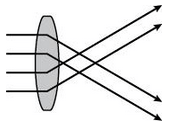
Which figure represents the path light takes through a converging lens?
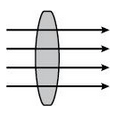
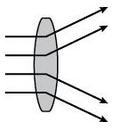
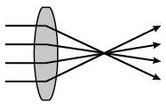
What does "refraction" mean?
The change of direction of a light ray
The increase of mass in an object
The increase of temprature
The way a luminous object reflects light
What is are the 2 different types of reflection?
Reflected Ray / Rough Surface
Specular Scattering
Specular Reflection / Diffuse Scattering
Rough Transprent / Diffuse Surface
What are the 2 different types of lenses?
Convex / Converge
Coverage / Conrage
Croex / Contage
PLANE MIRROR
SPECULAR
DIFFUSE
WAVY SEA
SPECULAR
DIFFUSE
SNOW
SPECULAR
DIFFUSE
GLARE ON PAIR OF EYEGLASSES
SPECULAR
DIFFUSE
The ray of light leaving the mirror
The ray of light approaching the mirror/the ray given off from a light source

The picture shows which type of reflection?
Specular Reflection
Optical Reflection
Diffuse Reflection
Scatter Reflection

The angle between the incident ray and the normal. (X on the diagram) is called the:
Angle of Optic Sight
Angle of Reflection
Angle of Incidence
Angle of Normal

The angle between the reflected ray and the normal (labelled Y on the diagram) is called the:
Angle of Incidence
Angle of Reflection
Angle of Normal
Angle of Optic Sight

An imaginary line that is drawn at a right angle (90 degrees) to a mirror (Green line) is called the:
Reflected Ray
Normal
Incident Ray
Perpendicular Ray

When light reflects off of a completely smooth surface it is called:
Diffuse Reflection
Optical Reflection
Smooth Reflection
Specular Reflection

If the angle of incidence in the diagram is 80°, the angle of reflection will be:
10°
100°
90°
80°
Opaque
Materials light cannot pass through
Lens
Piece of glass that focuses light
Specular
Reflection from a smooth surface
Luminous
Something that gives out light
Normal
Imaginary lines at right angles to a surface
what are primary colors
red
purple
yellow
blue


This polar bear is happy because someone gave him a pumpkin to play with. But, this polar bear is sad because it looks like his head is no longer attached to his body. :( What property of light creates this optical illusion?
Refraction
Reflection
Transparency
Opaqueness

Reorder the sentences to show the process of how the eye enables us to see objects.
Light enters the eye through the pupil
The size of the pupil is altered by the iris
The cornea and lens, focus light onto the retina
The retina contains two light sensitive cells called rods and cones. When light hits these cells, chemical reactions produce electrical impulses that travel via the optic nerve to the brain
Label the different part of the eye

