
 Worksheets
G8 Force and Energy basics
Total questions: 120
Worksheet time: 3600secs
When forces on an object are balanced, what is the net force?
0
5
10
21


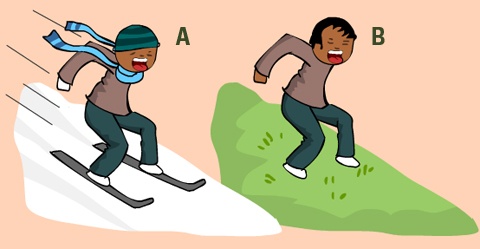
Friction is a
(a) non-contact force
(b) contact force
(c) magnetic force
(d) electrostatic force
Friction can be reduced by using
(a) oil
(b) grease
(c) powder
(d) all of these
The force that pushes a plane forward
lift
thrust
weight
drag
The force that pushes a plane upward
lift
thrust
weight
drag
What causes an object to fall faster?
Smaller surface area
Larger surface area
If it has a parachute
If it is softer

The more streamlined an object is, the...
More air resistance
Less air resistance
Slower air resistance
Faster air resistance
When a falling object stops accelerating and falls at a constant speed, it is
fluency
constant velocity
acceleration
terminal velocity
What is a parachute designed to maximize?
Gravity
Air Pressure
Air Resistance
Thrust
When dropped from the same distance, which will fall to the floor faster?


Once object reach their_____ they permanently deform.
breaking point
deformation point
damage point
elastic limit
How do you know if an object is elastic?
If it springs back to its original shape.
If it increases its length.
If it is squishy.
If it is flexible.
Which is an elastic object?
bread
paper
a basketball
a shoe
What is extension?
The extent to which an object can be stretched without permanently altering its size or shape.
A measure of how stiff or strong a spring is.
The increase in the length of something.
When an object springs back to its original shape.
What happens if you apply a small force to a spring ?
It will stretch only a small amount.
It will stretch more.
Springs don't stretch.
What is a spring?
How can we know the elastic limit?
if the object is stretched too much and does not return to its original shape.
If the object is stretched too much and returns to its original shape.
buoyant force/upthrust


If the weight of an object is equal or less than the upthrust acting on it then the object would
balance
equal
float
sink
If the weight of an object is greater than the upthrust acting on it then the object would
balance
equal
float
sink
The object will sink if its weight is
greater than upthrust on it
less than upthrust acting on it
equal to upthrust acting on it
all of above

Which line is the best line of best fit?
a
b
c
i don't see any lines
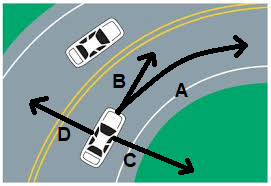
A car is rounding a bend as shown in the diagram. Which arrow correctly shows the direction of the cars velocity?
A
B
C
D
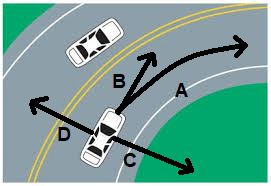
A car is rounding a curve as shown in the diagram. Which arrow correctly shows the direction of the centripetal force keeping the car in circular motion?
A
B
C
D
What are the units for force, F
Newtons, N
Joules, J
Watts, W
kilograms, kg
What are the units for mass, m
Joules, J
Newtons, N
kilograms, kg
seconds, s
What are the units for velocity, v
m/s
m/s2
kg
s
What are the units of Potential Energy, PE
Newtons, N
Joules, J
Watts, W
kilograms, kg
Energy stored in an object's height
Chemical
Mechanical
Nuclear
Gravitational
Mechanical

Select the answers that are a type of potential energy
elastic energy
chemical energy
gravitational energy
light energy

A battery has what kind of energy?
Chemical
Potential
Light
Heat

Energy transfer occurs when
an object transfers its energy to another
an object transforms into another object
light energy is transferred to chemical energy
electrical energy passes through a cable

A rolling ball will always come to a stop, why?
friction slows everything down, transforming kinetic energy to heat
the ball stops because it runs out of energy
the ball stops because you stopped rolling it
the ball has destroyed its energy and stops moving

In the skate park simulation, placing the skater higher up had what effect on gravitational potential energy?
increased gravitational potential energy
decreased gravitational potential energy
it had no effect on the gravitational potential energy
the skater had gravitational energy
The Law of Conservation of Energy states that:
energy can be created and destroyed
energy cannot created but it can be destroyed
energy cannot be created or destroyed, it transfers and transforms
energy is everywhere

Select the right answer that describes energy transformation in a torch (> symbol means transformation)
chemical > electrical > light
potential > heat energy
chemical > sound > heat
kinetic > chemical > electrical
A roller coaster going down a hill is seeing a drop in ________ energy and a gain in _________ energy.
Mechanical / Thermal
Kinetic / Potential
Potential / Kinetic
Electrical / Sound

Which two points on the Newton's Cradle Demonstrate the most potential energy?
1 and 3
2 and 4
1 and 5
3 and 5

Which point on the Newton's Cradle demonstrates the most kinetic energy?
1
2
3
4
5

Which point on the Roller Coasters path does the cart have the least potential energy?
W
X
Y
Z

Which two points on the track have more potential energy than kinetic energy?
W
X
Y
Z
The chemical energy of a battery is converted to heat and light energy in a flashlight. Which of the following best explains the CONSERVATION of energy
The switch of the flashlight allows energy to flow
the heat and light energy are equal to chemical energy
the wires carry electrical energy from the battery to the bulb
after hours of use, the batteries will lose their energy
When water turns a turbine connected to a generator, electricity is produced. This electricity lights homes and offices. Which of the following shows, in order, the energy transformations that occur?
Chemical ---> Mechanical ---> Electrical
Electrical ---> Light ---> Mechanical
Mechanical ---> Electrical ---> Light
Mechanical ---> Chemical ---> Light
Which of these examples best shows a change from potential to kinetic energy?
Water flowing over a tall cliff
A metal spring being stretched out
Electricity making a bulb light up
A stone lying on top of a mountain
Which one of them is not a fossil fuel?
Coal
Water
Gas
Oil
All of the following are uses of fossil fuels EXCEPT
to produce electrical energy
gasoline
to heat homes
windmills
What is a renewable energy resource?
an energy source that is replaced more slowly than they are used
an energy source that can never be replaced
an energy source that is replaced faster than they are used
a fossil fuel
All are advantages of using Geothermal energy EXCEPT
Nonrenewable resource
Renewable resource
almost endless source
little land needed
All are disadvantages of using Water energy EXCEPT
Nonrenewable resource
needs dams that hurt the ecosystem
needs rivers

How does the mass of a bowling ball that has been rolled down the lane affect the kinetic energy?
The kinetic energy does not depend on the mass of the bowling ball.
The kinetic energy is increasing proportional to the mass of the bowling ball.
The kinetic energy is decreasing proportional to the mass of the bowling ball.
The kinetic energy is increasing proportional to the square of the mass of the bowling ball.
According to the law of conservation of energy, the total amount of energy in the universe
remains constant
changes constantly
increases
decreases

What is the GPE at point A
14 J
12 J
6 J
8 J

What is the KE at point B?
14 J
12 J
6 J
8 J

What is the Total Energy of the system?
14 J
12 J
6 J
8 J

What is the Total Mechanical Energy at point A?
500,000 J
400,000 J
200,000 J
50,000 J
What is the Kinetic Energy at point B?
500,000 J
400,000 J
300,000 J
50,000 J
What is the Kinetic Energy at point C?
500,000 J
400,000 J
300,000 J
50,000 J
What is the GPE at point E?
500,000 J
250,000 J
300,000 J
100,000 J

What is the Total Energy at the top?
15,000 J
3,750 J
7,500 J
11,250 J
What is the KE 1/4th of the way down?
15,000 J
3,750 J
7,500 J
11,250 J
What is the KE 1/2 of the way down?
15,000 J
3,750 J
7,500 J
11,250 J
What is the KE 3/4th of the way down?
15,000 J
3,750 J
7,500 J
11,250 J

What is the GPE at the top?
50 J
25 J
0 J
100 J
What is the KE half way down?
50 J
25 J
0 J
100 J
What is the Total Energy at the bottom?
50 J
25 J
0 J
100 J
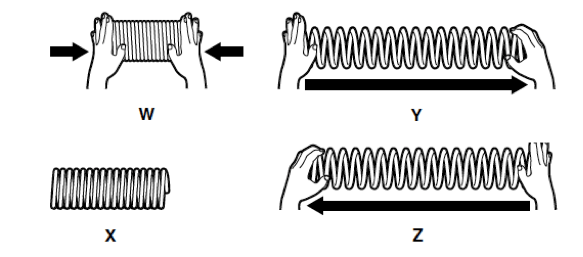
Elastic potential energy is energy stored in an object, such as a spring, due to the object being stretched or compressed. In which position is it most likely that the spring has lost its elastic potential energy?
W
Y
X
Z
Which object has elastic potential energy?
a hanging leaf
a burning coal
a rolling ball
a stretched bow
When does a yo-yo have the most potential energy?
When it's moving at its top speed.
When it's moving between its highest and lowest points.
When it's at its lowest point.
When it's at its highest point.
As the ball hits the ground, ..................energy is transferred to ....................... enrgy.
gravitational to kinetic
kinetic to chemical
kinetic to elastic
kinetic to gravitational
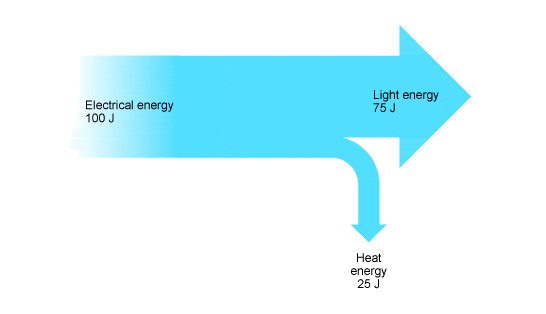
What is this diagram called?
Stankey Diagram
Sankey Diagram
Smelly Diagram
Some sort of Diagram
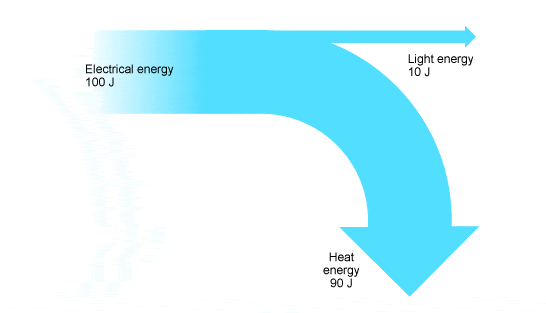

What type of device might this Sankey be about?
A very efficient LED light bulb
A very inefficient incandescent light bulb
A coal power plant
A wind turbine

A kettle uses 100J of electrical energy to produce 7J of sound energy and 93J of thermal energy. How efficient is the kettle?
100%
7%
93%
95%
A washing machine uses 250J of electrical energy to produce 125J of useful energy. How efficient is it?
5%
50%
55%
100%
A hairdryer uses 300J of energy to produce 60J of sound energy and 240J of thermal energy. Calculate it's efficiency.
80%
90%
20%
100%
Which of these equations is correct?
efficiency = total energy transferreduseful energy transferred
efficiency = useful energy transferredtotal energy transferred
energy = efficiency ×100%
efficiency = total energy tranferredwasted energy transferred

How much energy is wasted as sound?
350J
450J
250J
550J

How much energy is wasted as thermal energy
24
16
14
12

What is the efficiency?
2%
20%
5%
15%
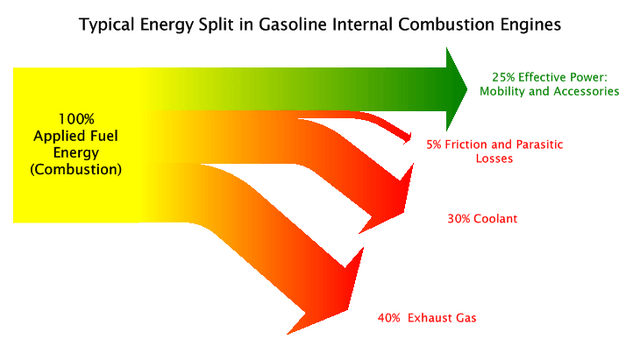

Fossil fuels are nonrenewable resources because they
take millions of years to form
are not re-useable
are in high demand
pollute the air

