
 Worksheets
6TH GRADE PRACTICE CHEM
Total questions: 86
Worksheet time: 2hrs 35mins
Used to find precise volume of liquids.
Flask
Beaker
Graduated cylinder
Thermometer
used to find the length of an object
Meter stick
Stop watch
Electronic scale
Spring scale

Name this tool.
Thermometer
Triple Beam Balance
Pan Balance
Safety Goggles
A water molecule has the chemical formula H2O. This means that the water molecule is made up of
Two hydrogen atoms and one oxygen atom
Two oxygen atoms and one hydrogen atom
Two hydrogen atoms and two oxygen atoms
Two molecules of water
Cohesive means ........
the water molecules stick to each other
the water molecules stick to other surfaces
the water molecules are less dense
the water molecules are far apart
Adhesive means ........
the water molecules stick to each other
the water molecules stick to other surfaces
the water molecules are less dense
the water molecules are far apart
Water striders can walk on water because of ____________.
capillary action
adhesion
surface tension
universal solvent
Water can bounce on water because of surface tension.
True
False
Why is water so good at dissolving so many substances?
it is polar
it is less dense as a solid
cohesion
adhesion


Which is a Physical change?
Color
Rusting
Burning
Reactions with acid
Which answers are a Homogeneous mixture?
Hot chocolate
Oxygen
Lucky Charms cereal
sugar in water
What is true of the Metric System? Mark all that apply.
A measurement System based on the number 10.
It is used to measure mass, length and volume.
It is used throughout Science and in all other countries other than the US.
It includes inches, feet and pounds.
What might you measure using millimeters?
The distance to school.
An insect.
The length of a car.
The length of a football field.

What would you use a RULER for?
To measure length.
To measure mass.
To measure volume.
To measure time.

What would you use a TRIPLE-BEAM BALANCE for?
To measure length.
To measure mass.
To measure volume.
To measure time.

Looking at the photo, what is the mass of the object?
48.5 g
480.5 g
40.4005 g
485 g

Based on the photo, what is the volume of the liquid?
35 mL
24 mL
25 mL
30 mL
any substance that has mass and takes up space
matter
atom
particle
the smallest unit of matter
matter
atom
particle
the parts of an atom
matter
atom
particle
Which of these are the parts of an atom?
proton
neutron
electron
there are no parts
Which of these has a definite shape?
solid
liquid
gas
Which of these has a definite volume?
solid
liquid
gas
How do the particles in a SOLID move?
wiggle
slow dance
move fast, collide
stay in place
How do the particles in a LIQUID move?
wiggle
slow dance
move fast, collide
stay in place
How do the particles in a GAS move?
wiggle
slow dance
move fast, collide
stay in place
How are the particles arranged in a SOLID?
close together in a defined space
spread apart but still sort of structured
loose, spread out
How are the particles arranged in a LIQUID?
close together in a defined space
spread apart but still sort of structured
loose, spread out
How are the particles arranged in a GAS?
close together in a defined space
spread apart but still sort of structured
loose, spread out
Which phases change in SUBLIMATION?
Solid to Gas
Liquid to Gas
Liquid to Solid
Gas to Solid
Which phases change in VAPORIZATION?
Solid to Gas
Liquid to Gas
Liquid to Solid
Gas to Solid
Which phases change in FREEZING?
Solid to Gas
Liquid to Gas
Liquid to Solid
Gas to Solid
Which phases change in DEPOSITION?
Gas to Solid
Gas to Liquid
Solid to Liquid
Which phases change in CONDENSATION?
Gas to Solid
Gas to Liquid
Solid to Liquid
Which phases change in MELTING?
Gas to Solid
Gas to Liquid
Solid to Liquid

This symbol represents _________________degrees.
Fahrenheit
Celsius
Kelvin
Absolute zero

Mass is measured in what units
grams
centimeters
cubic centimeters
What tools are necessary to measure the density of an IRREGULAR shaped object? (Select ALL correct answers that apply)
Triple Beam Balance/Scale
Graduated Cylinder/Beaker
Metric Ruler/Meter Stick
What tools are necessary to measure the density of a REGULAR shaped object? (Select ALL correct answers that apply)
Triple Beam Balance/Scale
Graduated Cylinder/Beaker
Metric Ruler/Meter Stick

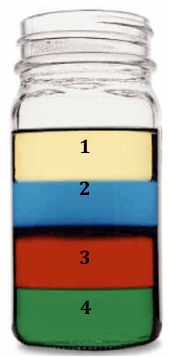
Use the figure above, to answer the following question. Pic the answer that puts the objects in order from MOST DENSE to LEAST DENSE.
B, A, C, D
D, C, A, B
A, B, C, D
D, C, B, A
How do you calculate volume of a regular object?
L x W x H
Water levels
Subtraction


IF we are using Boyles' law and our Pressure goes UP, what must our volume do?
Go UP
Go DOWN
Stay the same
Wrong law.
Charles' Law deals with what quantities?
pressure/temperature
pressure/volume
volume/temperature
volume/temperature/pressure
Warm air is....
More dense than cold air
Less dense than cold air
Has the same amount of density

When Volume of a container is increased, pressure decreases at constant temperature. This is ……………………………..
relationship. The name of this relationship is …………………………… law.
Inversely proportional / Boyle’s
Directly proportional/ Boyles’s
Inversely proportional / Charles’s
Directly proportional / Charle’s
Boyles Law Is A
Directly Proportional Relationship
Inversely Proportional Relationships
Pressing On A Balloon Raises The
Fun
Volume
Pressure
Temperature
Boyles Law Tells That
The More The Volume The Less The Temperature
The More The Temperature The Less The Pressure
The More The Volume The More The Pressure
The More The Pressure The Less The Volume
Charles Laws Are A
Directly Proportional Relationship
Inversely Proportional Relationships
What is the formula for Boyle's Law?
P1V1=P2V2
P1V2=P2V1
P1/V1=P2/V2
P1V1/P2V2
When Volume increases then Pressure must...
Increase
Decrease
When Pressure increases then the Volume must...
Increase
decrease
According to Charles Law, if Temperature of a gas increases Volume will also....
Increases
Decreases
Stays the same
According to Charles Law, the relationship between Temperature and Volume can best be described as....
Inverse Relationship
No Relationship
Direct Relationship
The result of an inward pull among the molecules of a liquid that brings the molecules on the surface closer together; causes the surface to act as if it has a thin skin.
surface tension
viscosity
gas
vibrate

