wayground logo

Free Printable Worksheets

Font size

S
M
L
XL
Worksheets

Semester 2 Earth Science Review

Total questions: 90

Worksheet time: 1hrs 24mins

Name
Class
Date
1.

Which example is a form of precipitation?

a)

Dew

b)

Fog

c)

Frost

d)

Hail

2.

In which area would the rate of evaporation be the lowest?

a)

Over the ocean

b)

Over the mountains

c)

Over the rainforest

d)

Over the desert

3.

As a part of the water cycle, water from Earth's surface enters the clouds and finally falls back to the ground in the form of rain. What is the correct sequence of processes water undergoes?

a)

Evaporation, Condensation, Precipitation

b)

Precipitation, Condensation, Evaporation

c)

Condensation, Evaporation, Precipitation

d)

Evaporation, Precipitation, Condensation

4.

What would happen if the Sun is removed from the water cycle?

a)

The water cycle would not include precipitation but would continue with groundwater flow.

b)

The water cycle would no longer occur because the Sun provides the energy for evaporation and transpiration.

c)

The water cycle would no longer occur because the Sun provides energy for the formation of clouds.

d)

The water cycle would not include evaporation and transpiration but would continue with condensation.

5.

The image shows various stages in the water cycle. During which stage does water flow back towards the sea as runoff?

a)

W

b)

X

c)

Y

d)

Z

6.

On Earth, what process generates most of the water vapor?

a)

Condensation

b)

Evaporation

c)

Precipitation

d)

Transpiration

7.

Rain and snow are two different forms of precipitation that fall on Earth's surface. Which factor is responsible for there being different forms of precipitation?

a)

Evaporation

b)

Run-off

c)

Temperature

d)

Transpiration

8.

What is the energy source that drives the water cycle?

a)

The moon T

b)

The heat from our home in the winter all around the world

c)

The sun

d)

he heat generated solely from the core of the earth

9.

What are formed when water vapor condenses?

a)

Clouds

b)

Mountains

c)

Transpiration

d)

Valleys

10.

The movement caused within a fluid by the tendency of hotter and therefore less dense material to rise, and colder, denser material to sink under the influence of gravity, which consequently results in transfer of heat. ____________________

a)

Evaporation

b)

Convection

c)

Precipitation

d)

Transpiration

11.
What is it called when plants give off water vapor as a waste product?
a)
condensation
b)
evaporation
c)
sublimation
d)
transpiration
12.

Water in its gas form is called ____________________,

a)

water vapor

b)

precipitation

c)

ice

d)

air

13.
The atmosphere, the ground, and also bodies of water are all heated by the Sun's energy. How does this energy reach Earth?
a)
radiation
b)
conduction
c)
convection
d)
gravity
14.
Warm, less dense air (including vapor) rises in the atmosphere. Cool, more dense air (including vapor) sinks. This transfer is . . . .
a)
convection
b)
conduction
c)
radiation
d)
gravity
15.

Evaporation is the change of state from ___________ to __________

a)

liquid to gas

b)

solid to liquid

c)

gas to liquid

16.
Clouds are formed by
a)
Evaportation
b)
Convection
c)
Condensation
d)
Wind
17.
What is the process during which water cools and turns from a gas to a liquid?
a)
Condensation
b)
Runoff
c)
Precipitation
d)
Evaporation
18.
What step of the water cycle occurs when clouds become too heavy
a)
Condensation
b)
Runoff
c)
Precipitation
d)
Evaporation
19.
What is the process during which water changes from a liquid to a gas as it heats up?
a)
Condensation
b)
Runoff
c)
Precipitation
d)
Evaporation
20.
True or False: Water vapor is the name given to water in liquid form.
a)
True
b)
False
21.

What is the process during which water evaporates from the leaves of plants and trees and goes up into the atmosphere as water vapor.

a)

Condensation

b)

Runoff

c)

Precipitation

d)

Transpiration

22.

What step of the water cycle does this picture show?

a)

Condensation

b)

Runoff

c)

Precipitation

d)

Evaporation

23.

What is it called when water droplets form on the outside of a cool glass?

a)

Condensation

b)

Transpiration

c)

Precipitation

d)

Evaporation

24.

What step of the water cycle is shown in this picture?

a)

Condensation

b)

Runoff

c)

Precipitation

d)

Evaporation

25.

Movement of energy through a body of water is a

a)

Tide

b)

current

c)

wave

d)

longshore drift

26.

The development of a wave usually begins with

a)

currents

b)

wind

c)

gravity

d)

tsunamis

27.

The rise and fall of Earth's waters on its coastlines are called

a)

currents

b)

tides

c)

waves

d)

gravity

28.

Tides are caused by the interaction and influence of

a)

the Earth

b)

the Sun

c)

the Moon

d)

gravity

e)

wind

29.

There are two high tides and two low tides every

a)

every year

b)

approximately every 24 minutes

c)

approximately every 24 hours

d)

approximately every 12 hours

30.

A large stream of water that moves through the ocean is called a

a)

longshore drift

b)

current

c)

tide

d)

wave

31.

Surface currents are driven mainly by

a)

breakers

b)

tides

c)

global winds

d)

tsunamis

32.

Spring tides are when the sun and moon are lined up and working together.

a)

True

b)

False

33.

Neap tides are when the sun and moon are lined up and working together.

a)

True

b)

False

34.

The moons rotation around the earth is what causes the tides to change daily.

a)

True

b)

False

35.

The moon phases occur because...

a)

the sun, the earth, and the moon do a dance and create shadows

b)

the moon grows and shrinks

c)

the moon revolves around the earth

d)

the moon produces its own light

36.

The moon goes through every phase..

a)

once a month

b)

twice a month

c)

once a year

d)

the moon doesn't have phases, it has seasons

37.

In relation to the moon, waxing means...

a)

growing

b)

shrinking

c)

shining

d)

i don't know, the karate kid does it

38.

In relation to the moon, waning means...

a)

growing

b)

shrinking

c)

crying

d)

don't horses wane?

39.

We always see the same side of the moon

a)

True

b)

False

40.

Define gibbous

a)

less than half of moon visible

b)

all of moon visible

c)

more than half of moon visible

d)

none of moon visible

41.

The diagram shows how Earth spins on its axis, causing day and night. Which term describes the movement shown?

a)

tilt

b)

orbit

c)

rotation

d)

revolution

42.
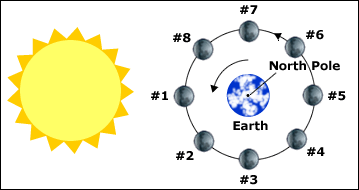
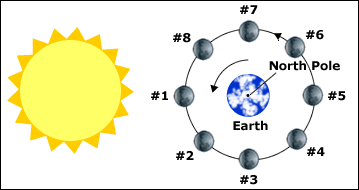
What phase is the moon when in position #5?
a)
New Moon
b)
First Quarter
c)
Full Moon
d)
Third Quarter
43.
In what phase is the moon when in position #8?
a)
Waning crescent
b)
First Quarter
c)
Waxing crescent 
d)
Third Quarter
44.
Why does none of the moon appear lit during a new moon?
a)
The sun's light is blocked by Earth's shadow
b)
Because the moon is between the Earth and the Sun
c)
Because the moon is located at a right angle to Earth, relative to the sun
d)
Part of the moon that is lit faces away from the sun and Earth
45.
What is a difference between spring and neap tides?
a)
Spring tides occur when the earth and sun are IN LINE with the new or full moon. 
b)
Spring tides occur when moon in 3rd or 1st quarter phases
c)
Spring tides are LOWER than neap tides
d)
Spring tides occur in Spring and neap tides can occur in any season
46.
What happens when there is a spring tide
a)
Short Tides and semi-short tides
b)
High tides and very low tides
c)
low tides and medium tides
d)
small tidal ranges
47.
What type of tides would this arrangement of earth-moon-sun create?
a)
neap tide
b)
spring tide
c)
new moon tide
d)
full moon tide
48.

Streamlike movements of water that occur at or near the surface of the ocean caused by wind are called

a)

jet currents

b)

coriolis currents

c)

surface currents

d)

deep currents

49.

Which factor affects the movement of deep currents?

a)

increase in salinity

b)

the coriolis effect

c)

continental deflection

d)

deep currents

50.

Streamlike movements of water that occur at or near the surface of the ocean caused by wind are called

a)

jet currents

b)

coriolis currents

c)

surface currents

d)

deep currents

51.

___________ carry warmer, less dense water from the equatorial regions to polar regions (Ex. Gulf Stream)

a)

trade currents

b)

coriolis currents

c)

surface currents

d)

deep currents

52.

Deep Atlantic Currents are formed largely as a result of

a)

erosion by surface winds

b)

heating of surface water

c)

the rotation of the Earth

d)

denser water sinking

53.

Which of the following best describes the water found in the deep currents of the Atlantic Ocean?

a)

cold with high salinity

b)

cold with low salinity

c)

warm with high salinity

d)

warm with low salinity

54.

Sarah can float more easily in ocean water than in water in a swimming pool. Why is it easier for her to float in ocean water?

a)

ocean water is denser

b)

ocean water is deeper

c)

there is a larger volume of ocean water to float in

d)

she has a smaller mass in ocean water

55.

How do deep ocean currents form?

a)

The form as warm, dense water sinks and flows beneath cold ocean water.

b)

They form as cold, dense water sinks and flows beneath warm ocean water.

c)

They form as warm, dense water sinks and flows with other warm ocean water.

d)

The wind blows causing the deep ocean currents.

56.

What phenomenon does the Coriolis Effect arise from?

a)

Rotation of the Earth on its axis.

b)

Revolution of the Earth on its axis.

c)

Curvature of the Earth’s surface.

d)

Effect of winds high in the atmosphere.

57.

What happens to the ocean as depth increases?

a)

temperature increases

b)

salinity decreases, temperature decreases

c)

pressure decreases

d)

temperature decreases, salinity increases

58.

Ocean currents have an effect on which two things

a)

climate and weather

b)

land and sea

c)

temperature and density

d)

equator and poles

59.

Which two features together control the density of seawater?

a)

temperature and sea depth

b)

salinity and plankton concentration

c)

temperature and salinity

d)

salinity and depth

60.

Assuming that Egg A is in a solution that does not contain salt and Egg B and Egg C are in a solution that does contain salt, what can you infer about the relationship between density and salinity in the ocean?

a)

As salinity in the ocean decreases, density of the ocean increases.

b)

As salinity in the ocean increases, density of the ocean increases.

c)

There is no relationship between salinity and density in the oceans.

d)

Salinity and density always remain the same throughout different parts of the ocean.

61.
What is the name of the atmospheric layer we live in?
a)
troposphere
b)
mesosphere
c)
stratosphere
d)
thermosphere
62.
Which layer of the atmosphere contains the ozone layer, which protects us from the sun's harmful rays?
a)
troposphere
b)
mesosphere
c)
stratosphere
d)
thermosphere
63.
What tool is used to measure air pressure?
a)
thermometer
b)
anemometer
c)
psychrometer
d)
barometer
64.
The earth receives heat energy from the sun by _______________, which is the transfer of energy as electromagnetic waves?
a)
radiation
b)
convection
c)
conduction
d)
greenhouse effect
65.
The transfer of heat energy by direct contact, or touch, is __________________?
a)
radiation
b)
convection
c)
conduction
d)
greenhouse effect
66.
What is the term for the conditions in the atmosphere over a long period of time?
a)
 Stratosphere
b)
 Climate
c)
 Weather
d)
 Wind
67.
Feeling the heat from a fire is an example of which type of atmospheric heating?
a)
Radiation
b)
 Convection
c)
Conduction
d)
 Greenhouse effect
68.
Compared to the ocean, land heats up and cools down
a)
Faster
b)
 Slower
c)
 Equally
d)
Gradually
69.
What kind of weather does a stationary front bring?
a)
 Light rain followed by clear weather
b)
 Many days of cloudy wet weather
c)
 Severe thunderstorms and rain
d)
 Cold and dry weather
70.
What is a warm front?
a)
 Warm air mass becomes caught between cold air masses
b)
two air masses meet and stay separate
c)
 Warm air moves over cold air and replaces it
d)
 Cold air moves under warm air and pushes it up
71.
What forms when two air masses meet?
a)
 Flood
b)
 Cloud
c)
Front
d)
Climate
72.
What is the effect on the air due to unequal heating rates of heating and cooling between water and land?
a)
different density (high & low pressure)
b)
ocean and land breezes
c)
convection currents
d)
all choices
73.
Which global wind pattern is responsible for moving weather fronts across the Unites States?
a)
Polar Easterlies
b)
Trade Winds
c)
Prevailing Westerlies
d)
Doldrums
74.
Distinct weather patterns on Earth's surface are created by __________ and the Coriolis Effect.
a)
unequal heating
b)
magnetic fields
c)
increased temperature
d)
increased air pressure
75.
What increases air's ability to hold more water vapor?
a)
increased wind speed
b)
decreased temperature
c)
increased temperature
d)
increased air pressure
76.
What causes changes in the weather?
a)
air masses move and come together
b)
water evaporates
c)
the air gets more humid
d)
clouds form
77.
What air mass is forming at point F in the map?
a)
cP
b)
cT
c)
mT
d)
mP
78.
What air mass is forming at point A in the map?
a)
cP
b)
cT
c)
mT
d)
mP
79.
What type of air will the air mass shown at point E bring?
a)
warm and humid air
b)
warm and dry air
c)
cold and humid air
d)
cold and dry air
80.
Which statement is TRUE about this weather symbol?
a)
This symbol points in the direction the front is moving.
b)
This symbol represents a cold front.
c)
The symbol shows that thunderstorms are likely ahead of the front.
d)
All of these are true about this symbol.
81.
What provides the "fuel" for a hurricane?
a)
warm water evaporating from oceans
b)
cool water condensing to form rain
c)
warm water condensing to form clouds
d)
cool water moving through deep currents
82.
Where are do most of Earth's tornadoes form?
a)
over the Atlantic ocean
b)
in the valleys of Europe
c)
in the rainforests of Brazil
d)
over the continental US
83.
What weather conditions will an area most likely experience if this symbol is shown over it on a weather map?
a)
Due to high pressure air rising, it will most likely have a warm front.
b)
Due to low pressure air rising, it will experience tornadoes.
c)
Due to high pressure air that doesn't rise, it will have clear skies.
d)
Due to low pressure air rising, it will experience hot weather.
84.
What is the "eye" of a hurricane?
a)
The calm center of a hurricane with little to no winds
b)
The most violent part of a hurricane that brings massive flooding
c)
The wall of high winds around the center of a hurricane
d)
The outer band of winds and rain that a hurricane brings.
85.
What will the weather forecast most likely be for the next 48 hours in the northwestern part of the United States?
a)
Slow-moving light rain ahead of a warm front, followed by clearer, warmer weather.
b)
Possible fast-moving thunderstorms ahead of a cold front, followed by cooler temperatures and clear skies.
c)
Heavy snowfall ahead of the occluded front followed by a hurricane.
d)
Days of heavy rain and possible flooding due to the stationary front.
86.
What is a key similarity among thunderstorms, tornadoes, and hurricanes?
a)
Each weather event can last up to a week over an area.
b)
All three weather events have the highest wind speeds ever recorded.
c)
High pressure created from cool, dry air sinking are used to create all three.
d)
Low pressure created from warm, humid air rising is needed for their formation.
87.
What could explain the record-breaking number of hurricanes (15) that formed in 2005?
a)
The ozone layer absorbed less UV radiation from the sun than in previous years.
b)
There were more windy days that usual that year.
c)
The temperature of the Atlantic ocean was higher than normal that year.
d)
The Earth's rotation was faster than in previous years.
88.
Where are do most hurricanes form?
a)
over oceans close to the equator
b)
over oceans close to the poles
c)
over land close to the poles
d)
over land close to the equator
89.
What type of front is being shown?
a)
a cold front
b)
a warm front
c)
a stationary front
d)
an occluded front
90.
Which statement is TRUE about the front shown?
a)
None of the air masses has enough energy to push the other one out of the way in this stationary front.
b)
Warm air is being cut-off from the ground by the cold air in this occluded front.
c)
A tornado is forming along this cold front.
d)
Days of rain have formed along this warm front.