
 Worksheets
Earth Science 1
Total questions: 99
Worksheet time: 1hrs 11mins
Which layer is made (mostly) of LIQUID iron and nickel?
crust
mantle
outer core
inner core

Which layer of the Earth is the THINNEST?
crust
mantle
outer core
inner core

Which layer of the Earth is the THICKEST?
crust
mantle
outer core
inner core
Which layer is the hottest?
crust
mantle
outer core
inner core
What is the middle part of the mantle that is partially molten rock, or putty like, or semisolid.
Asthenosphere
Mesosphere
Lithosphere
Crust
Which of the following is true regarding the composition of the lithosphere?
The lithosphere is mostly liquid, with some medium-density materials, such as silicon.
The lithosphere is more plastic and flows slowly compared to the solid crust of Earth.
The lithosphere includes the core and the lower portion of the mantle.
The lithosphere includes the crust and the uppermost portion of the mantle, which is sold and rigid.
Which of the following correctly lists the layers from innermost to outermost?
inner core, outer core, lower mantle, upper mantle, crust
lower mantle, upper mantle, crust, inner core, outer core
lower mantle, inner core, upper mantle, outer core, crust
crust, inner core, lower mantle, upper mantle, outer core

As you travel from the crust to the core, how would temperature, pressure and density of the material change?
They would all increase
They would all decrease.
Nothing, the layers are made of the same material throughout
Temperature would decrease, but pressure and density would increase
This zone divides the upper and lower mantle and is a layer of soft and weak rock
Crust
Middle mantle
Lithosphere
Asthenosphere
Why was Wegener's theory rejected?
he really was a crazy little man
he found evidence of matching fossils, land formations and climate evidence
he could not identify the cause behind continental drift
he did not have the support of his fellow scientists
What 3 things did Wegener study to support his ideas? Mark all THREE.
matching fossils
matching land features
matching forces
climate change
What was the name of the supercontinent?
Panorama
Pangea
Panamerican
Wegener
What is the theory that continents were all once together and have drifted apart?
american movement
continental plates
continental drift
memorial drift
What was Wegener's hypothesis?
all continents are joined in a single landmass as they have been for a long time
all continents are situated as they have been forever
all continents were far apart and have joined into a single landmass
all continents were joined in a single landmass and have drifted apart
The mesosaurus is an example of which type of evidence?
matching fossil
matching land formation
climate change
memorial movement
Glacier grooves are an example of climate change evidence because?
glacial grooves are found in Antarctica today and it is cold
glacial grooves are found in the warm areas today, so it means that continent used to be near the poles
glacial grooves are found in the cold today and it is closer to the poles
glacial grooves are found in the warm areas because there was an ice age and continents were never together
Which is the best statement for fossil evidence?
Lystrosaurus fossils found on same continent, many places
Lystrosaurus fossils found on several continents and they could swim in fresh water
Lystrosaurus fossils found on two continents that are connected today
Lystrosaurus fossils found on several continents and they could not swim, so the continents were connected.
Mountain ranges on different continents being the same age, type and structure is
matching fossil evidence
matching land formation evidence
climate change evidence
memorial movement evidence

This picture is an example of which type of evidence?
matching fossil
matching land formation
climate change
memorial movement

This picture is an example of which type of evidence?
matching fossil
matching land formation
climate change
memorial movement


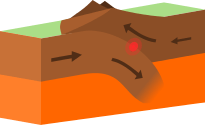
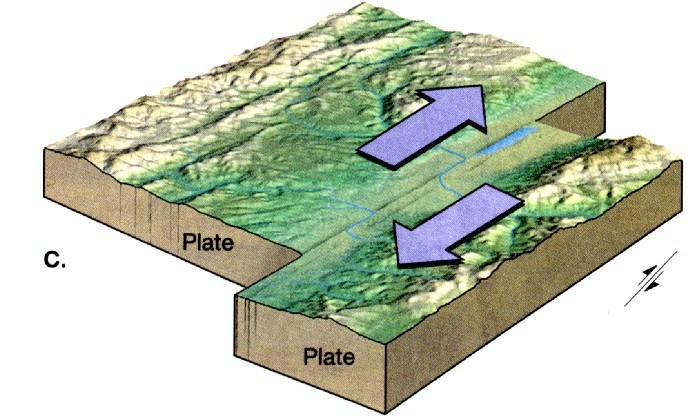
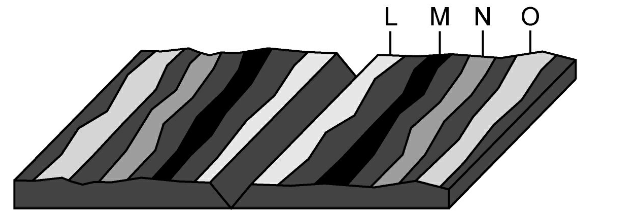


What were 2 kinds of evidence were used to prove that the seafloor spread?
rock formations, WWII shipwrecks
magnetic seafloor stripes, WWII ship logs
magnetic seafloor stripes, age of rocks
Process by which new ocean crust forms.
Seafloor spreading
Continental drift
Mid-ocean ridge
Rift
Sea-floor spreading begins at the
Deep ocean trench
Mid-ocean ridge
Continent's edge
Why does oceanic crust sink below the continental crust during subduction
oceanic crust is less dense
oceanic crust is more dense
oceanic crust is older
oceanic crust is warmer
Scientists think that the continents once formed a giant landmass that broke apart, and then slowly drifted apart. What is the name given to this hypothesis?
sea-floor Spreading
plate tectonics
continental drift
Pangaea
Most geologist think that the movement of Earth's tectonic plates is caused by
the rotation of the Earth.
the Earth's magnetic field.
subduction in the mantle
convection currents in the mantle (asthenosphere)
convection currents in the lithosphere
Who was the scientist that created the Continental Drift Hypothesis?
Harry Hess
George Washington
Alfred Wegener
Marie Curie
Fossils of the Mesosaurus were found on the continents of South America and Africa within the same layers of rock. This provides evidence that the two continents were once
separated by an ocean.
joined as one large land mass.
in different hemispheres.
located near the poles.
Most scientists did not believe Alfred Wegener's hypothesis about drifting land masses. Why?
He did not give enough evidence.
They thought his time table was off.
They did not like Alfred.
He could not explain how the land masses moved.
Which two land masses did Wegener think fit the best together like puzzle pieces?
N American and Europe
S America and Aftrica
Australia and Africa
Europe and S America
How does the continental drift hypothesis explain the evidence of the same age and type of rock (Mt. Ranges) on different land masses?
The world's climate changed over time.
Scientists have incorrectly identified glacier remains.
The landmasses were at one time in a different climate.
Glaciers covered the world.
How did Wegener explain that the same fossils ended up on different land mass?
The same organisms were born and died on different land masses.
The organisms were carried by land bridges across the water.
The organisms lived on a single land mass that split apart.
The organisms were carried to different land masses by "rafting."
The process by which new seafloor forms when magma rises at the mid-ocean ridges and solidifies, pushing older rock away is called (a) .
Match the following
Paleomagnetism
the study of magnetic minerals in rock
Plate Tectonics
theory of how lithospheric plates move and change shape
Sea-Floor Spreading
process by which new ocean floor forms as magma rises and solidifies at the Mid-Ocean Ridge
Trench
long, narrow, steep depression that forms on the sea floor as a result of subduction
Magma
liquid rock produced under the Earth's surface
Mid-ocean ridges are the sites of intense _________ activity.
emotional
volcanic
earthquake
mathematical
At a mid-ocean ridge, melted rock rises through cracks in the _________.
ceiling
river
inner core
sea floor
As the melted rock cools and hardens,
it forms new ________.
volcanoes
hope
core
crust
___________ is the hypothesis that states that the continents once formed a single landmass, broke up, and drifted to their present locations.
Continental drift
Sea-floor spreading
Plate tectonics
Mid-ocean range

In the 1960s, scientists studying the ocean floor discovered _____________.
that the ocean floor had magnetic patterns
the Titanic
that the ocean floor had magical properties
that the ocean floor was as smooth as a desert
Magnetic reversal is the process by which ________________.
the Earth's north and south magnetic poles periodically change places
the continents once formed a single landmass, broke up, and drifted to their present locations
new oceanic lithosphere (sea floor) forms as magma rises to Earth’s surface and solidifies at a mid-ocean ridge
What technology did scientists use in the mid-1900s to map the mid-ocean ridge?
satellites
deep-sea diving
submarines
sonar
In sea-floor spreading, molten material rises from the mantle and erupts
along the edges of all the continents
along mid-ocean ridges
in deep-ocean trenches
at the north and south poles
(a)
(a)

Base your answer on the diagram, which shows models of two types of earthquake waves. Model A best represents the motion of earthquake waves called:
(a)
P-waves (compressional waves) that travel faster than S-waves (shear waves) shown in model B
P-waves (compressional waves) that travel slower than S-waves (shear waves) shown in model B
S-waves (shear waves) that travel faster than P-waves (compressional waves) shown in model B
S-waves (shear waves) that travel slower than P-waves (compressional waves) shown in model B

S-wave arrival time, only
P-wave arrival time, only
Difference in the arrival time of the P-wave and S-wave
Difference in the height of the P-wave and S-wave
A minimum of (a) seismic stations are needed to determine the location of an earthquake’s epicenter.
The circles on the map show the distances from three seismic stations, X, Y, and Z, to the epicenter of an earthquake. Which location is closest to the earthquake epicenter?
(a)

The figure below is an illustration of ________, which occurs beneath tectonic plates and causes them to move.
Ring of Fire
Osmosis
S waves
Convection Currents

The place where an earthquake originates inside the Earth's surface is called...
Epicenter
Focus
Underground
Crust
5. Which type of wave travels the fastest?
Primary Wave
Secondary Wave
Long Wave
The San Andreas fault line runs through California and commonly produces earthquakes. This plate boundary is called a:
Convergent
Transform
Subduction
Divergent

Where is the Ring of Fire located?
Atlantic Plate
Pacific Plate
Japanese Plate
North American Plate
What geologic hazards are caused by Ring of Fire volcanic eruptions? (Select all that apply)
Earthquakes
Volcanic Eruptions
Mudslides
Tsunamis
How are megathrust earthquakes generated?
Major volcanic eruptions causing massive displacement of earth.
Triggered by subduction as the rocks slide past each other at convergent plate boundaries.
Generated by the ripping of continental plate from oceanic plate.
Kaiju rising from the rift of the Pacific Rim.
What s driving the movement of the tectonic plates?
Gravity
Tides caused by lunar activity
Convection currents deep in the mantle
A giant turtle
What percentage of Earth's volcanoes are found in the Ring of Fire?
10%
25%
50%
75%
What is the vent?
A spray of lava.
The main part of the volcano, cone shaped.
An opening at the surface where volcanic eruptions occur.
A pipe-shaped passageway that the magma flows along.

A volcano that has erupted within the past 10,000 years is considered to be...
Explosive
Active
Dormant
Inactive
What process causes volcanos to form?
Climate change
Tectonic plates moving
Tornadoes
Humans
A ______ is the path in which magma flows to the vent.
A cinder cone
Pyroclastic eruption
Lava Flow
Conduit

