
Font size
 Worksheets
Unit 3 - Summative Review - Electrons in Atoms
Total questions: 54
Worksheet time: 1hrs 13mins
True or False: Rutherford's model doesn’t explain how the electrons were arranged around the nucleus.
True
False

The wavelength of a wave is measured from
crest to crest
crest to trough
origin to crest
origin to trough
The speed of light is the product of it’s wavelength and __________.
amplitude
frequency
crest
duration
A (a) separates sunlight into a continuous spectrum of colors.
True of False: Heated objects emit only certain frequencies of light at a given temperature
True
False
Matter can gain or lose energy only in small, specific amounts called ______.
quanta
hertz
millimeters
ions
The photoelectric effect is when ________ are emitted from a metal’s surface
when light of a certain frequency shines on it.
protons
electrons
neutrons
ionss
A ______ is a particle of electromagnetic radiation with no mass that carries a
quantum of energy
proton
neutron
photon
ion
How do the excited Neon atoms of Neon lights return to their stable state
by emitting matter to release energy.
by emitting light to gain energy.
by emitting matter to gain energy.
by emitting light to release energy.
True or False: Each element’s atomic emission spectrum is same.
True
False
Niels Bohr's quantum model of the atom seemed to explain why ______ ________ _______ of elements are discontinuous.
(a)
The lowest allowable energy state of an atom is called its ______state
excited
ground
stable
lower
When an atom gains energy, it is in an _______state.
excited
ground
stable
lower
Each circular orbit where electrons were allowed was given a number, called the _______number.
photon
position
level
quantum
According to Bohr's model, the electron in a hydrogen atom moves around the nucleus ______.
in circular orbits of only certain, allowed energy states
in non-circular orbits of seven possible energy states
in circular orbits of variable and continuous energy states
in circular orbits of three possible energy states
What did the Bohr model of the atom predict?
the speed of light
the existence of unknown subatomic particles
the energy equivalent of mass
frequencies of emission spectrum lines in hydrogen
According to the de Broglie equation, the (a) of a particle is equal to Planck's constant divided by the particle's mass and its frequency.
The de Broglie equation predicts that all moving particles have ______.
circular orbits
wave characteristics
measurable mass
observable wavelengths
It is impossible to know precisely both the velocity and the position of a particle at the same time, according to which of these?
the general theory of relativity
the Heisenberg uncertainty principle
kinetic molecular theory
the de Broglie equation
Which is the term for the three-dimensional region around the nucleus that describes the electron's probable location as predicted by the Schrödinger wave equation?
probability function
atomic orbit
atomic orbital
energy level
Which of these are features of the quantum mechanical model of the atom but not of the Bohr model of the atom?
only certain electron energy values allowed
fixed electron paths
electrons treated as waves
electron location treated as probability
The atomic model in which electrons are treated as waves is called the _______ __________ model of the atom.
(a)
Which is the term for the major energy levels of the atom, specified by n?
energy sublevels
atomic orbitals
principal energy levels
electron shells
The number that is assigned by the quantum mechanical model to indicate the relative sizes and energies of atomic orbitals is the _________ _______ number.
(a)

Which type of orbital is shown here?
s
d
f
p
Given that the principal quantum number is n, the number of orbitals in each principal energy level is given by the expression ______.
2(n +1)
n2
2n
(n + 1)2
The aufbau principle states that each electron occupies the (a) energy
orbital available.
The arrangement of electrons in the atom is called the
________ _____________..
atomic orbital
electron configuration
electron arrangement
primary atomic sequence
____'_ rule states that single electrons
with the same spin must occupy each
equal-energy orbital before additional
electrons with opposite spins can
occupy the same energy level orbitals.
Pauli's
Rutherford's
Hund's
Charles'
The Pauli exclusion principle how many electrons can occupy an energy orbital?
2
4
6
8
Match the following
transition metals
d-block
actinide series
f-block
alkali metals
s-block
noble gases
p-block
Reorder these representative elements from fewest valence electrons to most valence electrons.
Hydrogen (H)
Boron (B)
Sulfur (S)
Bromine (Br)
True or False: Valence electrons are defined as
electrons in the atom’s innermost
orbitals
True
False
An element's electron configuration and number of valence electrons can be determined by its ______.
atomic mass
position on the periodic table
melting and boiling points
chemical symbol
Each orbital can hold how many electrons?
5
4
8
2


How many electrons can the d sublevel (the d orbitals) hold?
14
10
2
6

Choose the correct electron configuration for Beryllium (Be).
1s1
1s2 2s2
1s2 2s2 2p1

Choose the correct electron configuration for Chlorine (Cl).
1s2 2s2 2p1
1s2 2s2 2p6 3s2
1s2 2s2 2p6 3s2 3p5


What element has the following electron configuration: 1s2 2s2 2p6 3s2?
Ca+2
Ca
Mg
Na
Ar
Match the elements with their electron configuration! (3 minutes)
1s2 2s2 2p3
Nitrogen, N
1s2 2s2 2p6 3s2 3p3
Phosphorus, P
1s2
Helium, He
1s2 2s2 2p6 3s2 3p6
Argon, Ar
1s2 2s2 2p6 3s2 3p6 4s2 3d5
Manganese, Mn
Elements in the same group have the same number of:
protons
neutrons
electrons
How many VALENCE ELECTRONS does Nitrogen have?
7
5
2

This could be the dot diagram of
Mg
Cl
C
O


How many dots would you put around carbon, a group 14 element?
4
6
8
18
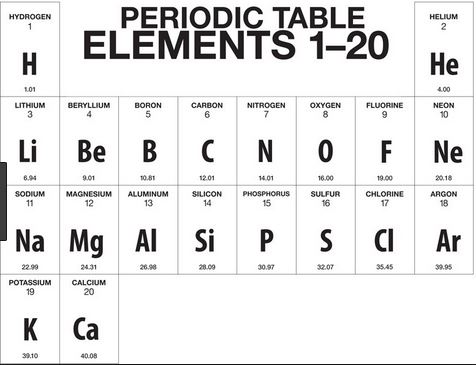
How many valence electrons does Aluminum Have?
1 Valence electron
2 Valence electron
3 Valence electron
4 Valence electron
5 Valence electron
The _____ the element is in determines the number of valence electrons it has.
period/row
group/column
Which term means the arrangement of electrons in an atom?
electron configuration
electron orientation
electron sublevel
electron orbital
Electron configuration notation uses a number, a letter, and a superscript. Match each notation to its meaning.Match the following
Number
principle energy level
letter
energy sublevel
superscript
number of electrons in the orbital
Match each element, at left, with the correct number of dots needed for its electron-dot structure, at right.
potassium
one dot
calcium
two dots
phosphorus
five dots
silicon
four dots
Match the rule or principle to the step in the process of determining electron configuration.
Determine the lowest energy levels for the number of electrons in the atom in question.
aufbau principle
Add electrons to orbitals of equal energy.
Hund's rule
Assign spins to electrons in orbitals of equal value
Pauli exclusion principle

