
 Worksheets
Test 3 - CCNA 2
Total questions: 45
Worksheet time: 27mins
A PC is to access a web server on another network. Which inter-VLAN method will provide the highest bandwidth at Layer 3 and also provide a default gateway for the PC?
multilayer switch with routing enabled
router on a stick
trunked interface between the router and the switch
multiple physical interfaces on the router, all connected to a Layer 2 switch
Which port state will switch ports immediately transition to when configured for PortFast?
forwarding
blocking
listening
learning
After the election of the root bridge has been completed, how will switches find the best paths to the root bridge?
Each switch will analyze the port states of all neighbors and use the designated ports to forward traffic to the root.
Each switch will analyze the sum of all port costs to reach the root and use the path with the lowest cost.
Each switch will analyze the sum of the hops to reach the root and use the path with the fewest hops.
Each switch will analyze the BID of all neighbors to reach the root and use the path through the lowest BID neighbors.
What value determines the root bridge when all switches connected by trunk links have default STP configurations?
(a)
During the implementation of Spanning Tree Protocol, all switches are rebooted by the network administrator. What is the first step of the spanning-tree election process?
All the switches send out BPDUs advertising themselves as the root bridge
Each switch determines the best path to forward traffic
Each switch determines what port to block to prevent a loop from occurring
Each switch with a lower root ID than its neighbor will not send BPDUs
Which three port states are used by Rapid PVST+? (Choose three.)
listening
learning
forwarding
discarding
blocking
When PVST is running over a switched network, which port state can participate in BPDU frame forwarding based on BPDUs received, but does not forward data frames?
(a)
An administrator is troubleshooting a switch and wants to verify if it is a root bridge. What command can be used to do this?
(a)
Which three components are combined to form a bridge ID? (Choose three.)
Bridge priority
Cost
Extended system ID
MAC address
Port ID
What is an advantage of using STP in a LAN?
It combines multiple switch trunk links into a logical port channel link to increase bandwidth.
It decreases the size of the failure domain.
It provides firewall services to protect the LAN.
It temporarily disables redundant paths to stop Layer 2 loops.
What is the primary purpose of the Spanning Tree Protocol (STP) in a network?
To provide redundancy in case of link failure.
To manage IP address allocation in the network.
To ensure a loop-free topology in Layer 2 networks.
To prevent broadcast storms in the network.
Which of the following statements is true regarding the role of the root bridge in STP?
The root bridge can be manually configured by the network administrator.
The root bridge does not participate in the forwarding of frames.
The root bridge is always the switch with the highest MAC address.
The root bridge is elected based on the lowest bridge ID.
In a network using STP, what happens when a link fails?
Only the root bridge will be affected and will stop forwarding traffic.
The network will experience a broadcast storm until the link is restored.
STP will automatically re-calculate the best path and activate a backup link.
All switches will reboot to re-establish the topology.
What type of route allows a router to forward packets even though its routing table contains no specific route to the destination network?
dynamic route
default route
destination route
generic route
Why would a floating static route be configured with an administrative distance that is higher than the administrative distance of a dynamic routing protocol that is running on the same router?
to be used as a backup route
to load-balance the traffic
to act as a gateway of last resort
to be the priority route in the routing table
A company has several networks with the following IP address requirements:
IP phones – 50
PCs – 70
IP cameras – 10
wireless access points – 10
network printers – 10
network scanners – 2
Which block of addresses would be the minimum to accommodate all of these devices if each type of device was on its own network?
172.16.0.0/25
172.16.0.0/24
172.16.0.0/23
172.16.0.0/22
What happens to a static route entry in a routing table when the outgoing interface associated with that route goes into the down state?
The static route is removed from the routing table.
The router polls neighbors for a replacement route.
The static route remains in the table because it was defined as static.
The router automatically redirects the static route to use another interface.
The network administrator configures the router with the ip route 172.16.1.0 255.255.255.0 172.16.2.2 command. How will this route appear in the routing table?
C 172.16.1.0 is directly connected, Serial0/0
S 172.16.1.0 is directly connected, Serial0/0
C 172.16.1.0 [1/0] via 172.16.2.2
S 172.16.1.0 [1/0] via 172.16.2.2
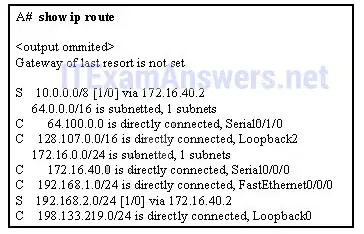
Refer to the exhibit. What two commands will change the next-hop address for the 10.0.0.0/8 network from 172.16.40.2 to 192.168.1.2? (Choose two.)
A(config)# no network 10.0.0.0 255.0.0.0 172.16.40.2
A(config)# no ip address 10.0.0.1 255.0.0.0 172.16.40.2
A(config)# no ip route 10.0.0.0 255.0.0.0 172.16.40.2
A(config)# ip route 10.0.0.0 255.0.0.0 s0/0/0
A(config)# ip route 10.0.0.0 255.0.0.0 192.168.1.2
Which type of static route that is configured on a router uses only the exit interface?
recursive static route
directly connected static route
fully specified static route
default static route
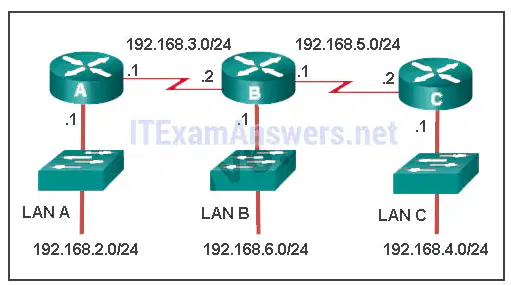
Refer to the graphic. Which command would be used on router A to configure a static route to direct traffic from LAN A that is destined for LAN C?
A(config)# ip route 192.168.4.0 255.255.255.0 192.168.5.2
A(config)# ip route 192.168.4.0 255.255.255.0 192.168.3.2
A(config)# ip route 192.168.5.0 255.255.255.0 192.168.3.2
A(config)# ip route 192.168.3.0 255.255.255.0 192.168.3.1
A(config)# ip route 192.168.3.2 255.255.255.0 192.168.4.0
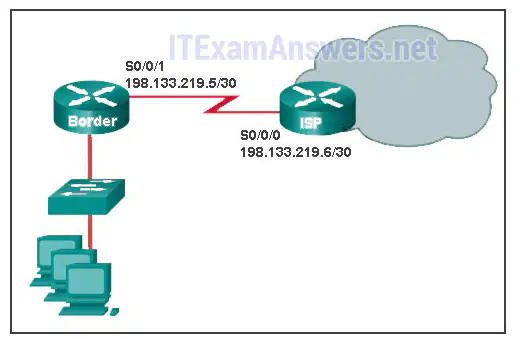
Refer to the exhibit. The network administrator needs to configure a default route on the Border router. Which command would the administrator use to configure a default route that will require the least amount of router processing when forwarding packets?
Border(config)# ip route 0.0.0.0 0.0.0.0 198.133.219.5
Border(config)# ip route 0.0.0.0 0.0.0.0 198.133.219.6
Border(config)# ip route 0.0.0.0 0.0.0.0 s0/0/1
Border(config)# ip route 0.0.0.0 0.0.0.0 s0/0/0
Refer to the exhibit. What command would be used to configure a static route on R1 so that traffic from both LANs can reach the 2001:db8:1:4::/64 remote network?
ipv6 route ::/0 serial0/0/0
ipv6 route 2001:db8:1:4::/64 2001:db8:1:3::1
ipv6 route 2001:db8:1:4::/64 2001:db8:1:3::2
ipv6 route 2001:db8:1::/65 2001:db8:1:3::1

Refer to the exhibit. Which default static route command would allow R1 to potentially reach all unknown networks on the Internet?
R1(config)# ipv6 route 2001:db8:32::/64 G0/0
R1(config)# ipv6 route ::/0 G0/0 fe80::2
R1(config)# ipv6 route ::/0 G0/1 fe80::2
R1(config)# ipv6 route 2001:db8:32::/64 G0/1 fe80::2
Which two previously independent technologies should a network administrator attempt to combine after choosing to upgrade to a converged network infrastructure? (Choose two.)
user data traffic
VoIP phone traffic
scanners and printers
mobile cell phone traffic
electrical system
What are two advantages of modular switches over fixed-configuration switches? (Choose two.)
lower cost per switch
increased scalability
lower forwarding rates
need for fewer power outlets
availability of multiple ports for bandwidth aggregation
Which type of address does a switch use to build the MAC address table?
destination IP address
source IP address
destination MAC address
source MAC address
Which network device can be used to eliminate collisions on an Ethernet network?
firewall
hub
router
switch
What two criteria are used by a Cisco LAN switch to decide how to forward Ethernet frames? (Choose two.)
path cost
egress port
ingress port
destination IP address
destination MAC address
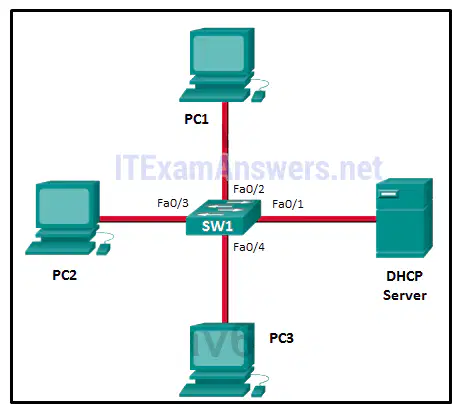
Refer to the exhibit. Consider that the main power has just been restored. PC3 issues a broadcast IPv4 DHCP request. To which port will SW1 forward this request?
to Fa0/1 only
to Fa0/1 and Fa0/2 only
to Fa0/1, Fa0/2, and Fa0/3 only
to Fa0/1, Fa0/2, Fa0/3, and Fa0/4
to Fa0/1, Fa0/2, and Fa0/4 only
What is one function of a Layer 2 switch?
forwards data based on logical addressing
duplicates the electrical signal of each frame to every port
learns the port assigned to a host by examining the destination MAC address
determines which interface is used to forward a frame based on the destination MAC address
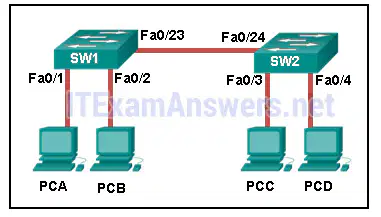
Refer to the exhibit. How is a frame sent from PCA forwarded to PCC if the MAC address table on switch SW1 is empty?
SW1 floods the frame on all ports on the switch, excluding the interconnected port to switch SW2 and the port through which the frame entered the switch.
SW1 floods the frame on all ports on SW1, excluding the port through which the frame entered the switch.
SW1 forwards the frame directly to SW2. SW2 floods the frame to all ports connected to SW2, excluding the port through which the frame entered the switch.
SW1 drops the frame because it does not know the destination MAC address.
A small publishing company has a network design such that when a broadcast is sent on the LAN, 200 devices receive the transmitted broadcast. How can the network administrator reduce the number of devices that receive broadcast traffic?
Add more switches so that fewer devices are on a particular switch.
Replace the switches with switches that have more ports per switch. This will allow more devices on a particular switch.
Segment the LAN into smaller LANs and route between them.
Replace at least half of the switches with hubs to reduce the size of the broadcast domain.

Refer to the exhibit. How many broadcast domains are displayed?
1
4
8
16
55
Which solution would help a college alleviate network congestion due to collisions?
a firewall that connects to two Internet providers
a high port density switch
a router with two Ethernet ports
a router with three Ethernet ports
What is the destination address in the header of a broadcast frame?
0.0.0.0
255.255.255.255
11-11-11-11-11-11
FF-FF-FF-FF-FF-FF
A (a) network is one that uses the same infrastructure to carry voice, data, and video signals.
What are two functions of a router? (Choose two.)
It connects multiple IP networks.
It controls the flow of data via the use of Layer 2 addresses.
It determines the best path to send packets.
It manages the VLAN database.
It increases the size of the broadcast domain.
In order for packets to be sent to a remote destination, what three pieces of information must be configured on a host? (Choose three.)
hostname
IP address
subnet mask
default gateway
DNS server
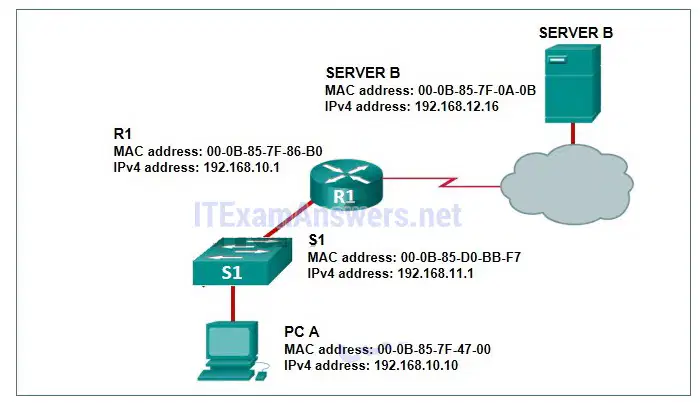
Refer to the exhibit. PC A sends a request to Server B. What IPv4 address is used in the destination field in the packet as the packet leaves PC A?
192.168.10.10
192.168.10.1
192.168.11.1
192.168.12.16
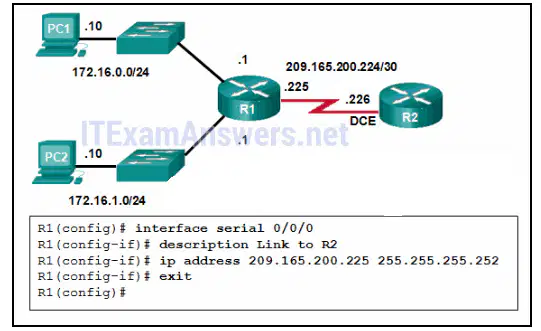
Refer to the exhibit. A network administrator has configured R1 as shown. When the administrator checks the status of the serial interface, the interface is shown as being administratively down. What additional command must be entered on the serial interface of R1 to bring the interface up?
IPv6 enable
clockrate 128000
end
no shutdown
What two pieces of information are displayed in the output of the show ip interface brief command? (Choose two.)
IP addresses
MAC addresses
Layer 1 statuses
next-hop addresses
interface descriptions
What type of network uses one common infrastructure to carry voice, data, and video signals?
borderless
converged
managed
switched
Which interface is the default location that would contain the IP address used to manage a 24-port Ethernet switch?
VLAN 1
Fa0/0
Fa0/1
VLAN 99
interface connected to the default gateway
If one end of an Ethernet connection is configured for full duplex and the other end of the connection is configured for half duplex, where would late collisions be observed?
on both ends of the connection
on the full-duplex end of the connection
only on serial interfaces
on the half-duplex end of the connection

