wayground logo

Free Printable Worksheets

Font size

S
M
L
XL
Worksheets

Unit 2: Force and Motion Study Guide

Total questions: 85

Worksheet time: 2hrs 54mins

Name
Class
Date
1.
Bill jogs 400 meters to Andy's house, turns around, and runs 400 meters back home.  He does so in 267 seconds.  What is Bill's average speed?
a)
about 3 m/s
b)
about 1.5 m/s
c)
0
d)
about 4 m/s
2.
What is the formula to calculate speed?
a)
S = t/d
b)
S = d/t
c)
S = d x t
d)
S = t x d
3.

A runner races in the 100 meter dash. It takes her 10 seconds to finish. What is her average speed?

a)

10 m/s

b)

1000 m/s

c)

100 seconds

d)

10 seconds

4.
Which of the following is a unit of time?
a)
sec
b)
mi
c)
m/s
d)
km
5.
Which of the following is a unit of speed ?
a)
sec
b)
mi
c)
m/s
d)
min
6.
Which of the following is a unit of distance ?
a)
miles/hr
b)
mi
c)
s
d)
min
7.
Which of the following is a unit of distance ?
a)
miles/hr
b)
hr
c)
km
d)
min
8.
Which of the following is a unit of time?
a)
km/hr
b)
hr
c)
km
d)
mi
9.
Which of the following is a unit of speed?
a)
km/hr
b)
hr
c)
km
d)
s
10.
A train travels 25 km in .5 hrs. How fast is the train going?
a)
25 miles/hr
b)
5 miles/hr
c)
125 km/hr
d)
50 km/hr
11.
The baseball park is 4200 m from Camden's house.  I took him 30 minutes to get there.  What was Camden's speed?
a)
.007 m/min
b)
12.60 m/min
c)
140 m/min
d)
126 m/min
12.
How long would it take a bus traveling at 50 km/h to travel 125 km?
a)
6,250 hours
b)
2.5 km
c)
2.5 hours
d)
6,250 km
13.
Distance over time.
a)
Travel
b)
Motion
c)
Velocity
d)
Speed
14.
It takes a leopard 5 minutes to travel 3 miles. What is the leopard's speed?
a)
15 m/m
b)
8 m/m
c)
.6 m/m
d)
2 m/m
15.
If I choose to walk to school at a speed of 3mph, it will take me 4 hours to arrive. How far away do I live?
a)
7 miles
b)
12 miles
c)
1 mile
d)
.75 miles
16.
What is speed?
a)
how far you go
b)
how much distance is covered over a period of time
c)
how fast you accelerate
d)
the change in the location of a object
17.
What is the fastest land mammal?
a)
horse
b)
cheetah
c)
peregrine falcon
d)
mouse
18.
A person walked 10 miles.  It took them 2 hours.  How fast were they walking?
a)
8 mph
b)
5 mph
c)
2 mph
d)
10 mph
19.

Distance formula

a)

S X T

b)

T X S

c)

T/D

d)

D/T

20.

Time formula

a)

T= D/S

b)

T= S X T

c)

T = D/ T

d)

T= T/ T

21.
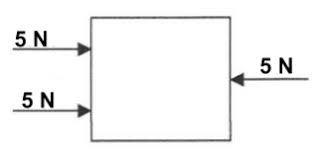
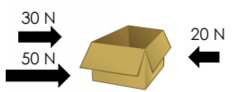
Calculate the net force of the object in the image shown.
a)
20N
b)
35N
c)
5N
d)
25N
22.
Is this a balanced or unbalance force?
a)
Balanced
b)
Unbalanced
c)
Neither one
d)
Both
23.
Which direction will the object move?
a)
Up
b)
Down
c)
Right
d)
Left
24.
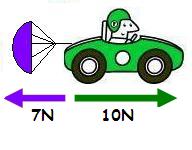
Calculate the net force of the object.
a)
10N
b)
2N
c)
15N
d)
5N
25.
Is this a balanced or unbalanced force?
a)
Balanced
b)
Unbalanced
c)
Neither
d)
Both
26.
Which direction will the object move?
a)
Right
b)
Left
c)
Up
d)
Down
27.
What is the net force of this object?
a)
0N
b)
50N
c)
25N
d)
5N
28.
Is this a balanced or unbalanced force?
a)
Balanced
b)
Unbalanced
c)
Neither
d)
Both
29.
This model shows the forces applied to a box.  However, this model DOES NOT show ________________________.
a)
the forces acting in opposite directions
b)
that the forces are unequal
c)
that student B is pushing harder
d)
the actual amount of the forces
30.
If a force causes an object to move, it's considered a(n) __________________ force.
a)
Balanced
b)
Unbalanced
c)
Massive
d)
Strong
31.
Students are playing tug-of-war. If group B pulls the rope to the right with a force of 400 N and group A pulls the rope to the left with a force of 250 N, what will happen to the ribbon in the middle of the rope?
a)
The ribbon will move to the left and group A will win the tug-of-war.
b)
The ribbon will move to the left and group B will win the tug-of-war.
c)
The ribbon will move to the right and group B will win the tug-of-war.
d)
The ribbon will move to the right and group A will win the tug-of-war.
32.
If a force causes an object to start moving, stop moving, or change direction it's considered a(an)__________________force.
a)
Balanced
b)
Unbalanced
c)
Magnetic
d)
Gravitational
33.
A cyclist traveling at 25 km/hr turns sharply to the left while continuing to move 25 km/hr. This means the forces involved are_____________________.
a)
Balanced, because the cyclist's speed did not change.
b)
Balanced, because he was still moving forward.
c)
Unbalanced, because it's the same bicycle.
d)
Unbalanced, because his direction changed.
34.
The forces represented by the arrows in the diagrams are applied to the four objects that are at rest on a table. Which object is most likely to move to the right?
a)
Object W
b)
Object X
c)
Object Y
d)
Object Z
35.
The forces represented by the arrows in the diagrams are applied to the four objects that are at rest on a table. Which object is most likely to remain in place?
a)
Object W
b)
Object X
c)
Object Y
d)
Object Z
36.
If a force does not cause an object to move, it's considered a(n) __________________ force.
a)
Balanced
b)
Unbalanced
c)
Wimpy
d)
Weak
37.
An airplane is travelling North through the sky at a constant speed when turbulence causes it to take a different route, changing its direction. Explain the forces at work on this plane.
a)
Unbalanced, because the plane is moving forward, not backwards
b)
Unbalanced, because the speed is constant and there is a change in direction
c)
Balanced, because the plane is not falling to a lower altitude
d)
Unbalanced, because the plane is in motion
38.
An airplane is travelling at a constant speed of 540 mph.  Explain the forces at work on the plane.
a)
Unbalanced, because the plane is moving forward not backards
b)
Balanced, because the speed is constant and there is no change in direction
c)
Balanced, because the plane is not falling to a lower altitude
d)
Unbalanced, because the plane is in motion
39.
Imagine a bat swinging with a force of 1200 N, hitting a ball pitched with a force of 400 N. At what net force does the ball move away from the bat?
a)
1600 N
b)
800 N
c)
400 N
d)
Net force of 0 N
40.
The roller coaster car begins at point W.  At what point along the track will the car have the greatest amount of kinetic energy?
a)
W
b)
X
c)
Y
d)
Z
41.

When an unbalanced force acts on an object, the force ______________________.

a)

changes the motion of the object

b)

is cancelled by another force

c)

does not change the motion of an object

d)

is equal to the weight of the object

42.

When two equal forces act in opposite directions on an object, they are called ______________________.

a)

frictional force

b)

balanced force

c)

centripetal force

d)

gravitational force

43.

The resistance of an object to any change in its motion is called ______________________.

a)

inertia

b)

friction

c)

gravity

d)

weight

44.

According to Newton’s second law of motion, force is equal to mass times ______________________.

a)

inertia

b)

weight

c)

acceleration

d)

direction

45.
What law is best described by inertia?
a)
1st
b)
2nd
c)
3rd
46.

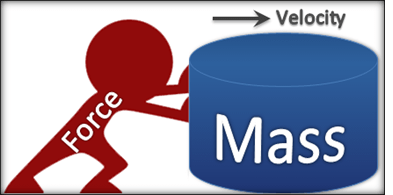
The picture is an example of Newton's...

a)

1st Law

b)

2nd Law

c)

3rd Law

47.

The picture is an example of Newton's...

a)

1st Law

b)

2nd Law

c)

3rd Law

48.
"For every action, there is an equal and opposite reaction."
a)
Newton's 1st Law
b)
Newton's 2nd Law
c)
Newton's 3rd Law
d)
Newton's 4th Law
49.
Force = Mass x Acceleration
a)
Newton's 1st Law
b)
Newton's 2nd Law
c)
Newton's 3rd Law
d)
Newton's 4th Law
50.
"An object in motion (or at rest) will to stay in motion (or at rest) until an outside force acts upon it."
a)
Newton's 1st Law
b)
Newton's 2nd Law
c)
Newton's 3rd Law
d)
Newton's 4th Law
51.
Any push or pull on an object.
a)
force
b)
velocity 
c)
inertia
d)
momentum
52.
The force that opposes motion between two surfaces in contact with each other.
a)
inertia
b)
friction
c)
momentum
d)
gravity
53.
The combination of all the forces acting on an object is the...
a)
net force
b)
action force
c)
reaction force
d)
balance force
54.
A Newton is a unit of...
a)
force
b)
inertia
c)
acceleration
d)
velocity
55.

When two equal forces act in opposite directions on an object, they are called ______________________.

a)

frictional force

b)

balanced force

c)

centripetal force

d)

gravitational force

56.

When an unbalanced force acts on an object, the force ______________________.

a)

changes the motion of the object

b)

is cancelled by another force

c)

does not change the motion of an object

d)

is equal to the weight of the object

57.

The resistance of an object to any change in its motion is called ______________________.

a)

inertia

b)

friction

c)

gravity

d)

weight

58.

According to Newton’s second law of motion, force is equal to mass times ______________________.

a)

inertia

b)

weight

c)

acceleration

d)

direction

59.
What law is best described by inertia?
a)
1st
b)
2nd
c)
3rd
60.

The picture is an example of Newton's...

a)

1st Law

b)

2nd Law

c)

3rd Law

61.

The picture is an example of Newton's...

a)

1st Law

b)

2nd Law

c)

3rd Law

62.

The picture is an example of Newton's...

a)

1st Law

b)

2nd Law

c)

3rd Law

63.

Acceleration is due to a force put on an objects mass.

a)

1st Law

b)

2nd Law

c)

3rd Law

64.
"For every action, there is an equal and opposite reaction."
a)
Newton's 1st Law
b)
Newton's 2nd Law
c)
Newton's 3rd Law
d)
Newton's 4th Law
65.
Force = Mass x Acceleration
a)
Newton's 1st Law
b)
Newton's 2nd Law
c)
Newton's 3rd Law
d)
Newton's 4th Law
66.
"An object in motion (or at rest) will to stay in motion (or at rest) until an outside force acts upon it."
a)
Newton's 1st Law
b)
Newton's 2nd Law
c)
Newton's 3rd Law
d)
Newton's 4th Law
67.
Any push or pull on an object.
a)
force
b)
velocity 
c)
inertia
d)
momentum
68.
The force that opposes motion between two surfaces in contact with each other.
a)
inertia
b)
friction
c)
momentum
d)
gravity
69.
The force of attraction between all matter.
a)
inertia
b)
friction
c)
net force
d)
gravity
70.
A Newton is a unit of...
a)
force
b)
inertia
c)
acceleration
d)
velocity
71.
When all the forces on an object are equal and opposite, & the net force is zero, that's...
a)
balanced forces
b)
unbalanced forces
c)
terminal velocity
d)
reaction forces
72.
The combination of all the forces acting on an object is the...
a)
net force
b)
action force
c)
reaction force
d)
balance force
73.
An archer pulls the bowstring back, then releases the string and the arrow flies forward. Pulling the string back is the...
a)
action force
b)
reaction force
c)
net force
d)
inertia
74.
An archer pulls the bowstring back, then releases the string and the arrow flies forward. The arrow flying forward is the...
a)
action force
b)
reaction force
c)
net force
d)
inertia
75.
Gravity is increased with...
a)
greater mass & shorter distance
b)
greater mass & farther distance
c)
lower mass & shorter distance
d)
lower mass & farther distance
76.

A force is a

a)

person

b)

push or a pull

c)

rock

d)

plant

77.

A force that slows or stops motion when objects are touching.

a)
Friction
b)
Push
c)
Pull
d)
Magnetism
78.

What can be attracted to magnets?

a)
wood
b)
skin
c)
Metals such as iron, nickel and cobalt
d)

plastic

79.
What will happen when these magnets are brought close together?
a)
They will attract each other.
b)
They will repel each other.
c)
Both magnets will turn to the left
d)
Both magnets will turn to the right
80.

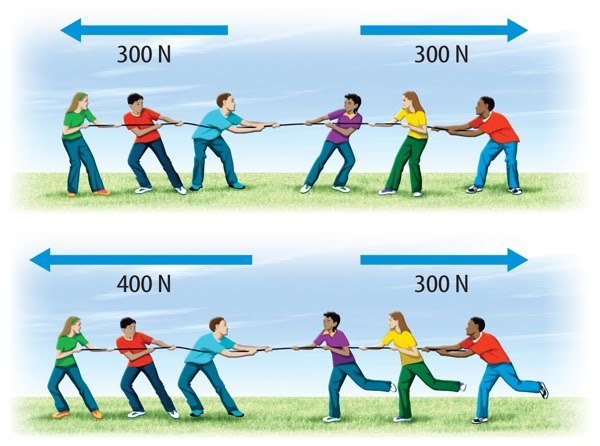
Is the net force balanced or unbalanced?

a)

Balanced

b)

Unbalanced

81.
Which one is balanced?
a)
top
b)
bottom
c)
both
82.
Calculate the net force shown in the  diagram?
a)

6 N Left

b)
0 N
c)

3 N Left

d)

9N Left

83.
What is the unit for FORCE? 
a)
N (Newtons)
b)
lbs (pounds)
c)
g (grams)
d)
m/s (meters per second)
84.
What is the net force?
a)
17 N Right
b)
3 N Right
c)
3 N Left
d)
17 N Left
85.

Calculate the net force. 

a)
60N, Left 
b)
40N, Right 
c)
0N
d)
60N, Right