wayground logo

Free Printable Worksheets

Font size

S
M
L
XL
Worksheets

Meteorology Unit Review

Total questions: 90

Worksheet time: 5hrs 30mins

Name
Class
Date
1.

How does a warm front form?

a)

Warm air becomes caught between cold air masses.

b)

Two air masses meet and stay separated

c)

Warm air moves over cold air and replaces it

d)

Cold air moves under warm air and pushes it up

2.

What kind of weather does a cold front usually bring?

a)

warm

b)

windy

c)

Stormy

d)

sunny

3.
Layer of Earth's atmosphere where it rains
a)
thermosphere
b)
mesosphere
c)
stratosphere
d)
troposphere
4.

Earth's ozone layer is important because it absorbs

a)

visible light

b)

harmful ultraviolet radiation (UV light)

c)

x-rays

d)

radio waves

5.

Identify the 2 main gases in Earth's atmosphere

a)

Nitrogen

b)

Oxygen

c)

Methane

d)

Carbon Dioxide

6.

The ozone layer is in this layer of the atmosphere:

a)

Stratosphere

b)

Thermosphere

c)

Exosphere

d)

Troposphere

7.

This is the layer where meteors, or shooting stars, burn up.

a)

Troposphere

b)

Stratosphere

c)

Mesosphere

d)

Thermosphere

8.

What causes wind?

a)

differences in air pressure

b)

differences in gravity

c)

difference in oxygen

d)

differences in the thermosphere

9.

What causes differences in air pressure?

a)

even heating of the Earth

b)

Even cooling of the earth

c)

uneven heating of the earth

d)

global warming

10.

Local winds blow over:

a)

short distances

b)

long distances

c)

the poles

d)

the equator

11.

Flow of air from land to a body of water is called:

a)

doldrum

b)

chinook

c)

sea breeze

d)

land breeze

12.

Sea breezes occur?

a)

during the day

b)

during the night

c)

high noon

d)

full moon

13.
What kind of air pressure does COLD air have?
a)
High pressure
b)
Low pressure
14.
During the day, warm air rises over the land then cools and falls over water in a continuous cycle.
a)
Land breeze
b)
Sea breeze
15.
What kind of air pressure does WARM air have?
a)
High pressure
b)
Low pressure
16.
What is responsible for warming the Earth’s surface and creating wind?
a)
The Moon
b)
Earth's interior (inside)
c)
Coriolis effect
d)
The Sun
17.
Which statement correctly defines wind?
a)
Wind is the movement of air from areas of low pressure to areas of high pressure
b)
Wind is the movement of air to a colder area in the atmosphere.
c)
Wind is the movement of air from areas of high pressure to areas of low pressure.
d)
Wind is the movement of air pushed around and bouncing off Earth's surface.
18.
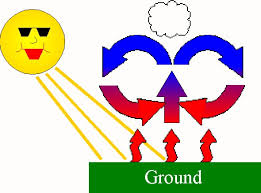
Why does warm air rise?
a)
Warm air is more dense than cooler air.
b)
Warm air has more pressure than cooler air.
c)
Warm air is less dense than cooler air.
d)
Warm air has a higher dew point than cooler air.
19.
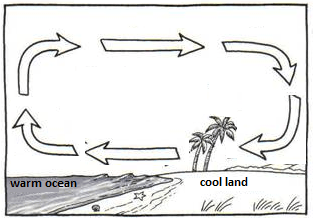
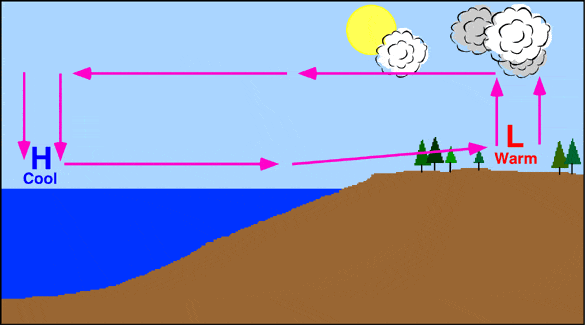
What kind of breeze is this and when would it form?
a)
Land breeze - daytime
b)
Land breeze - nighttime
c)
Sea breeze - daytime
d)
Sea breeze - nighttime
20.
Is this a land or a sea breeze?
a)
land breeze
b)
sea breeze
21.
The strength of a sea breeze depends on
a)
the heat of the day
b)
the difference between the temperature of the sea and the land
c)
the wind speed
d)
the amount of precipitation that day
22.
Which best describes why winds at the beach change direction between day and night? **
a)
because the temperatures over land and over water change 
b)
because warm air over land sinks and stays in place over land
c)
because cool air rises and is replaced by warm air from the ocean 
d)
because cool air sinks and stays in place over land 
23.
Why do land breezes occur at night?
a)
Land cools off slower than water, so the air above water is cooler.
b)
Water cools off faster than land, so the air above land is warmer.
c)
Land heats up slower than water, so the air stays cooler during the day.
d)
Water cools off slower than land, so the air above water is warmer.
24.

During the land breeze, what starts moving the cooler air out and warmer air in?

a)

conduction

b)

convection

c)

radiation

25.
What causes wind?
a)
movement of high pressure to low pressure
b)
movement of low pressure to high pressure
26.
The curving path of a moving object from an otherwise straight path due to Earth's rotation is called what?
a)
Sublimation
b)
Continental Deflection
c)
Transpiration
d)
Coriolis Effect
27.
What causes wind?
a)
convection currents
b)
conduction currents
c)
radiation currents
d)
tropical currents
28.
What is the instrument called that measures air pressure?
a)
thermometer
b)
ruler
c)
yard stick
d)
barometer
29.
Which of these MOST likely causes winds to blow on Earth?
a)
Earth spins quickly, causing air to blow around.
b)
The gravity of Earth and the Moon push and pull the air.
c)
Warm air rises and cool air falls toward Earth's surface.
d)
Ocean waves push air onto the shore and across Earth's surface.
30.
Which global winds have the greatest impact on the weather in the US?
a)
trade winds
b)
prevailing westerlies
c)
doldrums
d)
polar easterlies
31.
I am a fast-moving ribbon of AIR that moves from west to east in the Northern Hemisphere around the Earth.
a)
California Current
b)
Gulf Stream
c)
Jet Stream
d)
Atlantic Ocean
32.
What type of winds blow constantly, predictably, and over long distances?
a)
land breezes
b)
mountain breezes
c)
global winds
d)
land breezes
33.

The Coriolis effect causes ___________.

a)

the Earth to rotate on its axis

b)

earthquakes

c)

global winds to move in a curved path instead of a straight line

d)

the Earth to revolve around the sun

34.
The tropical winds running from 0 to 30 degrees latitude are called:
a)
subtropical westerlies
b)
polar westerlies
c)
trade winds
d)
polar winds
35.
What kind of heat transfer happens when the sun is heating your body?
a)
Conduction
b)
Radiation
c)
Convection
d)
Density
36.
What heat transfer happens when you burn your hand by touching a fire?
a)
Radiation
b)
Conduction
c)
Convection
d)
I don't know!!!!!!!!!!!
37.
Warm air rises and the cool air sinks demonstrates this type of heat transfer. 
a)
conduction
b)
convection
c)
radiation
d)
Insolation 
38.
Which direction will the heat flow while this person holds a hot cup of tea?
a)
from the cup to her hand
b)
from her hand to the cup
c)
no heat is transferred
39.
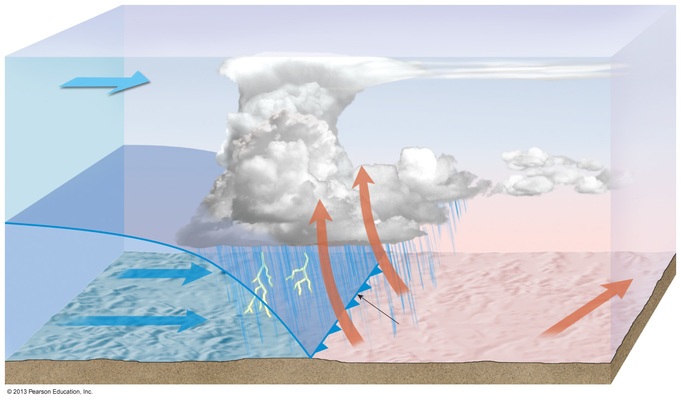
What type of storm front is this? 
a)
warm front
b)
cold front
c)
stationary front
d)
occluded front
40.

The symbol on a weather map for a cold front is what?

a)

a blue line with triangles on it

b)

a blue line with semi-circles on it

c)

a red line with triangles on it

d)

a red line with circles on it

41.
This is the symbol for a(n) _______________
a)
warm front
b)
cold front
c)
stationary front
d)
occluded front
42.
A front is
a)
where warm air is cooling at earth's surface
b)
a line where hot and cold air are separating
c)
a line where two different air masses meet
d)
where cold air is rising and forming rain clouds
43.
A cold front usually brings what kind of weather?
a)
snow  
b)
sunny and fair
c)
rain and/or thunderstorms 
d)
 cool and dry 
44.
What type of cloud produces most thunderstorms?
a)
cumulonimbus
b)
Altostratus
c)
Stratus
d)
Cirrus
45.
How do we name air masses?
a)
Water and temperature
b)
Air pressure
c)
moisture and temperature
d)
Cold and warm
46.
6. Air masses develop because the Earth is heated unevenly.
a)
True
b)
False
47.
What type of weather does a high pressure system bring?
a)
Stormy weather
b)
Clear skies, little rain
48.
What type of weather does a low pressure system bring?
a)
stormy, cloudy weather
b)
clear skies
49.
4. An air mass is...
a)
A body of air with the same temperature and moisture throughout.
b)
a body of air that produces rain
c)
A body  of evaporated water
d)
the weight of air
50.

Where do CONTINENTAL air masses form?

a)

Over water

b)

Over land

51.

Where do MARITIME air masses form?

a)

Over water

b)

Over land

52.

What type of air mass is found over EGYPT?

a)

Maritime Polar

b)

Maritime Tropical

c)

Continental Polar

d)

Continental Tropical

53.

Which type of air mass is HOT and DRY?

a)

Maritime Polar

b)

Maritime Tropical

c)

Continental Polar

d)

Continental Tropical

54.

Which type of air mass is HOT and HUMID?

a)

Maritime Polar

b)

Maritime Tropical

c)

Continental Polar

d)

Continental Tropical

55.

Which type of air mass is COLD and HUMID?

a)

Maritime Polar

b)

Maritime Tropical

c)

Continental Polar

d)

Continental Tropical

56.

Which type of air mass is COLD and DRY?

a)

Maritime Polar

b)

Maritime Tropical

c)

Continental Polar

d)

Continental Tropical

57.
If a city is located in a coastal area, what does that mean?
a)
near the coast, near large bodies of water
b)
on land, not near large bodies of water
58.
If a city is located at an inland area, what does that mean?
a)
near the coast, near large bodies of water
b)
on land, not near large bodies of water
59.
Which city is experiencing thunderstorms?
a)
Denver
b)
New York 
c)
Miami 
d)
Boise
60.
Which city has partly cloudy skies?
a)
Boise
b)
New York
c)
Atlanta 
d)
Dallas
61.
Which city is close to a warm front?
a)
Chicago
b)
New York
c)
Boise
d)
Denver
62.
a)
Low Clouds
b)
Low Temperatures
c)
Light Wind
d)
Low Air Pressure
63.
a)
Warm Front
b)
High Air Pressure
c)
Cold Front
d)
High Temperatures
64.
a)
High Air Pressure
b)
High Temperatures
c)
Heavy Rain
d)
Hail
65.
a)
High Pressure
b)
Warm Front
c)
Cold Front
d)
Mountains
66.
Our weather generally moves in this direction...
a)
West to East
b)
East to West
c)
North to South
d)
South to North
67.
The amount of water vapor present in the air is called ________________.
a)
weather
b)
humidity
c)
air mass
d)
dew point
68.
Air pressure is greatest:
a)
closer to Earth
b)
farther from Earth
69.
What causes warm air to rise?
a)
the fact that it's less dense than cold air 
b)
The fact that it weighs more than cold air 
c)
The fact that it has higher pressure than cold
d)
the fact that its more dense than cold air 
70.
The Earth's ____________ is the layer of gases that surround the planet and make it possible for living things to survive on Earth.
a)
atmosphere
b)
water cycle
c)
shell
d)
land
71.
Earth's atmosphere is made up of ______ of nitrogen. The remaining is made up of carbon dioxide, water vapor, and other gases.
a)
1/4
b)
2/3
c)
1/5
d)
3/4
72.
This extreme weather event forms over warm oceans and weakens when it hits land.
a)
Hurricane
b)
Tornado
73.
There are usually around ten of these every year in the Atlantic Ocean.
a)
Hurricane
b)
Tornado
74.
This extreme weather event forms over flat land.
a)
Hurricane
b)
Tornado
75.
Hurricanes lose power by
a)
traveling over the ocean
b)
travel over land
76.
What is the source for warming up ocean water?
a)
the sun
b)
water movement
c)
wind
d)
fish peeing in the ocean water
77.

The pressure inside the eye of a hurricane is _______.

a)

High

b)

Low

78.
In order for a hurricane to form, the water must be ________.
a)
Cool
b)
Warm
c)
Cold
d)
Hot
79.
What causes damage in a hurricane?
a)
Winds
b)
Flooding
c)
Storm Surge
d)
All of the above
80.
Where do most hurricanes develop?
a)
Middle of the United States
b)
Near the Equator
c)
Near Canada and Alaska
d)
Antarctica
81.
Ocean currents have an affect on which two things
a)
climate and weather
b)
temperature and density
c)
land and sea
d)
equator and poles
82.
What is the name of a scientist who studies weather?
a)
biologist
b)
geologist
c)
optometrist
d)
meterorologist
83.
In what direction do hurricanes rotate in the Northern Hemisphere?
a)
Clockwise
b)
Counterclockwise
c)
Up
d)
Down
84.

78% of the Earth's atmosphere is ___________ and 21% of the Earth's atmosphere is _____________.

a)

Oxygen, Nitrogen

b)

Nitrogen, Oxygen

c)

Nitrogen, Carbon Dioxide

d)

Oxygen, Carbon Dioxide

85.

In the troposphere, the temperature _____ as altitude increases.

a)

Increases

b)

Decreases

c)

Stays the same

d)

Goes up and down

86.

As altitude increases, air pressure....

a)

Increases

b)

Decreases

c)

Stays the same

d)

Goes up and down

87.

What is the order of the layers of the atmosphere, starting with the layer closest to Earth's surface?

a)

Stratosphere, Troposphere, Exosphere, Mesosphere, Thermosphere

b)

Troposphere, Stratosphere, Mesosphere, Thermosphere, Exosphere

c)

Troposphere, Stratosphere, Mesosphere, Exosphere, Thermosphere

d)

Troposphere, Stratosphere, Thermosphere, Exosphere, Mesosphere

88.

Which explanation correctly describes the greenhouse effect?

a)

The process of the atmosphere keeping the Earth's surface dense

b)

The process of the atmosphere trapping the sun's radiation, and making the Earth warm and livable for humans

c)

The process of the atmosphere keep us from floating into space

d)

The process of the atmosphere reflecting all of the Sun's heat back into space

89.
This layer is the hottest.
a)
troposphere
b)
mesosphere
c)
stratosphere
d)
thermosphere
90.

Which layer of the atmosphere, based on its composition, is most impacted by the addition of man-made greenhouse gas molecules?

a)

Troposphere

b)

Stratosphere

c)

Mesosphere

d)

Thermosphere