

Wayground logo

Free Printable Worksheets

Font size

S
M
L
XL
Worksheets

Radioactivity; Typer of Particles and Nuclear Equations

Total questions: 37

Worksheet time: 2hrs 1mins
Name
Class
Date
1.
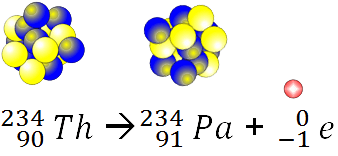
Which type of nuclear radiation is being emitted here?
a)
Alpha
b)
beta
c)
gamma 
d)
none
2.
What makes something radioactive?
a)
elements with an atomic number above 81
b)
an unstable nucleus
c)
contaminated sewage
d)
It decays over time
3.
Takes two small nuclei and combines them into a larger nucleus
a)
fission
b)
fusion
4.
Which type of nuclear radiation is being emitted here?
a)
alpha
b)
beta
c)
gamma
d)
none
5.
The three types of nuclear radiation in increasing order of penetrating power are ____.  
a)
  alpha, beta, gamma 
b)
X ray, beta, gamma
c)
alpha, gamma, beta 
d)
X ray, gamma, beta 
6.

During nuclear fission, a nucleus _________.

a)

grows

b)

divides

c)

shrinks

d)

combines with another

7.

Only nuclei with _________ atomic numbers can undergo fission.

a)

small

b)

even

c)

odd

d)

large

8.

Which type of radioactive decay can be blocked by tissue paper?

a)

alpha particles

b)

beta particles

c)

positrons

d)

gamma radiation

9.

What types of radioactive decay has a negative charge?

a)

alpha particles

b)

beta particles

c)

positrons

d)

gamma radiation

10.

What is the highest-energy type of radioactive decay?

a)

alpha particles

b)

beta particles

c)

positrons

d)

gamma radiation

11.

Which type of radioactive decay has NO mass?

a)

alpha particles

b)

beta particles

c)

positrons

d)

gamma radiation

12.

This is the balanced equation for the decay of Rn-222.

a)

true

b)

false

13.

What are the products of U-238 decay?

a)

a beta particle and Np-238

b)

a positron and Pa-238

c)

an alpha particle and 234-Pu

d)

an alpha particle and 234-Th

14.

What are the products of Ne-19 decay?

a)

a positron and F-19

b)

a beta particle and Na-19

c)

an alpha particle and O-19

d)

a positron and F-18

15.

The products of Co-60 decay are

a)

a positron and Fe-60.

b)

an alpha particle and Mn-56.

c)

a beta particle and Fe-60.

d)

a beta particle and Ni-60.

16.

Which represents positron decay?

a)

1

b)

2

c)

3

d)

4

17.

Which is the correct missing product for equation 1?

a)

Mass # is 230, nuclear charge is 86 and the atom is Rn

b)

Mass # is 222, nuclear charge is 84 and the atom is Po

c)

Mass # is 222, nuclear charge is 86 and the atom is Rn

d)

Mass # is 222, nuclear charge is 86 and the atom is At

18.

What is the other product in equation 2?

a)

The mass # is 131, the nuclear charge is 50, and the atom is Sn

b)

The mass # is 130, the nuclear charge is 52, and the atom is Te

c)

The mass # is 131, the nuclear charge is 52, and the atom is Te

d)

The mass # is 13o, the nuclear charge is 50, and the atom is Sn

19.
Solve this equation for alpha decay.
20985At = ___ + 42He
a)
20583Bi
b)
20986Rn
c)
20781Tl
d)
20885At
20.
Solve this equation for beta decay.
6027Co = ___ + 0-1e
a)
5625Mn
b)
6028Ni
c)
5823V
d)
5927Co
21.
If we start off with element 5024X after an alpha decay we get another element Y that looks like
a)
5022Y
b)
4622Y
c)
4820Y
d)
5426Y
22.
What is the missing isotope that will balance the following nuclear equation?
94Be  +  11H →  _____  +  42He
a)
105B
b)
105Ne
c)
63Li
d)
63C
23.
The least penetrating form of radiation is _____.
a)
alpha
b)
beta
c)
gamma
d)
UV
24.
The most penetrating form of radiation is _____.
a)
alpha
b)
beta
c)
gamma
d)
UV
25.
Alpha radiation consists of a ______.
a)
helium nucleus
b)
pure energy
c)
high velocity electron
d)
sunlight
26.
What is the product of the alpha decay of Gold-175?
a)
Ir-171
b)
Tl-179
c)
Au179
d)
Au171
27.
What happens to the atomic number during alpha decay?
a)
The atomic number decreases by 4
b)
The atomic number increases by 1
c)
The atomic number decreases by 2.
d)
The atomic number stays the same.
28.

Which nuclear reaction takes place because MULTIPLE nuclei combine with large amounts of heat and pressure to create ONE, large mass that then also releases vast amounts of energy

a)

fission

b)

fusion

c)

chain reaction

d)

endothermic

29.

The atomic bomb is what type of nuclear reaction?

a)

fission

b)

fusion

c)

half life

d)

endothermic

30.

The splitting of a nucleus into smaller, lighter nuclei is called what?

(taking a large marshmallow and tearing it into two smaller pieces)

a)

fusion

b)

fission

c)

hydrogen bomb

31.

 Balance the following nuclear equation:

           1327Al + 01n ⟶ 1124Na  +   ?\ \ \ \ \ \ \ \ \ \ \ _{13}^{27}Al\ +\ _0^1n\ \longrightarrow\ _{11}^{24}Na\ \ +\ \ \ ?  


a)

   24He\ \ \ _2^4He  

b)

   25H\ \ \ _2^5H  

c)

   1342 Al\ \ \ _{13}^{42\ }Al  

d)

   1425Si\ \ \ _{14}^{25}Si  

32.

 Balance the following nuclear equation:

           92238U + 01n ⟶ −1   0B  +   ?\ \ \ \ \ \ \ \ \ \ \ _{92}^{238}U\ +\ _0^1n\ \longrightarrow\ _{-1}^{\ \ \ 0}B\ \ +\ \ \ ?  


a)

   93239Np\ \ \ _{93}^{239}Np  

b)

   94239Pu\ \ \ _{94}^{239}Pu  

c)

   93238 Np\ \ \ _{93}^{238\ }Np  

d)

   94238Am\ \ \ _{94}^{238}Am  

33.

 Balance the following nuclear equation:

           94239Pu + 24He ⟶ ? +  01n\ \ \ \ \ \ \ \ \ \ \ _{94}^{239}Pu\ +\ _2^4He\ \longrightarrow\ ?\ +\ \ _0^1n  


a)

   96242Cm\ \ \ _{96}^{242}Cm  

b)

   94242P\ \ \ _{94}^{242}P  

c)

   93238 Pu\ \ \ _{93}^{238\ }Pu  

d)

   96240C\ \ \ _{96}^{240}C  

34.

 Balance the following nuclear equation:

           ? + 24He    ⟶   817O  +   11H\ \ \ \ \ \ \ \ \ \ \ ?\ +\ _2^4He\ \ \ \ \longrightarrow\ \ \ _8^{17}O\ \ +\ \ \ _1^1H  


a)

   714N \ \ \ _7^{14}N\  

b)

   917P\ \ \ _9^{17}P  

c)

   914 F\ \ \ _9^{14\ }F  

d)

   814O\ \ \ _8^{14}O  

35.

 Balance the following nuclear equation:

           82208Pb +  ?    ⟶   112277Cn  +   01n\ \ \ \ \ \ \ \ \ \ \ _{82}^{208}Pb\ +\ \ ?\ \ \ \ \longrightarrow\ \ \ _{112}^{277}Cn\ \ +\ \ \ _0^1n  


a)

   3070Zn \ \ \ _{30}^{70}Zn\  

b)

   11217P\ \ \ _{112}^{17}P  

c)

   4070 Zr\ \ \ _{40}^{70\ }Zr  

d)

   814O\ \ \ _8^{14}O  

36.

 Balance the following nuclear equation:

           2656Fe +  24He    ⟶   −1   0 e  +  ?\ \ \ \ \ \ \ \ \ \ \ _{26}^{56}Fe\ +\ \ _2^4He\ \ \ \ \longrightarrow\ \ \ _{-1}^{\ \ \ 0}\ e\ \ +\ \ ?  


a)

   2960Cu \ \ \ _{29}^{60}Cu\  

b)

   3960C\ \ \ _{39}^{60}C  

c)

   2940 Si\ \ \ _{29}^{40\ }Si  

d)

   814O\ \ \ _8^{14}O  

37.

Balance the following nuclear equation:

           ? +  24He    ⟶      14   30 Si +  11H\ \ \ \ \ \ \ \ \ \ \ ?\ +\ \ _2^4He\ \ \ \ \longrightarrow\ \ \ _{\ \ \ 14}^{\ \ \ 30}\ Si\ +\ \ _1^1H


a)

   1327Al\ \ \ _{13}^{27}Al

b)

   1527Ar\ \ \ _{15}^{27}Ar

c)

   1440 Si\ \ \ _{14}^{40\ }Si

d)

   814O\ \ \ _8^{14}O
