
 Worksheets
What's The Matter? Unit Review
Total questions: 75
Worksheet time: 2hrs 37mins
Matter is...
only things that we can see with our eyes
anything that has mass and takes up space
something you find in a mattress
how much space something takes up
Elements are...
made of two or more different types of atoms
always made of two or more types of atoms
made of only one type of atom
Molecules are...
made of two or more different types of atoms
always made of two or more atoms
made of only one type of atom
Mass is the amount of
weight in an object.
physical property in an object.
space an object occupies.
matter in an object.
What is volume?
the amount of energy in a material.
the measure of the amount of space taken up by an object.
the measure of the height of an object.
the measure of how much of one substance can be dissolved in another substance.
Density is
the measure of how much of one substance can dissolve in another substance.
the measure of the amount of energy in a material.
the measure of the amount of matter in a given volume of an object.
the measure of the width and length of an object.
What is solubility?
the measure of how much of one substance can be dissolved in another substance
the measure of how much energy it takes to melt a substance
the ability of a substance to melt completely when heated
the ability of a substance to turn into water vapor
Which statement is true about an apple that has been cut in half?
its density will increase
its density will stay the same
its mass will stay the same
its density will decrease
How can the volume of a marble be found?
by multiplying its length, width, and height
by putting it in a graduated cylinder filled with a known amount of water
by putting it in a graduated cylinder filled with no water in it
by subtracting its length, width, and height
What is a physical property?
the measure of the amount of matter in an object
the measure of the amount of matter in a given volume of an object
the measure of the pull of gravity on an object
something about a material that can be measured or detected by the senses
Karen knows that her bracelet has a mass of 21 grams. What else does she need to know to determine the density of her bracelet?
its weight
its volume
its length
the material it is made of
Which of the following is not a physical property of an object?
color
size
flammability
shape
The density of fresh water is 1.0 g/mL. Based on the densities of the following objects, which object will sink when placed in water?
ice cube - 0.9 g/mL
rock - 2.3 g/mL
oil - 0.8 g/mL
balloon - 0.02 g/mL
The density of water is (a) g/mL
Which of the following is a independent physical property?
mass
volume
melting point
weight
Which of the following is a dependent physical property?
mass
density
melting point
texture
A dependent physical property...
changes based on the amount of matter
does not change based on the amount of matter
An independent physical property...
changes based on the amount of matter
does not change based on the amount of matter
Simple sugar is a mixture of water and sugar that was heated. Which ingredient in the mixture is the solute?
sugar
water
Simple sugar is a mixture of water and sugar that was heated. Which ingredient in the mixture is the solvent?
sugar
water
Which instrument would be used to measure mass?
scale
graduated cylinder
ruler
beaker
Which instrument would be used to measure volume?
scale
graduated cylinder
test tube
beaker
The temperature at which a solid changes to a liquid is the _______.
melting point
freezing point
boiling point
The temperature at which a liquid changes to a solid is the _______.
melting point
freezing point
boiling point
The temperature at which a liquid changes to a gas is the _______.
melting point
freezing point
boiling point
What does not impact the rate of solubility?
surface area
movement
heat
conductivity
The part of the solution that dissolves is called the ______.
solute
solvent
The part of the solution that does the dissolving is called the ______.
solute
solvent


What is the volume of the fish?
18.0 mL
6.0 mL
38.0 mL
32.0 mL
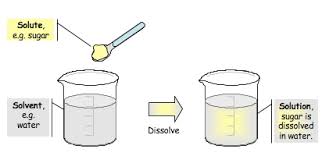
The ability of sugar to dissolve in water is called
malleability
Density
State
solubility
True or False. Melting butter is a physical change
True
false
If an object has a density of 1.03 g/ml, will it float or sink in water?
True
False
Float
Sink

What is the density?
2 g/mL
800 g/mL
60 g/mL
20 g/mL

What is the Density?
44 g/cm3
11 g/cm3
20 g/cm3
24 g/cm3

What is the Density?
245 g/cm3
28 g/cm3
5 g/cm3
42 g/cm3
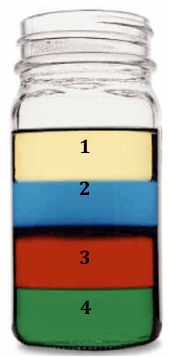
Which liquid has the lowest density?
Liquid 1
Liquid 2
Liquid 3
Liquid 4
Which conclusion is correct based on the picture.
Liquid 4 is the least dense since it is on the bottom of the jar.
Liquid 2 is water because it is blue.
Liquid 3 has a higher density than Liquid 2
Liquid 1 is the most dense because it is at the top of the jar.
Which units of measurement are used for volume?
grams
centimeters
grams/milliliter
milliliter

Which box has a lower density?
Which box has a larger volume?
The volume of the boxes are the same.
Which box has a larger mass?
The mass of the boxes are the same.

This is H2O. How many Hydrogen atoms are there?
1
2
3
0
How many different elements are in C6H12O6?
1
2
3
24
How many Nitrogen atoms are in NH3?
3
1
4
0
Phase change going from a Liquid to a Gas...
Vaporization
Deposition
Condensation
Melting
Phase change going from a Solid to a Gas...
Deposition
Sublimation
Condensation
Recombination
Phase change going from a Solid to a Liquid...
Freezing
Condensation
Melting
Sublimation
Phase change going from a Gas to a Solid...
Deposition
Sublimation
Condensation
Vaporization
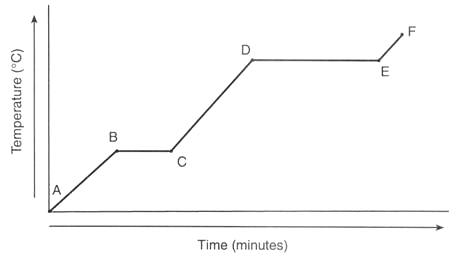
What state/phase is the object likely from points A to B?
Solid
Liquid
Gas
Plasma
What is happening to the particles in the substance between points D and E?
Melting
Freezing
Vaporizing
Sublimating

Where on the graph are phase changes taking place?
1
2
3
4
5
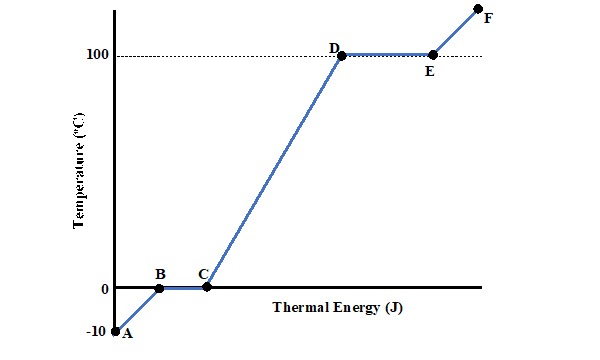
Between which two points is the gas heating up?
A ----> B
B <---- C
C ----> D
D ----> E
E ----> F


