
 Worksheets
EMA_EE3109FP_Revision paper 1
Total questions: 50
Worksheet time: 13hrs 30mins
The split phase motor is a
d.c motor.
three phase motor.
single phase motor.
universal supply motor.
Which of the following is NOT a part of universal motor?
Stator
Slip ring
Armature
Carbon brushes
The universal motor is usually used in
exhaust fans.
compressors.
portable drills.
high ceiling fan.
A universal motor can operate on
a single-phase supply only.
either a dc or 3-phase supply.
either a dc or single-phase supply.
either a single-phase or 3-phase supply.
Which one of the following statements is TRUE for a permanent-split capacitor motor?
There is no centrifugal switch.
The capacitor used is electrolyte type.
The capacitor is always in series with the running winding.
The starting winding is cut off after the motor has run up to speed.
In a permanent-split capacitor induction motor, the capacitor is connected
permanently
across the voltage supply.
in series with the starting winding.
in series with the centrifugal switch.
in parallel with the centrifugal switch.
The motor used in a household refrigerator is the
universal motor.
shaded-pole motor.
split-phase induction motor.
capacitor-start induction motor.
The direction of rotation for the split phase motor can be reversed by
reverse the rotor.
reversing the supply.
reversing either the starting or running winding.
reversing both the starting and running winding.
The centrifugal switch of a capacitor-start induction motor is used for
speed variation.
switching on the supply.
disconnecting the running winding.
disconnecting the starting winding and capacitor.
The direction of rotation of a universal motor can be reversed by changing
the supply leads.
the brush positions.
the field and armature connections.
either the field or armature connection.
The synchronous speed of a 3-phase induction motor refers to
speed of the rotor.
frequency of the rotor.
frequency of the supply.
speed of the rotating magnetic field.
When a 3-phase current is passed through a 3-phase winding,
a rotor is produced.
a stator is produced.
a sound is produced.
a rotating magnetic field is produced.
In a 3-phase induction motor, the rotor speed is
3 times the speed of the stator’s rotating magnetic field.
faster than the speed of the stator’s rotating magnetic field.
slower than the speed of the stator’s rotating magnetic field.
the same as the speed of the stator’s rotating magnetic field.
Given
Ns = synchronous speed in rpm
p = number of pole pairs
f = supply frequency in Hz
Which one of the following expressions is used to determine the synchronous speed of a 3-phase induction motor?


Given
Ns = synchronous speed in rpm
Nr = actual speed of rotor
Which one of the following expressions is used to determine the slip of a 3-phase induction motor?


A 500 hp, 6 poles, 3-phase, 440V, 50-Hz induction motor has a speed of 950 rpm on full load. Calculate the slip.
5
0.5
0.05
0.005
Calculate the synchronous speed for a 3-phase, 6 poles, 50Hz induction motor.
800 rpm
960 rpm
1200 rpm
1500 rpm
A wound rotor 3-phase induction motor has
1 slip-ring.
2 slip-rings.
3 slip-rings.
4 slip-rings.
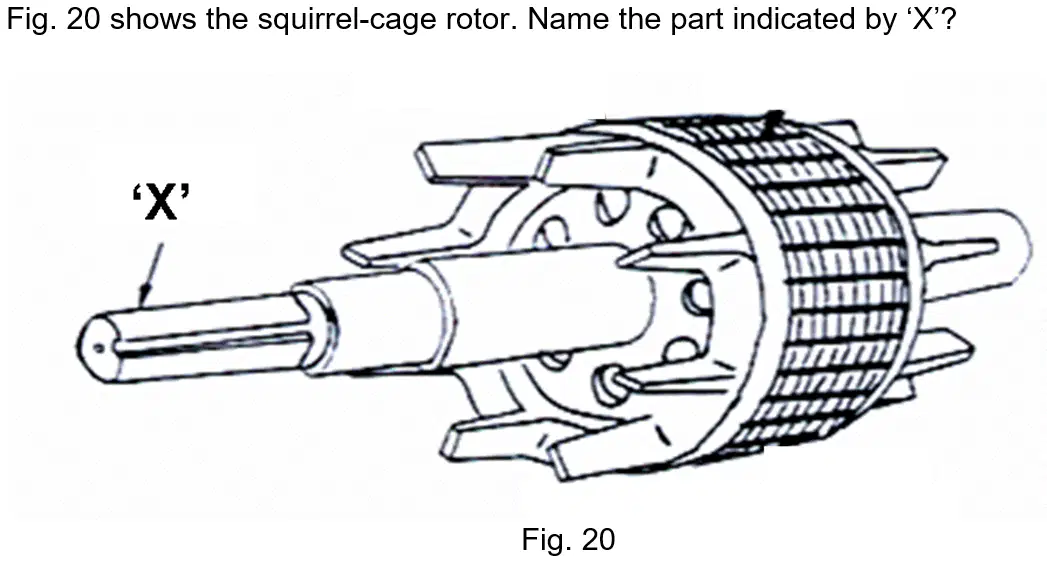
Shaft
End Ring
Rotor Bar
Laminated Core.
Identify the two types of rotor used in 3-phase induction motors.
star.
delta.
star or delta.
star and delta.
The external rotor resistors can be added to a 3-phase, wound rotor induction motor to
give high starting torque.
induce emf in the rotor circuit.
control the frequency of the supply.
supply voltage to the stator windings.

Fig. 24 shows the power stages of a 3-phase induction motor. What is the stage indicated by ‘X’?
Stator losses
Rotor iron losses
Frequency losses
Rotor copper losses
Interchanging any two supply lines of a three-phase induction motor will cause the motor to
stop immediately.
become short-circuited.
improve the power factor.
rotate in the opposite direction.
A squirrel-cage induction motor differs from a wound-rotor induction motor because it does not have
slip rings.
a rotating part.
rotor conductors.
windings in the stator.
The windings in the rotor of a 3-phase wound-rotor induction motor are connected in
star.
delta.
star-delta.
delta-star.
Which one of the following statements is true for the stator windings of a 3-phase induction motor?
The stator windings are always delta-star connected.
The stator windings are the rotating parts of the machine.
The stator windings produce the required rotating magnetic field.
The stator windings produce the required pulsating magnetic field.

In Fig. 29, identify the power stages of a 3-phase induction motor indicated by ‘X’?
Total rotor losses.
Rotor copper losses.
Mechanical power output.
Friction and windage losses of rotor.
The rotor power input to a 3-phase induction motor is 50kW. If the slip is 3%, find the rotor copper loss.
3kW
24kW
1.2kW
1.5kW
A 3-phase induction motor has an input of 1500W and the total losses amount to 375W, What is the efficiency of the induction motor?
25%
50%
75%
90%
The input power to the rotor of a 3-phase induction motor is 100kW. When the motor is running with slip s, the rotor copper loss is
(s x 100) kW
(s + 100) kW
(s – 100) kW
(100 – s) kW
Calculate the stator power input for a 400V, 3-phase induction motor which draws a current of 12A with a power factor of 0.8.
3840W
4800W
6651W
8314W
In an induction motor given rotor copper losses amounts to 500W and mechanical power developed amounts to 1000W. What is the rotor power input?
2W
500W
1500W
500000W
A 3-phase induction motor has an input of 1500W and the output amounts to 1200W, What is the efficiency of the induction motor?
20%
80%
100%
125%
Control equipment incorporating means of protection against overload of motor shall be provided if the electric motor having a rating exceeding
0.1kW
0.37kW
1.37kW
13.7kW
When a motor runs hot on no load the possible cause is
overload.
blown fuse.
shorted coils.
open circuit in the winding.
Which of the following motor enclosure is suitable for use in an extremely dusty environment?
Drip Proof type.
Pipe-ventilated type.
Totally enclosed type.
Totally enclosed fan cooled type.
Which of the following motor enclosure is suitable for use in hazardous environment such as gasworks and oil refineries?
Drip Proof type.
Flameproof type.
Pipe-ventilated type.
Totally enclosed type.
A technician would like to install a motor for a general workshop. Which of the following motor enclosure is suitable?
Drip Proof type.
Flameproof type.
Pipe-ventilated type.
Screen-protected type.
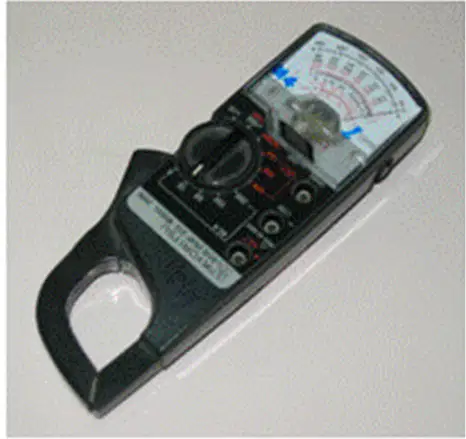
Identify the equipment shown
Voltmeter.
Multimeter.
Insulation tester.
Clip-on ammeter.
A technician would like to check the continuity of a fuse. Which of the following measuring instrument is suitable?
Ohm-meter.
Oscilloscope.
Insulation tester.
Clip-on ammeter.
A technician would like to check the speed of rotation of a motor. Which of the following measuring instrument is suitable?
Tachometer.
Oscilloscope.
Insulation tester.
Clip-on ammeter.
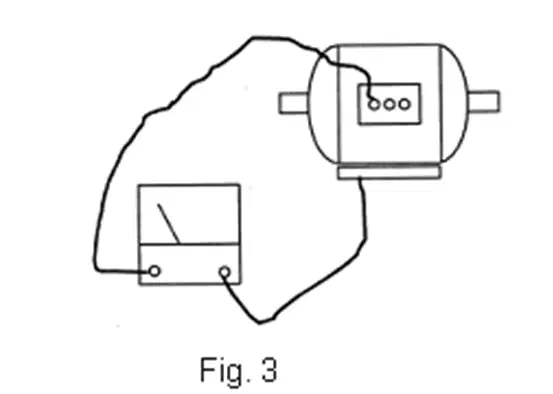
Fig. 3 shows a test to measure
the resistance of windings.
the resistance of the motor frame.
insulation resistance between windings.
insulation resistance between windings and motor frame.
A test for insulation between phase and motor frame is also referred to as a/an
cool down the motor.
burn the motor windings.
make the motor run normally.
draw less current from the supply.
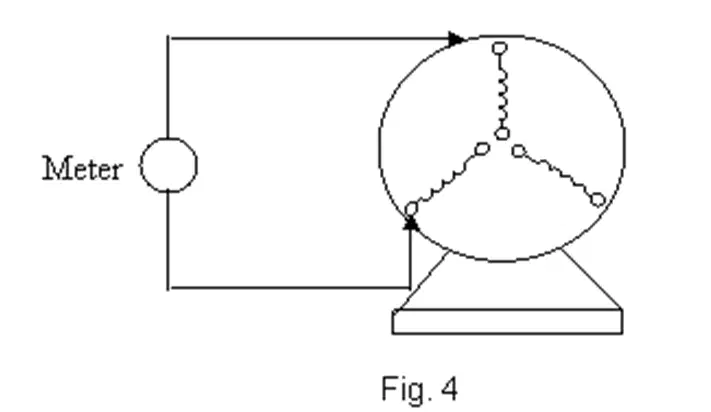
In Fig. 4, the winding is being tested for
ground.
polarity.
open circuit.
short circuit.
polarity.
open circuit.
short circuit.
If single-phasing occurs in a 3-phase induction motor while it is running, the
motor will
come to a standstill.
reverse its direction.
continue to run normally.
continue to run inefficiently.
Which of the following measurements between the field conductor and stator core indicates a healthy insulation?
5 Ω
5 kΩ
5 mΩ
5 MΩ
When measuring the insulation resistance between the Red, Yellow, Blue windings to Earth , if the reading given by the insulation resistance tester reads infinity ohms, it shows that the motor insulation is
good.
grounded.
open circuit.
short circuit.
A three phase induction motor fails to start. The first thing to do is to
switch off the motor.
dismantle the motor.
throw away the motor.
check whether there is supply to the motor.
When a 3-phase induction motor winding is grounded, the insulation resistance tester will read
zero
infinity
5.5MΩ
500MΩ
When testing a 3-phase induction motor, what is the reading on the meter if the coil is open?
zero
infinity
1mΩ
10mΩ

