
 Worksheets
Chemistry Practice Test
Total questions: 95
Worksheet time: 8hrs 2mins
anything that has mass and takes up space
Atom
Molecule
Light
Matter
Type of matter made of two or more elements...
element
mixture
compound
A pure substance that cannot be broken down into any other substance by chemical or physical means. Key word: Pure!
compound
mixture
molecule
element
I am 2 or more elements chemically bonded. Hint: You might give this answer in another question
atom
molecule
compound
mixture
I am two or more atoms chemically bonded. smallest unit of matter that can exist by itself and retain all of a substance's chemical properties.
atom
compound
molecule
mixture

What is matter?
Anything that has mass
Anything that occupies space
Both, anything that has mass and takes up space
I don't know

Which of the following is made up of matter?
Music
Light
Love
Air


Which of the following is not a property?
Color
Shape
Form
Light

Everything we touch is made of ...
Matter
Air
the resistance of a gas or liquid to flow
Viscosity
Watery
energy
Venture


The upward force that fluids exert on all matter.
Pascal
Fluid
Atmospheric
Buoyant
You can change density of an object by changing the object’s mass.
True
False
Buoyant force is caused by differences in fluid pressure.
True
False

Steam rising from wet clothes while ironing them. This is an example of__________.
Evaporation
Condensation

Paint dries up after a while. This is an example of__________.
Condensation
Evaporation
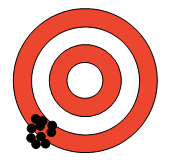
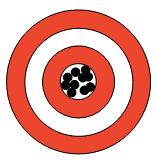
How close a measurement is to the accepted value is called..
Accuracy
Precision
Significant
Estimate
Archimedes' principle states that the buoyant force on a(n) _____ is equal to the weight of the displaced volume of fluid.
object in a fluid
object floating o a fluid
fluid mixing with liquid
substance dissolving into a fluid
An object that sinks into a fluid is _______ the liquid.
less dense than
equally dense as
more dense than
being dissolved in
Unlike a gas, a plasma
is a fluid
has no definite shape
has no definite volume
conducts electric current
suggested explanation to a problem or observation based upon known information
theory
law
hypothesis
experiment
variable
used to test a hypothesis
experiment
law
variable
control
anything that can affect the results of an experiment HINT: changes
control
data
variable
law
Which of the following occurs first in the scientific method?
theory
hypothesis
problem
observation
experiment
observations and measurements made during an experiment
conclusion
law
law
data
part within the experiment that is maintained without change in order to provide a comparison for the part of the experiment containing the variable
fact
data
control
theory
part within the experiment that is maintained without change in order to provide a comparison for the part of the experiment containing the variable
fact
data
control
theory
hypothesis that has been tested and supported by a great amount of evidence over a long period of time.
hypothesis
fact
experiment
theory
statement describing (but not explaining) a natural event or phenomenon
conclusion
law
application
theory
new use to which results are put or new technique developed
application
check off application did not cover in class
control
conclusion
a summary that explains whether or not the data support the hypothesis. HINT: it is also used at the end of an English paper. In __________,
theory
law
hypothesis
conclusion
Which one of the following substances are not a mixtures?
Mayonnnaise
paint
Sodium chloride
air
The smallest part of an element that has all the properties of that element is called a/an
molecule
mixture
compound
atom
The study of the composition, structure, and properties of matter; the processes that matter undergoes; and the energy changes that accompany those processes best describes the science of
biology.
physics.
astronomy.
chemistry.
All known elements are organized into a chart known as the
element table.
group table.
periodic table.
metal-nonmetal table.
The vertical columns of the periodic table are called
periods.
rows.
groups.
chemicals.
Which substance represents an element?
CO2 (Carbon Dioxide)
H2O (Water)
O (Oxygen)
NaCl (Sodium Chloride)
Which substance represents a compound?
Water (H2O)
Carbon (C)
Nitrogen (N)
Sodium (Na)
____ 1. Which of the following is considered an exact number (with infinite significance)?
There are 15 students enrolled in the class.
The fence is 43 meters long.
The diameter of a sphere is 3.69 cm.
The depth of water at the shallow end of a pool is 3.0 feet.
The distance between San Diego, California and Okinawa, Japan is 6.539 miles.
____ 2. What is the definition of a Law?
an explanation to explain why a relationship exists in the Scientific Method
an explanation that is not yet supported by a lot of evidence
an observation that must be investigated
an observable relationship between 2 values
None of the above
A well established hypothesis is often called a
theory
observation
Fact
Law
best guess
____ 4. Add: 120.89 + 36 + 49.9 ; the correct answer is:
206.79
206.8
206
207
206.7
Divide 14360 by 203. The quotient expressed to the proper number of significant figures is:
71
0.0141
0.01414
70.74
70.7
Chemistry is defined as the study of the composition and structure of materials and
the categories of matter.
the changes in matter.
the electrical currents in matter.
molecules in living things.
Matter includes all of the following EXCEPT
air.
smoke.
light.
water vapor.
A physical property may be investigated by
melting ice.
allowing silver to tarnish.
letting milk turn sour.
burning wood.
The state of matter in which a material has neither a definite shape nor a definite volume is the
gaseous state
elemental state.
liquid state.
solid state.
The most useful source of chemical information about the elements is a
calculator.
periodic table.
table of metric equivalents.
table of isotopes.
All of the following are steps in the scientific method EXCEPT
observing and recording data.
forming a hypothesis.
discarding data inconsistent with the hypothesis.
developing a model.
A testable statement used for making predictions and carrying out further experiments is a
law.
generalization.
theory.
hypothesis.
A volume of 1 cubic centimeter ( cm3 ) is equivalent to
1 milliliter.
1 liter.
1 gram.
10 decimeters.
The SI base unit for time is the
day.
minute.
hour.
second.
Idea that matter cannot be created nor destroyed
Rutheford's Rule
Mendeleev's Mandate
Law of Conservation of Matter
The Periodic Law
Person that wrote the Law of Conservation of Matter/Mass
Antione Lavoisier
Democritus
JJ Thomson
Dmitri Mendeleev
The science that seeks to understand what matter does
by studying what atoms and molecules do.
(a)
Virtually everything around you is
composed of chemicals.
True
False
The (a) are bound together to form several different types of molecules.
The characteristics of carbon dioxide molecules make carbon dioxide a _____ at room temperature.
solid
liquid
gas
The characteristics of water molecules make water a ________ at room temperature.
solid
liquid
gas
If a law, hypothesis, or ________ is
inconsistent with the findings of an
experiment, it must be revised and new
experiments must be conducted to test the
revisions.
observation
theory
method
independent variable
A neutral nucleus with 2 protons and 2 electrons
Hydrogen
Helium
Lithium
Noble gases
Elements with highly STABLE configuration
Hydrogen
Alkali metals
Noble gases
buoyancy

