wayground logo

Free Printable Worksheets

NEW

Font size

S
M
L
XL
Worksheets

Conservation & Mechanical Advantage

Total questions: 61

Worksheet time: 2hrs 47mins

Name
Class
Date
1.

Is this statement True or False ?

The law of conservation of energy states that energy can neither be created nor destroyed - only converted from one form of energy to another.

a)

True

b)

False

2.

Observing only the mixer what energy transformation do you observe?

a)

Electrical - to mechanical and then heat

b)

Electrical to chemical then nuclear

c)

Chemical to Electrical to Heat

d)

Sound- Electric- Heat

3.

Look at the image what energy transformation does a tree experience?

a)

Chemical energy to thermal energy

b)

Mechanical energy to Sound Energy

c)

Radiant energy to Chemical energy

d)

Electrical energy to chemical energy

4.

Red = Kinetic, Blue = Potential, Yellow = Total Energy

Total Energy = PE + KE

When blue is full, that means it is 100% Potential Energy and _________ Kinetic Energy.

a)

0%

b)

50%

c)

100%

5.

Red = Kinetic, Blue = Potential, Yellow = Total Energy

Total Energy = PE + KE

When red is full, that means the object is...

a)

staying still

b)

going slow

c)

going fast

6.

Red = Kinetic, Blue = Potential, Yellow = Total Energy

Total Energy = PE + KE

When blue is full, the object is...

a)

staying still

b)

moving slow

c)

moving fast

7.

For which graph is the object moving the fastest?

a)

left

b)

right

8.

What is the final kinetic energy of the system for the process shown in the figure if E1 = 4 J ?

a)

2 J

b)

4 J

c)

6 J

d)

8 J

9.

Which point has the most potential energy?

a)

G

b)

F

c)

B

d)

A

10.

Which point has maximum kinetic energy ?

a)

Location G

b)

Location B

c)

Location E

d)

Location D

11.

Which two factors influence the amount of kinetic energy an object has?

a)

Height and Mass

b)

Height and Speed

c)

Speed and Mass

d)

Location and Force

12.

Which two factors influence the amount of potential energy that an object has?

a)

Height and Mass

b)

Speed and Mass

c)

Height and Speed

d)

Force and Speed

13.
What kind of simple machine is a wheelchair ramp?
a)
wheel and axle
b)
pulley
c)
wedge
d)
inclined planes
14.
A simple machine is a device that helps to reduce the amount of _____ required to work.
a)
force
b)
energy
c)
work
15.
An object being lifted or moved is a
a)
load
b)
fulcrum
c)
force
d)
work
16.

What is effort (input) force?

a)

the force one exerts on a machine

b)

the force which an effort force must overcome in order to do work on an object via a simple machine.

c)

the force the machine exerts on a object

d)

the output work times the input distance

17.
How is work defined?
a)
the amount of energy 
b)
the transfer of force over a distance
c)
rate of work in a given time
d)
the change in distance in a given time
18.
Is this an example of work?
A teacher applies a force to a wall and becomes exhausted.
a)
True
b)
False
19.
if a load of a lever is 100 newtons and the force you apply is 20 newtons, what is your mechanical advantage?
a)
120 N
b)
5 N
c)
2000 N
d)
80 N
20.
if a load of a lever is 100 newtons and the force you apply is 20 newtons, what is your mechanical advantage?
a)
120 N
b)
5 N
c)
2000 N
d)
80 N
21.
The amount by which a machine multiplies input force is known as the 
a)
work.
b)
power.
c)
output force.
d)
mechanical advantage.
22.

the percentage of the input work that is converted to output work

a)

mechanical advantage

b)

efficiency

c)

joule

d)

machine

23.
The efficiency of a machine can be increased by reducing __________________________. 
a)
effort
b)
resistance friction
c)
fulcrum
d)
friction
24.

The _________ of a machine is always less than 100%.

a)

mechanical advantage

b)

friction

c)

force

d)

efficiency

25.
All simple machines help make work _________.
a)
harder
b)
smaller
c)
lighter
d)
easier
26.

What is mechanical advantage?

a)

The advantage a machine has over a bicycle

b)

A measure of how much a simple machine reduces work

c)

A measure of when is the best time to use a simple machine

d)

the number of times a machine increases input force

27.
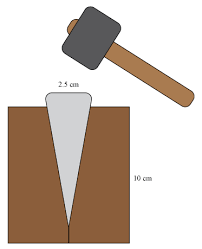
What is the primary mechanical advantage of using the simple machine seen in the image?
a)
You can apply a large force and have it penetrate over a very long distance.
b)
You can apply a long distance and have it convert into a very short distance.
c)
You can apply a short distance and have it multiplied to penetrate a large distance.
d)
You can apply a small force to penetrate something that normally requires a large force.
28.
To increase the mechanical advantage of a lever
a)
make sure the fulcrum is in the middle of the lever
b)
move the fulcrum closer to the load
c)
move the fulcrum closer to the effort
d)
use a bigger fulcrum
29.
What is the mechanical advantage of this pulley system?
a)
2
b)
3
c)
4
d)
5
30.
How does a single fixed puled, like the one seen here, help you do work?
a)
changes the direction of the force
b)
increases the amount of applied force
c)
decreases the amount of applied force
d)
allows you to pull the rope a shorter distance
31.
Input force is the same as 
a)
output
b)
resistance 
c)
effort
32.
The units for MA are called
a)
Joules
b)
Watts
c)
newtons
d)
MA is a ratio so it does not have units
33.

What is effort (input) force?

a)

the force one exerts on a machine

b)

the force which an effort force must overcome in order to do work on an object via a simple machine.

c)

the force the machine exerts on a object

d)

the output work times the input distance

34.
What is the equation for mechanical advantage?
a)
MA=input force*output force
b)
MA=output force/input force
c)
MA=input force/output force
d)
MA= output force - input force
35.
if a load of a lever is 100 newtons and the force you apply is 20 newtons, what is your mechanical advantage?
a)
120 N
b)
5 N
c)
2000 N
d)
80 N
36.
The amount by which a machine multiplies input force is known as the 
a)
work.
b)
power.
c)
output force.
d)
mechanical advantage.
37.

the percentage of the input work that is converted to output work

a)

mechanical advantage

b)

efficiency

c)

joule

d)

machine

38.
The efficiency of a machine can be increased by reducing __________________________. 
a)
effort
b)
resistance friction
c)
fulcrum
d)
friction
39.

The _________ of a machine is always less than 100%.

a)

mechanical advantage

b)

friction

c)

force

d)

efficiency

40.

A simple machine reduces the amount of work needed to accomplish a task.

a)

true

b)

false

41.

Real machines:

a)

actually exist

b)

have an efficiency less than 100%

c)

lose energy due to friction

d)

all are correct

42.

A machine with a ratio greater than 1:

a)

multiplies the input force so the machine would be good to help move heavy objects.

b)

does not multiply the force, but increases distance and speed.

c)

is good for lifting and moving objects quicker.

d)

Is not good for lifting or moving objects quicker.

43.

A machine with a ratio less than 1:

a)

multiplies the input force so the machine would be good to help move heavy objects.

b)

does not multiply the force, but increases distance and speed.

c)

is good for lifting and moving objects quicker.

d)

Is not good for lifting or moving objects quicker.

44.
If the weight of the block is 10N, how much force does one have to apply to lift it using this pulley (MA=2)?
a)
2N
b)
5N
c)
10N
d)
15N
45.
Identify this simple machine
a)
Lever
b)
Wheel & Axle
c)
Inclined Plane
d)
Screw
46.
Two examples of a pulley...
a)
knife & axe blade
b)
lightbulb & screw
c)
flagpole hoist & window blinds
d)
catapult & teeter totter
47.
Which of the following does a simple machine do?
a)
allows the users to apply less force over a longer distance
b)
reduce the amount of force needed to do work
c)
change the direction of the applied force
d)
all of the above
48.
Which is an example of someone using a simple machine to do work?
a)
a boy runs across a football field
b)
a banker counts money
c)
a mother pushes a stroller up a ramp
d)
a girl eats a sandwich
49.
The device used to raise a flag up a flag pole is an example of a 
a)
wheel and axle 
b)
lever
c)
inclined plane 
d)
pulley 
50.
An inclined plane wrapped around a rod forms this simple machine 
a)
lever
b)
pulley
c)
screw
d)
wedge 
51.
A simple machine that consists a rigid bar that pivot about a fixed point
a)
lever
b)
pulley
c)
wheel and axle
d)
fulcrum 
52.
A seesaw is an example of a  
a)
wedge
b)
lever 
c)
inclined plane 
d)
pulley 
53.
Stairs
a)
wedge
b)
pulley
c)
inclined plane
d)
wheel and axle
54.
This device
a)
wedge
b)
lever
c)
incline plane
d)
wheel and axle
55.
The fixed point on the lever is called 
a)
load
b)
resistance
c)
bar
d)
fulcrum
56.
Name this simple machine. 
a)
Wheel and Axle
b)
Lever
c)
Pulley
d)
Wedge
57.
What is effort (input) force?
a)
the force required by a machine in order to accomplish work (the force you put on the machine)
b)
the force which an effort force must overcome in order to do work on an object via a simple machine.
c)
the force the machine exerts on a object
d)
the output work times the input distance
58.
What is resistance (output) force?
a)
the force required by a machine in order to accomplish work (the force you put on the machine)
b)
the force which an effort force must overcome in order to do work on an object via a simple machine.
c)
the force the machine exerts on a object
d)
the output work times the input distance
59.
A fishing pole is an example of a compound machine. What simple machines are used to make up this compound machine?
a)
lever, wheel and axle, pulley
b)
wheel and axle, inclined plane, pulley
c)
wheel and axle, pulley, inclined plane
60.
A machine multiplies your effort force by 3 times.  What does the number 3 represent?
a)
force
b)
mechanical advantage
c)
distance
d)
work
61.

What simple machine is in this image

a)

Wedge

b)

Lever

c)

screw

d)

wheel and axel

e)

Incline plane