
Font size
 Worksheets
Chapter 13 - Meiosis and Sexual Cycles
Total questions: 77
Worksheet time: 2hrs 34mins
Label this diagram.
synaptonemal complex
homologs
sister chromatids
Organize these options into the right categories.
Prophase I
Metaphase I
Anaphase I
Telophase I
Meiosis II
Prophase
Anaphase
Metaphase
Telophase
Label this diagram.
homologs moves on opposite ends
haploid cells created n=2
non-sister chromatids
sister chromat stay
1 chromes lined up
2 chromes
Prophase I
Anaphase I
Metaphase I
Telophase I
Label the diagram.
each chrome have one chromatid
gametes are haploid
sister chromat moves on opposite sides
chromes lines up
chromes condenses
haploid cells made in meiosis I
Prophase II
Metaphase II
Anaphase II
Telophase II
What stage of interphase does DNA replication occur?
G1
S
G2

What do the blue and yellow arrows represent
The blue arrow is prophase and the yellow is interphase
The blue arrow is mitosis and the yellow arrow is meiosis
The blue arrow is interphase and the yellow is mitosis
The blue arrow is meiosis and the yellow is prophase

Crossing over occurs during prophase I of meiosis. Which statement about crossing over is true?
RNA translation occurs in the smooth endoplasmic reticulum
Crossing over takes place in backterial cells
Crossing over produces genetically identical daughter cells
Crossing over provides genetic diversity in eukaryotic cells
Embryonic cells each have an identical copy of DNA. If the DNA in all cells is identical, how do the embryonic cells become specialized (ex: Muscle cell, brain cell, liver cell, etc)
Each cell contains only the active parts of the DNA needed for the cell type
Each cell type has only one chromosome containing the DNA needed for that cell type
Each cell has an identical copy of DNA with enzymes controlling the expression of specific genes, leading to cell variety
If a person has leukemia, they are given a medicine that inhibits (stops) DNA synthesis. Which phase of the cell cycle will be most affected by this medicine?
G1
S
G2
M phase
Which of the following are in order from smallest to largest
Cells -> tissue -> organ -> organ system
Cells -> Organ system -> tissue -> organ
Organ system -> Organ -> Tissue -> Cell
Tissue -> organ system -> Cell -> Organ

What does the image demonstrate
Punnet squares
Crossing over
Metaphase
Dna replication
During prophase I crossing over occurs and genetic material is exchanged between homologous chromosomes. How is this important
Increases genetic variation
Reduces the diploid number to the haploid number
Increases the haploid number to the diploid number
Reduces the probability of mutations
In mitosis, one parent cell -
Forms two identical daughter cells
Forms four identical daughter cells
Forms two genetically diverse daughter cells
Forms four genetically diverse daughter cells
G1, S, and G2 are all phases of
Mitosis
Meiosis
Interphase
Prophase
In which phase does crossing-over happen?
answer choices
Anaphase II
Metaphase I
Prophase I
Prophase II
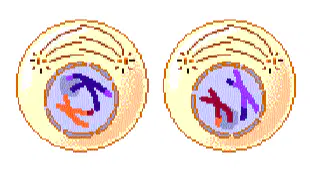
What phase is this?
answer choices
Telophase I
Metaphase I
Prophase II
Anaphase II
A chromosome is composed of two identical sister?
somatic cells
autosomes
centromeres
chromatids
During meiosis, if an organism has 10 chromosomes, how many will the new daughter cells have?
8
2
5
10
In mitosis the (a) daughter cells that are created are (b) . In meiosis the (c) daughter cells that are created are (d)
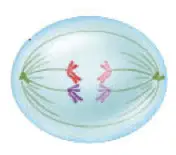
What phase is shown in the picture?
anaphase II
anaphase I
metaphase II
telophase I
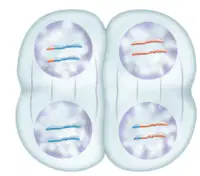
What phase is shown here?
Telophase II
Telophase I
Metaphase II
Anaphase I
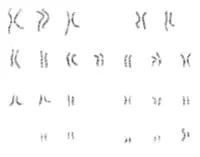
How many chromosomes do humans have?
answer choices
10 -- 5 from mom, 5 from dad
22--11 from mom, 11 from dad
46-- 23 from mom, 23 from dad
23
Full set of chromosomes of a cell arranged with respect to size, shape, and number.
phenotype
karyotype
chromatin
genotype

In the image.
What is number 2 pointing to?
Cytoplasm
Centromere
Chromosome
Chromatid
Humans have how many chromosomes ?
112
46
8
67
Why do cells go through mitosis?
to make food from sunlight
to create proteins
to get air into the cells
to reproduce, grow and repair/replace
Cell Cycle
Mitosis is made up of 5 phases.


What stage of Meiosis is being shown and described:
Both cells divide producing 4-1n cells (haploid) containing half the number of chromosomes
Prophase 2
Metaphase 2
Anaphase 2
Telophase 2

What stage of Meiosis is being shown and described:
Each chromosome lines up in the middle of the cell.
Prophase 2
Metaphase 2
Anaphase 2
Telophase 2

What stage of Meiosis is being shown and described:
Chromatids split forming individual chromosomes and are pulled to opposite ends of the cell.
Prophase 2
Metaphase 2
Anaphase 2
Telophase 2

What stage of Meiosis is being shown and described:
Each chromosome is made up of 2 copies of a homolog/2 chromatids
Prophase 2
Metaphase 2
Anaphase 2
Telophase 2

What stage of Meiosis is being shown and described:
Cell divides into 2 daughter cells. (2n...Diploid cells)
Prophase 1
Metaphase 1
Anaphase 1
Telophase 1

What stage of Meiosis is being shown and described:
The pairs line up in the center of the cell.
Prophase 1
Metaphase 1
Anaphase 1
Telophase 1

What stage of Meiosis is being shown and described:
Copied pairs partner up, chromosomes condense and nuclear membrane disappears.
Prophase 1
Metaphase 1
Anaphase 1
Telophase 1

What stage of Meiosis is being shown and described:
The homologs of each chromosome pair separate and are pulled to opposite ends
Prophase 1
Metaphase 1
Anaphase 1
Telophase 1

What stage of Mitosis is being shown and described:
New nuclear membrane begins to form around each new nucleus and the cell is pinched.
Anaphase
Telophase
Metaphase
Cytokinesis

What stage of Mitosis is being shown and described:
Cell carries out its normal functions, grows and prepares to divide, and the DNA is copied/duplicated.
Interphase
Telophase
Anaphase
Prophase

Which stage of Mitosis is being shown and described:
Chromosome pairs are split and tugged to opposite ends of the cell
Prophase
Metaphase
Anaphase
Telophase

Which stage of Mitosis is being shown and described:
The nucleus begins to disappear and chromosomes form.
Telophase
Anaphase
Prophase
Interphase

Which stage of Mitosis is being shown and described:
Daughter cells are pinched apart and parent cell's cytoplasm is divided between the 2 new cells.
Cytokinesis
Metaphase
Anaphase
Telophase

Which stage of Mitosis is being shown and described:
Chromosomes line up in the middle.
interphase
prophase
metaphase
anaphase
Which phase of mitosis do the chromosomes line up in the middle of the cell?
Anaphase
Metaphase
Telophase
Prophase
How many divisions are in meiosis?
46
23
2
4
Which phase does the cell grow and develop?
Prophase
Interphase
Cytokinesis
Metaphase
Timmy fell off his skateboard and scraped his knee. Which cell process is going to be used to heal the wound?
Mitosis
Meiosis
The wound would not heal
Cell diffusion
What is the correct order for the phases of mitosis?
Prophase, Anaphase, Telophase, Metaphase
Anaphase, Telophase, Prophase, Metaphase
Telophase, Anaphase, Prophase, Metaphase
Prophase,
Metaphase, Anaphase, Telophase
If an organism reproduces asexually, its offspring will most likely be...
genetically identical to the parent
genetically different from each other
produced from specialized cells known as gametes
A mutant
How many chromosomes do the daughter cells have in meiosis?
23
46
2
4
How many chromosomes do the daughter cells have in mitosis?
23
46
2
4
The end result of meiosis is...
4 identical cells
4 genetically different cells
2 identical cells
2 genetically different cells
The end result of mitosis is
4 Identical Cells are produced
4 genetically different cells are produced
2 identical cells are produced
2 genetically different cells are produced


What are the "X" shaped things in the drawing.
PMATs
Chromosomes
Ribosomes
Telophase
PMAT helps us remember the correct order of the phases of Mitosis. Which of the following has the phases of Mitosis in the correct Order
Interphase, Mitosis, Cytokinesis
Prophase, Metaphase, Anaphase, Prophase
Anaphase, Telophase, Prophase, Telophase
Prophase, Metaphase, Anaphase, Telophase

