
 Worksheets
xscdcdc
Total questions: 61
Worksheet time: 33mins


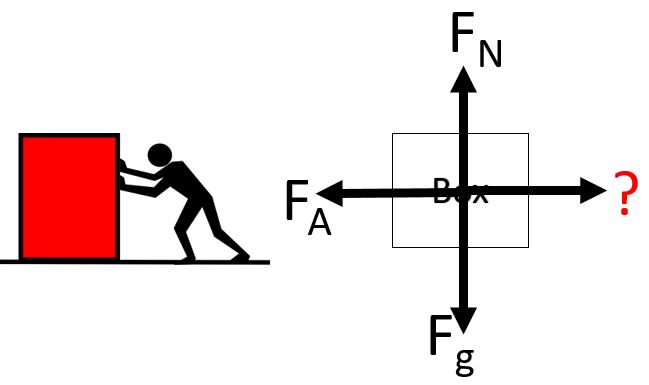
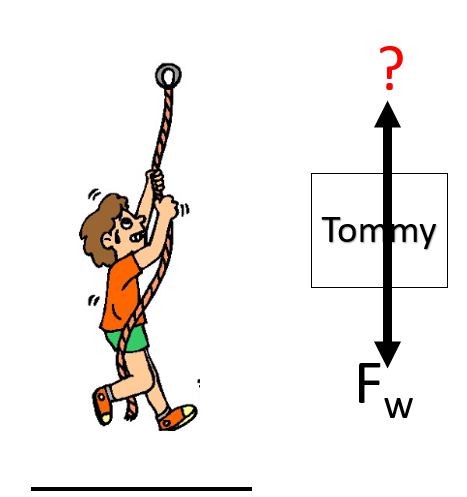

For a force on an object there is an equal and opposite force.
Newton’s 1st Law of Motion
Newton’s 2nd Law of Motion
Newton’s 3rd Law of Motion
the Law of Inertia
Choose the correct unit for: Force (F)
45 s
76 m
37 m/s2
5 N
Choose the correct unit for: mass (m)
5 N
2.2 kg
15 m/s
76 m
Choose the correct unit for: acceleration (a)
5 N
2.2 kg
37 m/s2
15 m/s
Which of the following represents Newton’s 1st Law (the Law of Inertia)?
A ball rolling on a flat surface coming to a stop.
When a car brakes suddenly, the passengers press forward against their seat belts.
Eating food at a table.
Running and stopping at the finish line.
What claim about acceleration is shown to be mathematically supported from the relationship between force, mass, and acceleration?
Claim 1: a = m + f
Claim 2: a = m / F
Claim 3: a = F x m
Claim 4: a = F / m
Acceleration is caused by a force acting on a mass.
Newton's 1st Law
Newton's 2nd Law
Newton's 3rd Law
the Law of Inertia
When a pair of balanced forces acts on an object, the net force that results is
greater in size than both forces combined.
equal in size to one of the forces.
greater in size than one of the forces.
equal to zero.
When an unbalanced force acts on an object,
the object’s motion does not change.
the mass of the object changes.
the object accelerates.
the inertia of the object increases.
Newton’s first law of motion states that if a moving object is acted on by balanced forces, it will
remain in motion at a constant velocity
change its momentum.
eventually come to a stop.
accelerate.
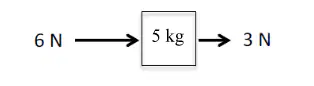
Give the acceleration on the object.
1.8 m/s2 right
1.8 m/s2 left
0.6 m/s2 right
0.6 m/s2 left

Give the net force on the object.
6 N right
9 N right
3 N right
2 N right
Choose the correct unit for: velocity (v)
37 m/s2
15 m/s
76 m
45 s
Thor, dog of thunder, pulls a sled with a force of 40 N and the sled accelerates at 2 m/s2. Calculate the mass of the sled.
2 kg
4 kg
20 kg
82 kg
Luna the Cat is visiting Thor, Dog of Thunder, on his home planet of Asgard. The gravity on Asgard is 3.2 m/s2 and her mass is only 6 kg. What is her weight on Asgard?
9.2 N
2 N
19.2 N
0.8 N
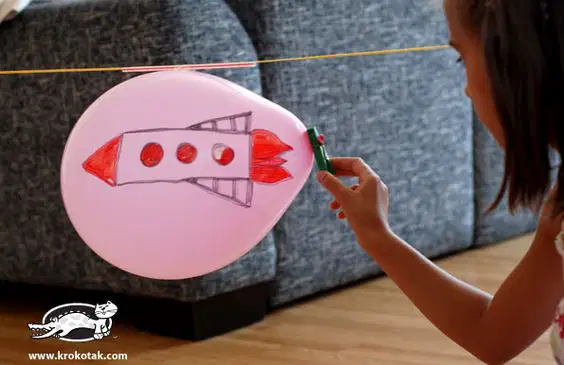
In a balloon rocket, the balloon pushes the air backward and the air pushes the balloon forward. Which law does this represent?
Newton's 1st
Newton's 2nd
Newton's 3rd
Nola is carrying a lunch tray with an apple on it. She suddenly stops walking and the apple continues to move forward. This is an example of which law?
Newton's 1st
Newton's 2nd
Newton's 3rd

Which object has the most inertia?
C, it has the smallest mass
B, it has the most mass
A, the mass is average size
All the same inertia

Calculate Net Force.
6 N left
14 N right
10 N right
3 N left
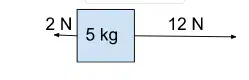
Calculate the acceleration.
1.6 m/s2
5 m/s2
0.5 m/s2
2 m/s2
What is the formula of Newton's Second Law?
F(net) = ma
F(net) = m/a
F(net) = a/m
F(net) = m + a
If a net force of 20 N is exerted on two objects, one with a mass of 0.5 kg and the other with a mass of 0.7 kg, which ball will have the greater acceleration?
The 0.5 kg ball
The 0.7 kg ball
Both have the same acceleration
A 20 kg bike accelerates at 10 m/s2. What is the net force acting on the bike?
2 N
0.5 N
0 N
200 N
A man pushes a 2kg box to the right with a force of 10N while a young boy pushes the box to the left with a force of 6N. What is the acceleration of the box?
0 m/s2
2 m/s2
5 m/s2
3 m/s2
A cat sitting on a couch, a pencil on desk, and a car at rest are all examples of..
Balanced Forces
Unbalanced Forces
Which type of force(s) will cause a change in an object's motion?
A zero net force
Balanced forces
Unbalanced forces
Newton's third law states that any action will have a(n) _______ and ______ reaction
Equal and similar
Equal and opposite
Equal and different
Greater and opposite
Which of Newton's laws is illustrated when a magician pulls a tablecloth out under the dishes without disturbing them?
First Law
Second Law
Third Law
Fourth Law

When the air is released from a balloon, the air moves in one direction, and the balloon moves in the opposite direction. Which law best explains the motion of the balloon?
Newton's first law
Newton's second law
Newton's third law
Slamming on the brakes in a moving car makes a passenger move forward against his or her seat belt because
the passenger has the inertia to keep moving forward
the passenger is being pushed by the seats of the car
the passenger is better able to stop themselves in this manner
the passenger has an equal and opposite force supporting their weight
You are holding a bowl of hot soup while standing in the kitchen. As you begin to move, the soup spills out of the bowl. This happens because
the soup spilled because of air resistance
if you had traveled faster this wouldn't have happened
the soup wanted to stay where it was, but you moved the bowl
the soup and the bowl act as one body with the same velocity
Why do you lean towards the left when a car turns right?
because of your inertia
because of the car's acceleration
because of gravity
A cart initially at rest is experiencing two forces. One is pushing 5N east and another 5N west. What is true about the motion of the cart?
it isn't moving
it is slowing down
it is speeding up
its speed is constant
The magnetic force is a
contact force
force acting at a distance
Which object has the most inertia?
A 1kg book at rest on a table
A 5kg box moving at a constant speed
A 12kg bike accelerating
A 20kg desk at rest

If the hammer hits the nail with a 55 N force, the nail hits the hammer with a
55N force
force less than 55N
force greater than 55N
0N force
A car has a mass 1000kg on Earth. Its weight on the Moon where the gravity is 1.6N/kg is
1000 kg
1600 N
9800 N
1.6 N

A book of mass 5kg rests on a table. The normal force acting on the book is
5N
49N
0N
There's no enough given to find it
A man is pushing a chair on the floor to the left side. Which diagram represents the free body diagram of the chair?


A 6kg sled is pulled on a surface of 0.72 coefficient of kinetic friction. The kinetic friction force acting on the sled is
4.32 N
58.8 N
42.3 N
0.72 N

A 30N force is applied to a 10kg block. The coefficient of static friction is 0.4. Will the block move?
Yes because Fs(max) < Applied force
No because Fs(max) > Applied force

