
 Worksheets
Forces Unit Review
Total questions: 72
Worksheet time: 3hrs 48mins

James exerts a force on 5N on Julian's hand. What is the force that Julian's hand exerts on James'?
Greater than 5N
Less than 5N
Equal to 5 N
Julian's hand does not exert a force on James
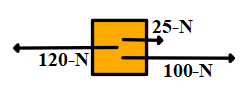
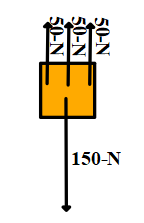
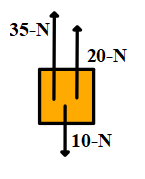
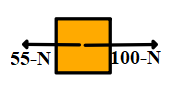
The free body diagram of four boxes are shown below. Which box is in equilibrium?


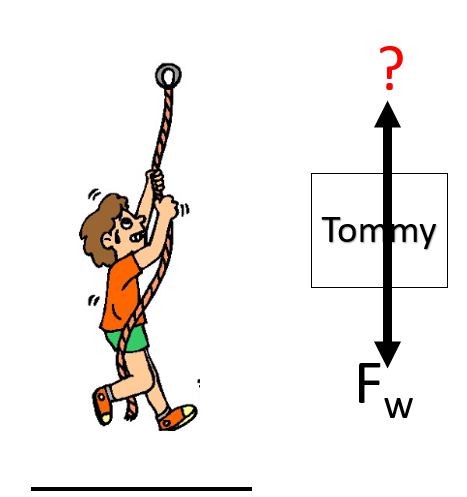
The force that keeps objects on top of surfaces instead of letting them sink into the surface is known as:
normal
abnormal
static
inertia
TRUE or FALSE
Normal force is always perpendicular to the surface at which an object is resting.
True
False
TRUE or FALSE
Friction force always goes in the same direction as the motion of an object.
True
False

The force that pulls objects toward the Earth
Speed
Gravity
Normal
Thrust
The acceleration of an object is dependent upon the net force acting upon the object and the mass of the object is which of Newton's laws?
1st
2nd
3rd
4th
For every action there is an equal and opposite reaction is which of Newton's laws?
1st
2nd
3rd
4th

What is defined a push or pull?
force
net force
an unbalanced force
a balanced force

What is the term for when two forces are acting in opposite directions on an object and are equal in size and the object stays still
net force
balanced force
accelerated force
unbalanced force

Forces that cause a change in motion of an object are called
balanced forces
net forces
motion forces
unbalanced forces

Calculate the net force
25
65
20
15

What is the net force?
400
800
200
600

If you are pushing a 1200 kg car with an acceleration of 0.5 m/s2 , what is the force you have applied to the car?
600
2400
4.16
60

calculate the force applied to a 5 kg shopping cart if it accelerates at 3 m/s2
15
1.67
0.6
1.57

If you INCREASE the force applied to a 50 kg crate, what happens to the ACCELERATION of the crate
acceleration increases
acceleration decreases
force increases
this cannot be determined

If you have a 500 kg motorcycle and you INCREASE the acceleration for 20 m/s2 to 40 m/s2, describe how you had to change the force applied to the motorcycle
had to increase the force
had to decrease the force
had to increase the acceleration
had to decrease the acceleration

Based on Newton's 2nd Law of Motion, which statement is true about the acceleration of wagon A and wagon B if both are being pulled with the same external force
wagon A will have a greater acceleration than wagon B
wagon B will have a greater acceleration than wagon A
wagon A and B will have the same accelerations
the wagons will both have and acceleration of zero

Based on Newton's 2nd Law of Motion, which statement is true about the force of the wagon with the kids if the mass of kids is identical but wagon A is moving TWICE the speed because it has more people pushing than that of wagon B
wagon A will have a greater force
wagon B will have a greater force
the force will be the same for both wagons
the force will be zero for both wagons
If you are standing still what forces are acting on you?
normal
weight
friction
drag
choose the non contact forces
gravity
friction
electricity
magnetism
Forces have both ________ and direction.
Magnitude
Speed
Gravity
Height


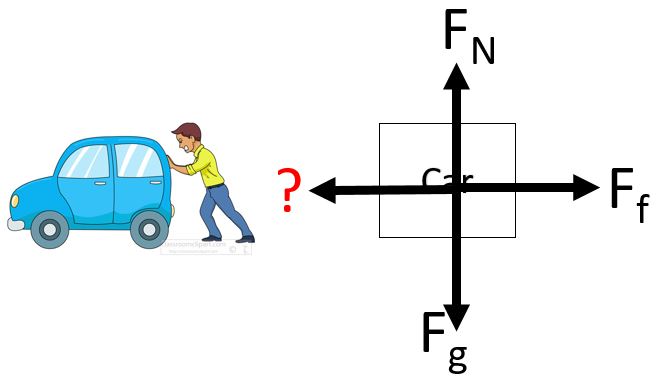

If a skydiver has a force of air resistance of value 50 N and the skydiver's weight is 75 N, what is happening to the motion of the skydiver?
Since the net force is down and the skydiver is moving down, they will get faster.
Since there is a force up, the skydiver must be moving upward.
Since there is a force up, the skydiver must be slowing down.
The force up will cancel the force down and the skydiver will move with constant (terminal) velocity.
The normal force is (a) to and (b) from the surface. It is created because of (c) between two surfaces.
An object is falling through the air at terminal velocity. Which of the following are true statements?
1. The net force is zero.
2. The forces are all balanced.
3. The object is accelerating.
4. The acceleration value is zero.
1 and 4
1, 2 and 3
1, 2 and 4
3 only

Based on the information in the diagram, what is the net force acting on this object?
12 N downward
4 N upward
4 N downward
8 N to the left

What are the horizontal and vertical net forces, if the 50 N force is applied at a 50° angle?
Fnet x= 45 N ; Fnet y= 0 N
Fnet x= 45 N ; Fnet y= 50 N
Fnet x= 27 N ; Fnet y= 38 N
Fnet x= 33 N ; Fnet y= 32 N

What is the y-component (vertical) of the force in the diagram?
58N
217N
-217N
65N

Which segment(s) on the following velocity vs time graph represents unbalanced forces?
A only
B only
A and C
A and B

The amount of attraction between two objects which are not in contact with each other is known as the _________.
Normal force
Gravitational force
Magnetic force
Electrical force
What is the proper setup of the gravitational force formula?
Fg= Gm2/r
F=ma
Fg= Gr2/(m1+m2)
Fg= G (m1m2)/r2
What effect does increasing the distance between the two objects do to the gravitational force?
The distance between two objects has no effect on the gravitational force
It increases
It stays the same
It decreases
When do gravitational forces exist between two objects?
They only exist between microscopic objects.
They are always present between any two objects.
Gravitational forces only act on objects falling on Earth.
They only exist for objects in space.
Which of the following changes would increase the gravitational force between two objects?
Increase G
Increase the mass
Increase r
Decrease G

FN=100N, Ff=20N
μ=5.0
μ=0.2
μ=1.2
μ=0.1
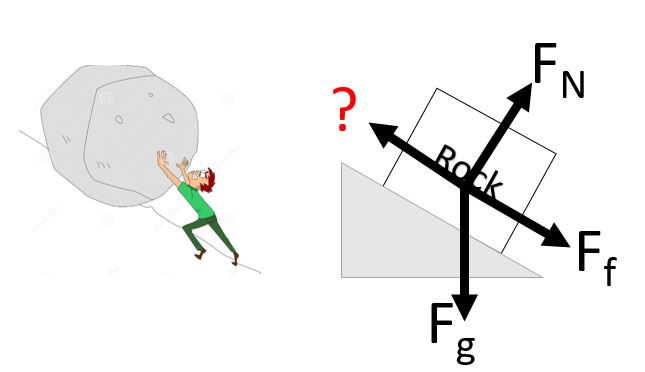
We calculate our weight with the equation:
W=m⋅G
W=m⋅g
W=gm
W=m
The units for mass are
kg
Netwons
m/s2
m/s
The units for force are
Newtons
kg
m/s2
m/s
Friction can be kinetic (movement) or static (no movement), which creates a greater force?
They are equally strong
kinetic > static
static > kinetic
friction doesn't cause a force


A man standing on a scale in an elevator notices that the scale reads 40 newtons greater than his normal weight. Which type of movement of the elevator could cause this greater-than-normal reading?
accelerating upward
accelerating downward
moving upward at a constant speed
moving downward at a constant speed
All objects have inertia
True
False

of the following is the gravitational force acting on the car?
A late traveler rushes to catch a plane, pulling a suitcase with a force directed 30.0° above the horizontal. If the horizontal (x) component of the force on the suitcase is 60.6 N, what is the resultant applied force exerted on the handle? (hypotenuse)

Using the gravity of earth at 9.81 m/s2 , how much does a person with a mass of 35 kg weigh in Newton's?
0.28 N
343 N
3.57 N
212 N

If a 56 kg person on an unknown planet weighs 450 N , what must be the gravity on this planet?
8.04 kg⋅m/s
8.04 m/s2
25,200 m/s2
25,200 kg⋅m/s

