
NEW
Font size
 Worksheets
Chapters 6/7 Biology
Total questions: 52
Worksheet time: 26mins
Which form of energy is NOT correctly associated with the related example?
Kinetic energy: fat molecules
Kinetic energy: movement of muscles
Chemical energy: glucose
Potential energy: water held behind a dam
Potential energy: ATP
Which best describes the first law of thermodynamics?
Energy is not created nor destroyed, but it can change from one energy form to another.
Energy is changed from one form to another with a loss of usable energy.
Energy can be created from matter or used to produce matter.
Some useful energy is lost as heat whenever an energy transfer occurs.
Energy transfers are always 100% efficient in changing energy from one useful form to another.
Which best describes the second law of thermodynamics?
Energy is not created nor destroyed, but it can change into matter.
Energy is not created nor destroyed, but it can change from one energy form to another.
Energy can be created from matter or used to produce matter.
Some useful energy is lost as heat whenever an energy transfer occurs.
Energy transfers are always 100% efficient in changing energy from one useful form to another.
A living organism represents stored energy in the form of chemical compounds. When an organism dies, what happens to this stored energy?
All chemicals immediately lose their high-energy bonds.
All molecules immediately degrade into basic elements.
All energy immediately leaves, and that is one manifestation that the organism is dead.
The chemical compounds in cells lose their organization over time because there is no longer an input of energy to maintain the organized state.
The chemical compounds remain exactly intact and ready to start up again unless digested by a consumer or decay organism.
Which of these statements is NOT a consequence of the second law of thermodynamics?
While the total amount of energy is unchanged, the energy lost as heat is no longer useful to the cell in doing work.
Reactions that occur spontaneously are those that increase the amount of useful energy in a system.
The amount of disorder in the universe is always increasing.
To maintain organization of a cell, a continual input of energy is required.
Which of the following is NOT a form of potential energy?
Food
Water in a dam
A muscle contracting
All of the choices are forms of potential energy
An automobile engine is about 20 to 30% efficient in converting chemical energy to mechanical energy. Cells are about 39% efficient in the transformation of glucose to ATP. The rest of the energy is lost as heat. This is illustrative of the:
Second law of thermodynamics
First law of thermodynamics
Newton's Law
Third law of thermodynamics
Astrophysicists explain that eventually the sun will swell to become a red giant, engulf the earth, and “burn out” with all forms of energy dispersing in a final “heat death”. Compared with conditions today, the entropy of the universe then will:
Have increased greatly.
Have decreased greatly.
Remain the same because energy cannot be created or destroyed.
Which of the following is an example of potential energy?
A Snickers bar
An apple
A glass of milk
All are examples of potential energy.
While we are sitting down to lunch, we are consuming _____ energy, which will then be converted into _____ energy as we work until dinner time.
Potential; Kinetic
Kinetic; Potential
Kinetic; Kinetic
Potential; Potential
The sum of the chemical reactions in a cell constitute:
Metabolism
Proteins
Enzymes
Chemical bonds
Endergonic reactions
Can only occur if there is an input of energy
Can only occur if there is an input of proteins
Can only occur if there is an input of enzymes
All of these choices are correct.
Coupling occurs when the energy released by an exergonic reaction is:
Used to drive an endergonic
Used to drive an exergonic
Not used at all
The subunits from which ATP is made are
ADP and phosphate
FAD and NAD+
FAD and NADPH
ADP and FAD
ATP is considered to be
A molecule that carries a great deal of chemical energy in a chemical bond
An enzyme used widely in all kinds of cells
A coenzyme used to inhibit or activate different enzymes
The precursor of a high energy membrane-bounded protein
Energy coupling of endergonic and exergonic reactions within cells:
Permits energetically favorable and unfavorable reactions to occur in the same place, at the same time
Uses energy released by one reaction to fuel the other reaction
Utilizes ATP to carry energy between the energetically favorable and unfavorable reactions
All of the choices are correct
During the conversion of glucose into a free form of energy only some of the energy is converted into usable ATP. What happens to the rest of the energy?
The enregy is converted to heat
The energy is stored away to use for another time
The energy is thrown away
There is no energy
The activity of an enzyme might be increased by all of the following except
An increase in substrate concentration
A vitamin
A two to four degree increase in temperature
The pressure of other enzymes
Which statement is NOT true about how various conditions will affect the activity of an enzyme?
An enyme's activity is generally reduced by an increase in substrate concentration
Raising temperatures generally speeds up a reaction
Lowering temperatures generally slows down a reaction
Each enzyme has an optimum PH range
Which of the following is a true statement about enzyme inhibition?
In competitive inhibition, the inhibitor binds to the active site of the enzymes.
In noncompetitive inhibition, the inhibitor binds to the allosteric site of the enzyme.
In irreversible inhibition, a poison binds to the enzyme so that it can never work again.
Most inhibitors act in a reversible fashion.
All of the statements are true.
A coenzyme is:
A nonprotein organic molecule that interacts with an enzyme to allow it to work.
A complex molecule that do most of the work in cells.
An organelle found in large numbers in most cells,.
None of these statements are true to what a coenzyme is.
All of the following would denature a protein except:
Heating temperatures above 100C.
Addition of a strong acid.
Addition of a strong base.
A missing coenzyme.
Lactose is milk sugar, and as infants, humans produce substantial amounts of the lactose enzyme to digest it. However, as we age, we soon lose some or even all of our lactase. In such cases, undigested lactose passes to the lower intestine where bacteria break it down into lactic acid and CO2, causing painful gas and bloating. This problem could be avoided by:
Taking lactase enzyme tablets or avoiding all dairy products.
Consuming lactose in tablet form.
Taking any enzyme tablets when consuming dairy products.
None of these
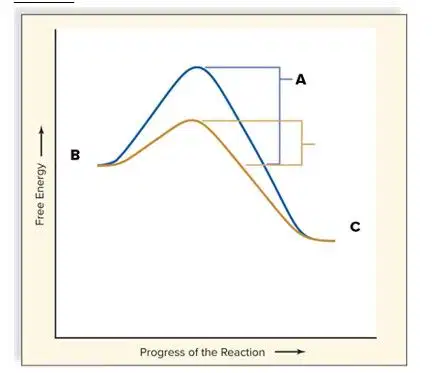
Study the figure shown here. What does letter “A” depict?
Energy of activation
Energy of conservation
Energy of reactant.
Energy of product.
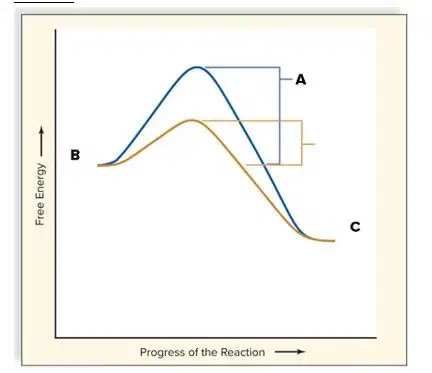
Study the graph shown here. The letter “B” depicts the _____, while “C” depicts _____.
Energy of activation; Energy of reactant
Energy of conservation; Energy of activation
Energy of product; Energy of reactant
Energy of reactant; Energy of product
B —> C is:
Exergonic
Endergonic
The metabolic pathway below involves how many possible chemical reactions?
A -> B-> C-> D-> E
5
4
9
10
______ represent(s) the first reactant(s) of this metabolic pathway and _____ represent(s) the end product(s) of this pathway.
A-> B-> B-> C-> D-> E
A;E
E;A
F;G
A;B
Which organelles are involved in a redox cycle?
Golgi complexes and lysosomes
Mitochondria and chloroplasts
Endoplasmic reticulum and vesicles
Vacuoles and vesicles
Mitochondria and endoplasmic reticulum
In the reaction NAD—> NADH, the NAD is ____, while the NADH is ____.
Reduced; Oxidized
Oxidized; Oxidized
Reduced; Reduced
Oxidized; Reducued
Which of the following substrates are required for cellular respiration?
Glucose and oxygen
Glucose and carbon dioxide
Sunlight and oxygen
Sunlight and glucose
Oxygen and carbon dioxide
What are the end products of photosynthesis?
Glucose and oxygen
Glucose and ATP
Carbon dioxide and energy
Carbon dioxide and water
Which substrate is missing:
6CO2 +____+ energy= C6H12O6 + 6O2?
6H2O
4H2O
4O2
Glucose
Which of the following substrates is essential to an organism that utilizes photosynthesis?
6H20
C6H12O6
6O2
6 Carbon atoms
Which of the following organisms are capable of photosythesis?
Plants only
Plants and algae only
Plants and some bacteria
Plants, algae, and some bacteria
To what does the term stroma refer?
The fluid-filled space of the chloroplast
A stack of thylakoid membranes
Membrane-bound compartments inside chloroplast
An essential organelle that prevents the indiscriminate diffusion of small molecules
To what does the term granum mean?
A stack of thylakoid membranes
An essential organelle that prevents the indiscriminate diffusion of small molecules
The fluid-filled space of the chloroplast
Membrane-bound compartments inside chloroplast
Which structure is required for a eukaryotic organism to be classified as an autotroph?
Chloroplast
Mitochondria
Golgi body
Nucleus
Which is most closely related with the Calvin Cycle?
Carbon dioxide fixation
Oxygen production
Carbon dioxide production
ATP production
Removal of electrons from water for passage through an electron transport system
A product of photosynthesis, ____, is the chief source of energy for most organisms.
Oxygen
Sucrose
Glucose
All of the answer choices
During the light reactions, what structure is responsible for absorbing the solar energy?
Chloroplast
Stroma
Stoma
Bark of the tree
What is the ultimate destination for the energized electrons during the light reactions of photosynthesis?
They are taken up by NADP+ to produce NADPH
They are taken up by NADPH to produce NADP+.
They are taken up by NADH to produce NAD+.
They are taken up by NAD+ to produce NADH.
Which of the following statements about the Calvin Cycle is correct?
The CO2 is absorbed and reduced to CH2O.
The CO2 is absorbed and reduced to C2H2O2.
The CO - is absorbed and reduced to CH2O.
The CO2 is absorbed and used to form ATP.
Why are plants green?
They reflect green wavelengths of light and absorb other colors of the visible light spectrum.
They absorb only yellow and blue wavelengths of light.
They reflect nearly all wavelengths of light.
They absorb only green wavelengths of light.
Which statement is NOT true about the noncyclic electron pathway?
Electrons are boosted to higher energy level in photosystem 1
Sunlight excites electrons in photosystem 1
It produces ATP
It produces NADPH
It produces carbohydrates through carbon dioxide fixation
____ is a product of the Calvin Cycle that is used to form glucose phosphate, amino acids, or fatty acids.
ATP
Ribulose bisphosphate ( RuBP)
Glyceraldehyde-3-phosphate (G3P)
PEP carboxylase (PEPcase)
Carbon dioxide
The fixation of carbon dioxide in the first step of the Calvin Cycle is facilitated by which enzyme?
RuBP carboxylase
Glyceraldehyde-3-phosphate (G3P)
PEP carboxylase (PEPcase)
Lactate dehydrogenase
Photorespiration occurs mainly in:
C3 plants
C4 plants
CAM plants
All of the answer choices
Which of the following plants is an example of a CAM plant?
Pineapple
Corn
Rice
Wheat
Oak tree
While C4 plants have carbon dioxide fixation and carbon dioxide uptake separated by location within the plant, CAM plants:
Fix much greater amounts of carbon dioxide than C4 plants.
Are found in tropical regions where nutrients are abundant.
Have these processes separated among two leaf types.
Have these processes separated by time.
What is the characteristic of C4 leaves?
Mesophyll cells are arranged concentrically around bundle sheath cells.
Restoration occurs in C4 leaves.
C4 plants experience more photorespiration than C3 plants.
All of the choices
The function of sunlight in photosythesis is to:
Reduce NADPH to NADP
Fix O2 in the Calvin cycle
Excite electrons in chlorophyll
Combine carbon dioxide and water to form ATP and NADPH

