
 Worksheets
Earth Science Review - Dufour
Total questions: 63
Worksheet time: 1hrs 18mins
What can a scientist learn from studying the relationship between fossils?
how paleontology has changed has changed
how life has changed
how science has changed
how the geologic column

The diagram below shows a geologic cross section. Which rock layer most likely contains fossils of the most recently evolved organisms?
1
2
3
4
Which of the following is TRUE about when mountains have developed on Earth?
All mountains on Earth today were present when Earth formed.
Mountains developed for a while after Earth first formed, but no new mountains are developing today.
Mountains have only occasionally developed since Earth formed.
Mountains have been developing continuously since Earth formed, and mountains are still developing today.

How are volcanoes formed?
spin of Earth
L-waves traveling through Earth
shock waves from movements in Earth's crust
magma pushes up through Earth's crust

Match the diagram with the type of plate movement that would most likely cause earthquakes.
A
B
C

What plate motion is happening at point A?
A convergent boundary where two plates collide.
A divergent boundary where two plates pull apart.
A transform boundary where two plates slide past each other.
Not enough information is given to be able to identify the plate motion.

The diagram shows several rock layers in an area. A scientist claims that an intrusion of magma (layer Y) formed before layer X. Which statement supports the scientists claim?
Layer X crosses over Layers W, Z, and Y.
Layer Y is larger in area than rock Layer Z.
Layer Z is parallel to Layer X, which was deposited before Layer Y.
Layer Y is partly covered by Layer X.
A (a) boundary can be found at the mid ocean ridge

Earth's tectonic plates have pressed together for many millions of years in several locations. What happened if they pressed together in a place where oceanic plate material meets continental plate material?
The continental plate material was pushed downward.
The oceanic plate material was pushed downward.
The plates were not able to move while they were pressing together, and no plate material was pushed upward.
The edges of the plates were not pushed upward but they were broken into small pieces.

Based on the diagram below, which letter indicates a place where new plate material is forming?
At the boundary of the continent and ocean basin.
In the middle of the ocean basin.
At the boundary where the two plates are pulling apart.
No new plate materials is forming anywhere show in the diagram.
Which of the following choices did Wegener give as evidence for continental drift? (select all that apply)
sea-floor spreading
mid-ocean ridge
glacial evidence
rock sequence
fit of continents

Use the diagram to select the one true statement about the rock layers.
A occurred after D
C is younger that B
C occurred before D
A is older than B

According to the diagram, which rock layer is probably the oldest?
A
B
C
D
What type of rock are the fossils most commonly found in?
Metamorphic
Igneous
Sedimentary
Bacon pancakes
The process that causes earth mantle to move in a circular motion is_____
Conduction
Convection
Radiation
The process of continents slowly moving due to convection is called.
Continental Drift
Continental Slide
Wegenernomics
Ocean Floor Spreading

Ocean floor is younger, closer to _____
The edge of continents
The mid ocean ridge
Boundary
Northern part of ocean
Which layer is the most dense layer of the earth?
mantle
crust
inner core
outer core

What do you know about the index fossil found in each of the following outcrops?
they are found in the same layer of rock
they are abundant
they are the same age
all of the above

What is the youngest item in the image?
A
B
C
D
E
Volcanic activity is most likely to be found at which type of plate boundary?
transform
convergent
divergent
transvergent
Which layer of the earth flows with convection currents allowing the plates on top of it to move?
asthenosphere
lithosphere
atmosphere
hemisphere

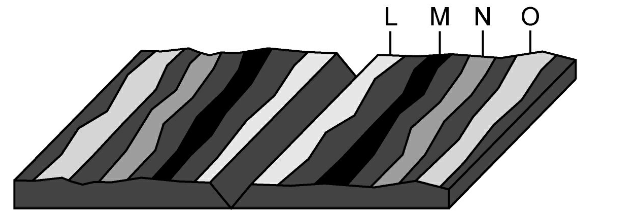
water, ice, wind or gravity
moves fragments of rock
and soil.
water, ice, wind or gravity
deposit rock sediments
and soil in a new place.
Earth’s crust into smaller
and smaller pieces.

Which statement best explains why this process results in weathering?
Where is heat and pressure the greatest in the Earth?
crust
mantle
outer core
inner core
How have scientists been able to infer the internal structure of Earth without being able to directly observe inside the Earth?
Scientists analyze how earthquake waves move throught Earth's interior.
Scientists use satellite radar and sonar technologies to map Earth's internal layers.
Scientists make educated guesses about Earth's internal structure based on previous hypothesis.
Scientists study different types of rocks from many different locations on Earth's surface.
Violent collisions of planetesimals ("baby planets") during the formation of the planet generated a significant amount of earth's internal heat.
true
false
Which layer of the earth is the least dense layer?
crust
mantle
outer core
inner core
The layers of the earth forming according to their density is known as:
density columns
layered earth theory
planetary differentiation
I can't think of another misleading option
Fossils are commonly preserved in what type of rock?
Igneous
Metamorphic
Sedimentary
Punk
What parts of organisms are typically fossilized?
the skin
the expression on their face
hard parts--like bones and shells
Everything that has ever lived has been fossilized
True
False
Which of these choices is a trace fossil?
Animal tracks
Shells
bones
insect in amber
A supervolcano erupting and covering the country in ash would be an example of:
catastrophism
uniformitarianism
The creation of the Grand Canyon is an example of:
catastrophism
uniformitarianism
How do most changes on Earth occur?
Gradually
Suddenly
What is a mass extinction?
When life is not affected by an event
When multiple species from all over the earth suddenly go extinct
When one species goes extinct due to habitat changes
When all life on earth is wiped out
What is the Geologic Time Scale?
old geologists
sweet geology music
Earth's history divided by major events and changes on Earth
a list of every living thing ever

What type of event usually marks the end of an Era
A Mass Extinction
High School graduation
An earthquake
A Volcanic Eruption
Preserved remains of plants and animals from the remote past are called?
Sedimentary rocks
Radioactive dating
Decayed organisms
Fossils
The Law of Superposition states
Younger rocks layers are on top of older rock layers
Fossils are found in sedimentary rocks
Older rock layers are on top of younger rock layers
Absolute age dating

Use relative age dating to put the rock layers in correct order from oldest to youngest.
B, D, A, E, C
C, E, D, A, B
A, C, E, D, B
C, E, D, B, A

Which is the youngest rock layer?
Siltstone
Conglomerate
Mudstone
Limestone

Which of the fossils is the oldest?
Dinosaur
Bird
Shell
Ammonite

Approximately how old is the Earth?
250 million years
4 billion years
1.5 billion years
4.6 billion years
The state of no longer existing
Sedimentary layers
Fossils
Diversity
Extinction

An animal has sharp, pointy teeth, what can we infer about this animal?
The animal lived in the water
The animal lived near the beach.
The animal is a carnivore.
The animal only ate plants.
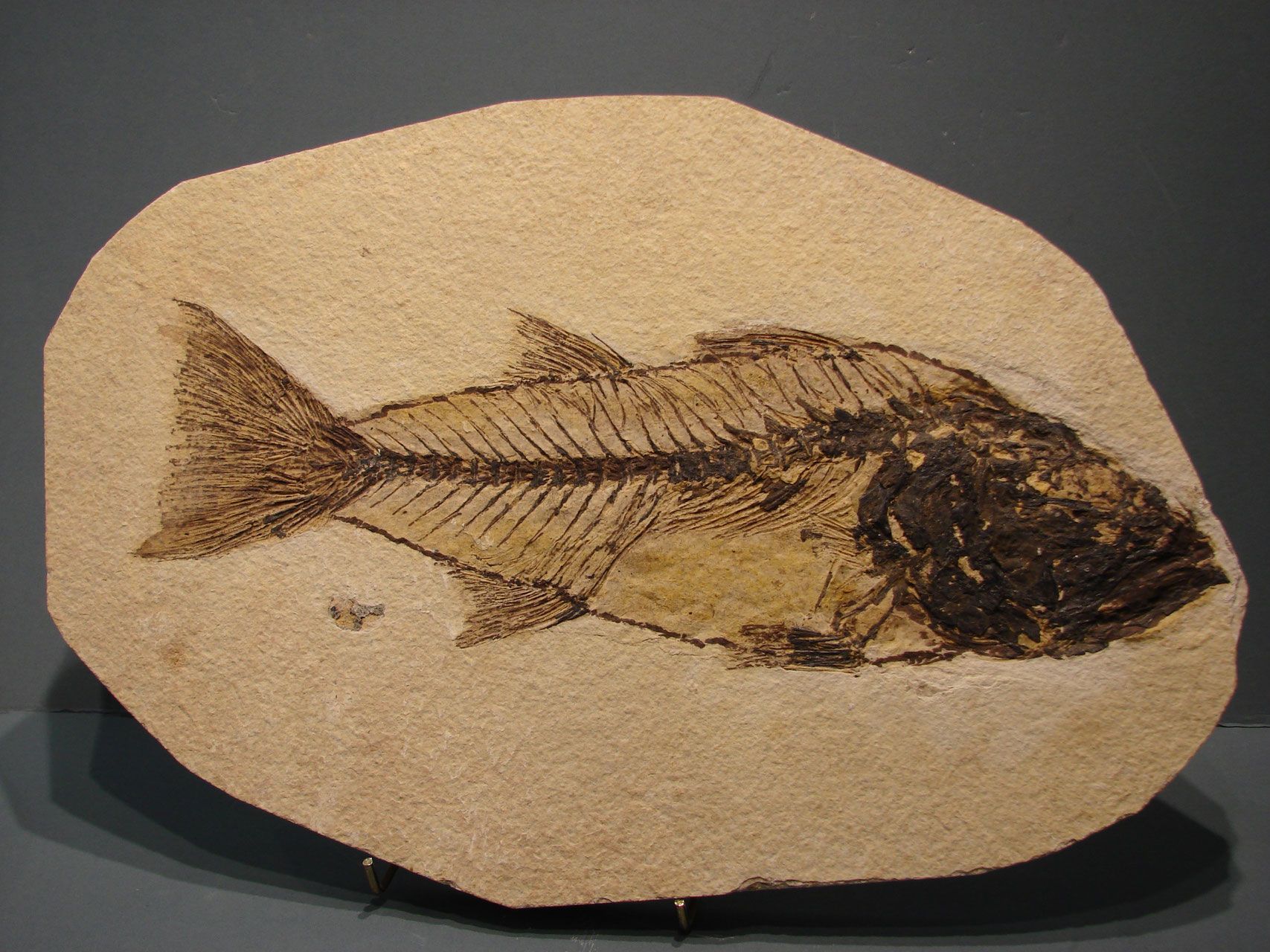
If a scientist found a fish fossil in the desert, what can they infer?
An animal ate the fish.
The water covered the area long ago.
Today's fish looks the same
The fish is endangered.

What are the oldest fossils and why?
B, C- because they are closest to the top
A, B- because they are closest to the bottom
They are all the same age- because they are all found on layer 2
A, B- because they are found closest to the top
With ________ dating, a rock’s exact age can be determined, whereas with ________ dating, a rock’s age is compared to the ages of other rocks.
absolute, relative
relative, absolute
true, absolute
relative, approximate
Which of the following is least likely to become fossilized?
bones
teeth
skin
shells
What do earthquakes tell scientists about the history of the planet?
Earth’s climate is constantly changing.
The continents of Earth are continually moving.
Dinosaurs became extinct about 65 million years ago.
The oceans are much deeper today than millions years ago.

The diagram shows layers of sedimentary rock. Assuming that this rock formation is undisturbed, What is the relative age of layer C?
It is the youngest rock layer.
It is the oldest rock layer.
It is older than B and younger than D.
It is younger than B and older than D.
How do scientist know when a mass extinction took place?
They find more fossils of plants.
They find fossils of animals that died suddenly.
They find a sudden disappearance of many fossil species.
They find evidence of changes in Earth’s atmosphere.

