wayground logo

Free Printable Worksheets

NEW

Font size

S
M
L
XL
Worksheets

Module 4 FOL

Total questions: 44

Worksheet time: 42mins

Name
Class
Date
1.

What are the two main stages of a cell's life?

a)

Interphase and division

b)

Prophase and anaphase

c)

Metaphase and telophase

d)

Cytokinesis and mitosis

2.

During which phase of interphase does DNA synthesis occur?

a)

G1

b)

S

c)

G2

d)

M

3.

What is the function of the centrioles in animal cells during mitosis?

a)

To form the spindle fibers

b)

To divide the nucleus

c)

To synthesize DNA

d)

To produce energy

4.

What is the correct order of the phases of mitosis?

a)

Prophase, metaphase, anaphase, telophase

b)

Metaphase, prophase, anaphase, telophase

c)

Anaphase, metaphase, prophase, telophase

d)

Telophase, anaphase, metaphase, prophase

5.

How does cytokinesis occur in animal cells?

a)

By forming a cell plate

b)

By forming a cleavage furrow

c)

By dividing the nucleus

d)

By producing new organelles

6.

What is the biological significance of mitosis?

a)

To produce genetically identical cells

b)

To repair and regenerate tissues

c)

To allow growth and development

d)

All of the above

7.

In mitosis, one parent cell -

a)

Forms two identical daughter cells

b)

Forms four identical daughter cells

c)

Forms two genetically diverse daughter cells

d)

Forms four genetically diverse daughter cells

8.
The result of meiosis is:
a)
two diploid cells
b)
two haploid cells
c)
four diploid cells
d)
four haploid cells
9.
Structure (b) is a ____.
a)
chromosome
b)
chromatid
c)
centromere
10.
Structure (a) is a ____.
a)
chromosome
b)
chromatid
c)
centromere
11.
Structure (c) is a ____.
a)
chromosome
b)
chromatid
c)
centromere
12.
products of meiosis are genetically
a)
different
b)
identical
13.

What do the blue and yellow arrows represent

a)

The blue arrow is prophase and the yellow is interphase

b)

The blue arrow is mitosis and the yellow arrow is meiosis

c)

The blue arrow is interphase and the yellow is mitosis

d)

The blue arrow is meiosis and the yellow is prophase

14.

Crossing over occurs during prophase I of meiosis. Which statement about crossing over is true?

a)

RNA translation occurs in the smooth endoplasmic reticulum

b)

Crossing over takes place in backterial cells

c)

Crossing over produces genetically identical daughter cells

d)

Crossing over provides genetic diversity in eukaryotic cells

15.

During prophase I crossing over occurs and genetic material is exchanged between homologous chromosomes. How is this important

a)

Increases genetic variation

b)

Reduces the diploid number to the haploid number

c)

Increases the haploid number to the diploid number

d)

Reduces the probability of mutations

16.

G1, S, and G2 are all phases of

a)

Mitosis

b)

Meiosis

c)

Interphase

d)

Prophase

17.
Name this phase of mitosis:
a)
Prophase
b)
Metaphase
c)
Anaphase
d)
Telophase
18.

what is this phase?

a)

anaphase

b)

prophase

c)

telaphase

d)

enter phase

19.

what is this phase

a)

prophase

b)

metaphase

c)

anaphase

d)

teloophase

20.

forms gametes

a)

Mitosis

b)

Meiosis

c)

Both

21.
a)
Prophase
b)
Interphase
c)
Anaphase
d)
Telophase
22.
a)
Cytokinesis
b)
Interphase
c)
Anaphase
d)
Metaphase
23.
a)
Cytokinesis
b)
Anaphase
c)
Telophase
d)
Prophase
24.

When the cells completely split it is call what?

a)

Telophase

b)

Cytokinesis

c)

Anaphase

25.
Which of the following is NOT occuring during interphase?
a)
Cell growth
b)
DNA being copied
c)
DNA condensing
d)
Two new cells are made
26.
Why would it be important to replicate DNA before a cell divides in mitosis or meiosis?
a)
In order for genetic information to be transferred into daughter cells.
b)
In order for the cell to be able to increase in size.
c)
In order for the DNA to be contained in the nucleus.
d)
In order for the cell to re-order the DNA sequencing in the new cells.
27.
TT,tt,PP,pp,SS,ss are examples of alleles that are?
a)
homozygous
b)
heterozygous
c)
different
d)
homologous 
28.
Y for yellow body is dominant over y for blue body.  What alleles would produce yellow bodies?
a)
YY,yy
b)
Yy,yy
c)
YY only
d)
YY,Yy
29.
If "T" is the allele for tall and "t" is the allele for short, then Tt would produce?
a)
tall
b)
short
c)
medium
d)
not enough info
30.
Two brown eyed parents (Bb) have a baby. What is the chance the baby is blue eyed?
a)
0 %
b)
25%
c)
50%
d)
75%
31.
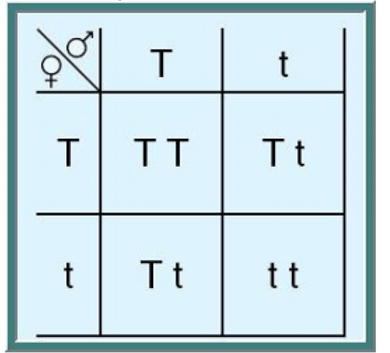
T - tall and t = short
In the punnett square below, what belongs in the missing square
a)
tt
b)
Tt
c)
Bb
d)
TT
32.
aa always shows up as
a)
dominant
b)
recessive
33.
What is a punnett square?
a)
graph used to predict the possible genotypes of offspring in a given cross
b)
a graph used to predict the possible birth rate of offspring.
c)
a graph used to predict the possible behavioral characteristics an offspring could have
d)
None of the above
34.
What you see, or the physical appearance.
a)
Genotype
b)
Phenotype
c)
Homozygous
d)
Heterozygous
35.

In pea plants, tall is dominant to short. If 2 heterozygous plants are crossed, what % of the offspring will be short?

a)

0%

b)

25%

c)

50%

d)

75%

36.

An ______________ trait is a trait we get from our parents.

a)

environmental

b)

inherited

37.

Little pieces of DNA that code for our traits are called

a)

cells

b)

chromosomes

c)

genes

38.
The letters that make-up the genetic code for a trait
a)
genotype
b)
heterzygous
c)
phenotype
d)
trait
39.

Two alleles that are simmilar are called _________

a)
genotype
b)
homozygous
c)
phenotype
d)
trait
40.

_________is that gene that always shows itself when present.

a)
genotype
b)
homozygous
c)
phenotype
d)
dominant
41.
What are the parents' genotypes?
a)
Homozygous for brown eyes
b)
Heterozygous for brown eyes
c)
Homozygous for blue eyes
d)
Heterozygous for blue eyes
42.
A type of gene that can be hidden is called
a)
genotype
b)
recessive
c)
dominant
d)
allele
43.

A physical attribute of an organism that can be expressed by a gene is known as a

a)
gene
b)
allele
c)
trait
d)
characteristic
44.
This type of inheritance pattern shows BOTH traits in possible offspring
a)
complete dominance
b)
incomplete dominance
c)
co-dominance
d)
dominant pattern