
Font size
 Worksheets
CVHS Ch. 5 Periodic Table Test
Total questions: 76
Worksheet time: 3hrs 32mins
REVIEW: What are the two parts of the atom are found in the atom's nucleus?
Electrons and Neutrons
Protons and Electrons
Protons and Neutrons
Neutrons and Electrons
REVIEW: What subatomic particle is found outside of the nucleus?
Isotope
Electron
Neutron
Mass

Which property did Mendeleev use to order his periodic table?
Neutron number
Electron number
Atomic Weight
Atomic number

What was Dmitri Mendeleev's greatest contribution to the history of the periodic table?
He arranged all of the known elements by their atomic number
He realised that there was a pattern of reactivity which repeated every 8 elements
He predicted the existence (and properties) of new elements

Why were there blank spaces left in Mendeleev's periodic table?
He didn't know what to put there.
Undiscovered elements not yet known.
Multiple elements could have fit
He forgot to add the elements in.

Vertical (up and down) columns in the periodic table are called _________ of elements and have similar properties.
groups
periods

Look at your periodic table. How many groups (or families) are there?
7
8
12
18

The horizontal (left to right) rows on the periodic table are known as
periods.
atoms.
groups or families.
valence electrons.

Look at your periodic table. How many periods are there?
6
7
8
18
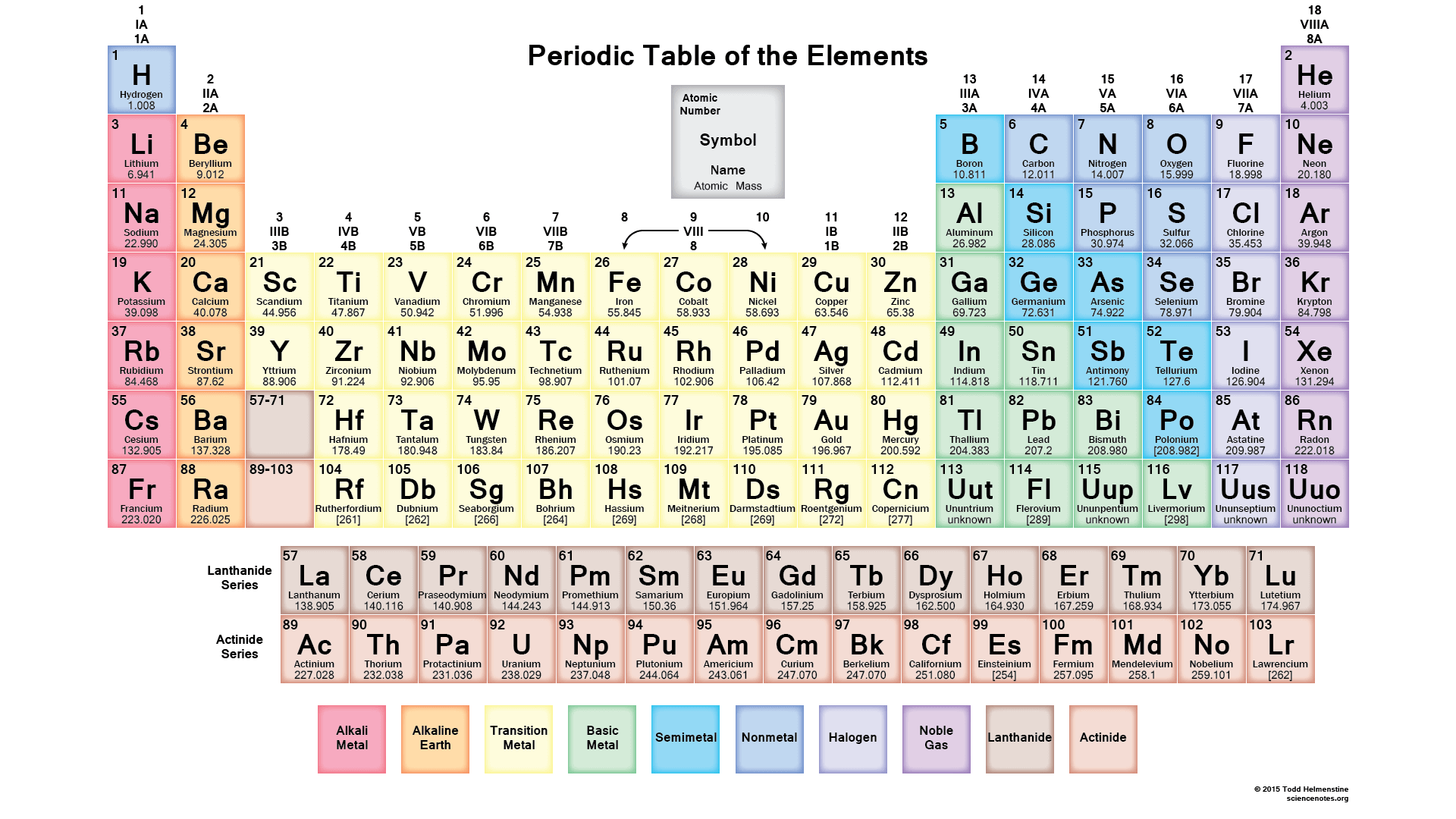

Sodium (Na) is found in period
3
2
4
1

Look at your periodic tables. How many energy levels are in an atom of Cesium, Cs?
55
133
1
6

What period is this element located in?
(Hint: count the number of energy levels)
2
3
4
6

The number of energy levels correspond to the row or period on the periodic table. What period is this element located in?
1
2
3
4

What element is in period 3 group 18 (8A)?
Aluminum
Potassium
Argon
Neon

Which element is located in group 3A and period 4?
Boron
Silicon
Beryllium
Gallium

The period for Bromine is ___________.
3
2
4
1

noble gases


What type of element makes up the largest percentage of elements on the Periodic Table?
metals
nonmetals
metaloids
halogens
Which two elements have the most similar chemical properties?
K and Na
K and Ca
K and Cl
K and S
Which element has similar chemical properties to: Chlorine (Cl)?
Lithium (Li)
Fluorine (F)
Krypton (Kr)
Barium (Ba)
Which element has similar chemical properties to: Rubidium (Rb)?
Lithium (Li)
Fluorine (F)
Krypton (Kr)
Barium (Ba)
Which element has similar chemical properties to: Calcium (Ca)?
Lithium (Li)
Fluorine (F)
Krypton (Kr)
Barium (Ba)
Potassium (K) is a...
Alkali Metal
Alkali Earth Metal
Halogen
Noble Gas
Xenon (Xe) is a...
Alkali Metal
Alkali Earth Metal
Halogen
Noble Gas
Chlorine (Cl) is a...
Alkali Metal
Alkali Earth Metal
Halogen
Noble Gas
Sodium (Na) is a...
Alkali Metal
Alkali Earth Metal
Halogen
Noble Gas

These groups have very special properties
These groups are not true elements
Simply for printing purposes
Because Mendeleev said so.


Which group has the most reactive nonmetals?
(HINT: group 17 and next to the non-reactive group)
alkali metals
noble gases
metalloids
halogens

Name the group that contains inert (nonreactive) elements.
noble gases
halogens
alkali metals
alkaline earth metals

The horizontal (side to side) rows in the Periodic Table are called
groups
families
periods
atomic numbers
_______________ developed the first periodic table and arranged the elements in order of increasing atomic mass.
Stevie Wonder
Sasha Vujacic
Dmitri Mendeleev
James Moseley

How did Mendeleev arrange the elements?
alphabetical
density
melting point
atomic mass

Name group 1 on the periodic table.
alkali metals
alkaline earth metals
noble gases
halogens

Name group 2 on the periodic table.
alkali metals
alkaline earth metals
noble gases
transition metals

Name group 18 on the periodic table.
alkali metals
alkaline earth metals
transition metals
noble gases

Name groups 3 - 12 on the periodic table.
noble gases
halogens
metalloids
transition metals

Name group 17 on the periodic table.
transition metals
metalloids
halogens
alkali metals
How do you calculate the number of neutrons? *
Mass = Atomic number - Neutrons
Mass - Atomic number = Neutrons
Atomic number = Neutrons

Metals are found on the ______________ side of the periodic table.
nonmetals
left
right
metals
This group of elements sit along a stair step line on the periodic table and have properties of both metals and nonmetals. _________________________
luster
metals
nonmetals
metalloids
where are the metaloids found
far left, vertical
stair step/diagonal
far right horizontal
at the bottom
A grouping of elements based on similar chemical properties, arranged by columns in the periodic table; also known as a group
family
period
row
isotope

Which color on the image of the periodic table corresponds with the metalloids.
bright yellow
gold
teal
light blue

Which elements are colored red?
nonmetals
metals
metalloids


Which color on the image of the periodic table corresponds with the lanthanides.
red
black
blue
orange
Which color on the image of the periodic table corresponds with the halogens.
red
black
blue
orange
Which color on the image of the periodic table corresponds with the noble gases.
red
black
blue
orange
Which color on the image of the periodic table corresponds with the transition metals.
red
black
blue
orange
Which family of elements reacts violently with water and exposure to oxygen?
alkali metals
alkaline earth metals
lanthanides
actanides
transition metals


What do the vertical columns on the periodic table tell us?
The number of orbitals/energy levels/shells
The number of valence electrons (electrons on the outer most shell)
What do the horizontal rows on the periodic table tell us?
The number of orbitals/energy levels/shells
The number of valence electrons (the electrons on the outer most shell)
choose the metalloid element
Alumunium
Germanium
Silver
Helium
Most metals share four common physical characteristics. Which of the options is not one of the four?
Luster
Conductivity
Ductility
Malleability
Reactivity
What is the periodic law?
Elements have numbers
Elements have specific names
Elements are organized based on families
Elements are organized based on atomic masses
Which one is correct about mendeleev's periodic law
Properties of elements are periodic function of their atomic mass
the physical and chemical properties of elements are periodic function of their atomic number.
physical properties of elements are periodic function of their atomic weight.
chemical properties of elements are periodic function of their atomic number.
Metals (select all that apply)
are found on the right side of the periodic table.
are found on the left side of the periodic table.
are good conductors of heat and electricity.
are brittle.
are malleable and ductile.
Nonmetals (select all that apply)
are found on the right side of the periodic table.
are found on the left side of the periodic table.
are good conductors of heat and electricity.
are brittle.
can be solid, liquids, or gases at room temperature.

