
Font size
 Worksheets
Inheritance
Total questions: 78
Worksheet time: 3hrs 8mins

What are some examples of discrete variation?
Eye colour
Height
Hair colour
Blood type
What are discrete characteristics determined by?
Multiple genes
2 genes
Single genes
12 Genes
What kind of graph do we usually use to represent discrete variation?
Bar graph
Histogram
Line graph
Scatter Graph
What are the differences between members of the same species called?
Characteristics
Niche
Variation
Ecosystem
Choose the correct word for this definition.
The differences that have a range of vales and therefore cannot easily be placed in groups
Recessive
Continuous variation
Discrete variation
Characteristics
What sort of graphs are used to represent continuous variation data?
Histogram
Bar chart
Line graph
Scatter graph
What is the definition of polygenic?
Controlled by different genes
Controlled by many genes
Controlled by one gene
Controlled by no genes
What is an example of continuous variation?
Weight
Height
Arm span
All of these
What is an allele?
The form of the gene.
A single piece of genetic information made from DNA
The appearance of the characteristic of an individual
The combination of genes that an organism has
What does it mean for an allele to be dominant
The appearance of the characteristic in an individual
The allele that is always expressed in the appearance of an organism
The allele that is only expressed in appearance if paired with another
What term is used to describe a version of a gene?
allele
genotype
phenotype
heterozygous
What term is used to describe an organism that carries two identical alleles for a gene?
dominant
recessive
homozygous
heterozygous
What term is used to describe an organism that carries two different alleles for a gene?
dominant
recessive
homozygous
heterozygous
What term is used to describe the observable features of an organism due to its genotype?
inheritance
phenotype
dominant
allele
Gary and Fiona are both healthy but produce a child with a genetic disease caused by a recessive allele.
Which of the following must be true?
The child could be heterozygous
Gary is homozygous and Fiona is heterozygous
Gary and Fiona are both homozygous
Gary and Fiona are both heterozygous

A plant has two different alleles of a gene, G, resulting in it having a green seed.
Which row of the table describes the phenotype and genotype of the seeds of this plant?
A
B
C
D

The pedigree chart shows the inheritance of a genetic disorder in a family.
What conclusion can be made about this genetic disease?
The genetic disorder is dwarfism
It is caused by a dominant allele
It is caused by a recessive allele
It is caused by codominant alleles

The pedigree chart shows the inheritance of a genetic disorder in a family.
What conclusion can be made about this genetic disease?
The genetic disorder is dwarfism
It is caused by a dominant allele
It is caused by a recessive allele
It is caused by codominant alleles
In a certain plant, the allele fo white fruit (W) is dominant over the allele for yellow fruit (w).
A white-fruited plant was crossed with a yellow-fruited plant.
About half of the offspring were white-fruited and the other half were yellow-fruited.
Which genotypes did the parent plants have?
ww and www
Ww and ww
WW and ww
WW and Ww
The colour of a mouse's fur is controlled by a single pair of alleles.
A mouse with black fur was crossed with a mouse with white fur. All of the offspring had black fur.
What would be the likely ratio in several generations of offspring, if two of these black offspring were crossed?
1 black fur : 3 white fur
2 black fur : 2 white fur
3 black fur : 1 white fur
4 black fur : 0 white fur
How many alleles for each gene are carried in all body cells?
1
2
3
4
What is discontinuous variation from?
The environment
Inheritance
Both
None of the above
What are the base pairing rules for DNA?
A always pairs with T, and G with C
A always pairs with C, and G with T
A always pairs with U, and G with C
A always pairs with G, and C with T
A section of DNA that codes for a specific protein
gene
genome
amino acids
RNA
The basic building blocks of proteins.
genes
amino acids
RNA
DNA
The study of the inheritance of traits
Genetics
Biology
DNA-ology
Gene-ometry
An allele that masks or covers up the other gene.
dominant
recessive
genotype
phenotype
An allele that is easily covered or hidden.
genotype
phenotype
dominant
recessive

What's the probability an offspring will have the dominant Brown Eyes in this Punnett Square
25%
50%
75%
100%

hereditary material with the instructions to make an organism
DNA
dominant trat
phenotype
heterozygous

passes genetic information onto the offspring
recessive
genotype
phenotype
parent

two different alleles for a trait
examples: Bb, Nn, Yy
genotype
phenotype
homozygous
heterozygous

two identical (same) alleles for a trait
examples: BB, NN, nn
genotype
phenotype
homozygous
heterozygous

gene most likely to stay hidden or covered up;
shown with a lowercase letter
dominant
recessive
phenotype
offspring
gene that covers up another form of the trait;
the "stronger" trait;
shown with a capital letter
dominant
recessive
parent
genotype

Both plants and animals will benefit from adaptations to improve their chances to survive.
True
False
What adaptation helps penguins and seals stay warm?
long eyelashes
long necks
a thick layer of fat
long fur
Why do giraffes have long necks and rough tounges?
To look like trees
to reach leaves on trees
to hide in trees
to swing from trees
Which part of a camel’s body helps protect against sandstorms?
hump
eyelashes
feet
Why do some organisms, like butterflies, have bright colors?
to warn predators they are poisonous
to make it easier to find food
to help them fly long distances
to blend in with their surroundings
What is natural selection?
passing of hiding traits to future generations
passing of survival traits to future generations
passing of hunting traits to future generations

Why do camels have humps?
to store water.
to store fat.
to carry things on.
How do a camel’s feet help it walk on the sand?
They are wide and flat to stop it slipping.
They are small and can move quickly.
They have claws on their feet.
What is an adaptation?
a special feature that helps animals survive
the animal's environment
the way an animal hunts
predators eat prey
Armor is an adaptation that helps animals...
hunt
protect themselves from predators
run quickly
blend in with their surroundings
Having webbed feet is an adaptation. How do webbed feet help animals survive?
They stay cool in the summer.
They can swim faster.
They can blend in with their surroundings.
They can attack their prey.
Sharp teeth are an adaptation. How do sharp teeth help animals survive?
Animals can use them to attack their prey.
Animals can run away from danger.
Animals can avoid the cold weather.
Animals can fly away.

Polar bear get protection from severe cold from his
small eyes
thick fur
sharp claws
strong limbs
Thick layer of fat which protect animals form cold is called......
Fatty
Blubber
Fur
Feather
What is a habitat?
all of one kind of animal or plant in the same area
all the animals living in the ocean
living and nonliving things that interact in the same space
the space where a plant or animal lives
Why are advantageous traits more likely to be passed onto offspring?
Because they are more likely to survive and reproduce.
Because they come from dominant alleles.
Because they come from recessive alleles.
Because the organism knew it needed that trait, survives, and passes it on.
Mutations are a change in what?
DNA
tRNA
protein
rRNA
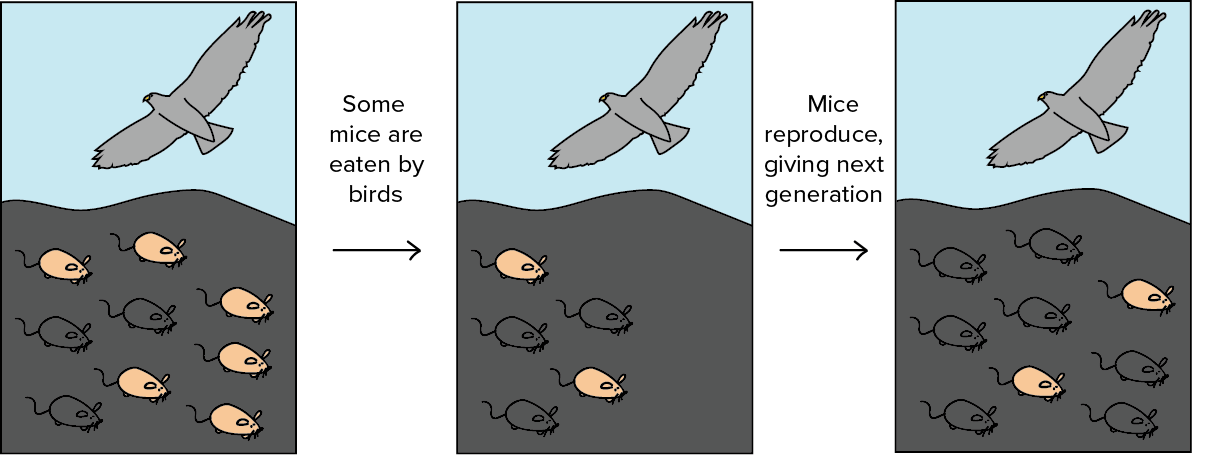

Where do adaptations come from?
The individual organism decides to adapt
Mutations that give an organism an advantage in its environment
Genetic recombination during meiosis
Both mutations and genetic recombination are sources of adaptation
"Organisms that are better adapted to the environment survive to pass traits to their offspring" is the definition of
Natural Selection
Evolution
Selective Breeding
Artificial Selection
Which best describes the role of mutations in natural selection?
Mutations help an organism to better survive in their environment
An organism may acquire a helpful mutation by interacting with the environment
A mutation may result in a beneficial trait that makes an organism more likely to survive and reproduce
Organisms with certain traits are more likely to win competitions for mutations

All rabbits of the same species living in a particular area would be an example of a(n)
population
species
community
ecosystem
The more genetic variation a population has,
the more likely it is for some individuals to
evolve
migrate
survive
mutate
Mutations are important because they bring about
death of the organism in which they develop
genetic variation needed for a population to evolve
benefits for the individual, not for the population
changes in genotype, but not phenotype


Why is competition important for natural selection?
It shows which variations are more successful, allowing the organisms with those variations to survive.
It causes organisms, regardless of which traits they have, to die out, reducing the population size.
It causes organisms to get stronger due to having to outcompete other species.
Competition is not important for natural selection.
What is evolution?
no more individuals of a species left
development of a species over time
differences in characteristics
the remains of plants and animals
What is variation?
no more individuals of a species left
development of a species over time
differences in characteristics
the remains of plants and animals
What is a fossil?
no more individuals of a species left
development of a species over time
differences in characteristics
the remains of plants and animals
What is extinction?
no more individuals of a species left
development of a species over time
differences in characteristics
the remains of plants and animals
Which of these provides evidence that dinosaurs lived on Earth millions of years ago?
photographs
fossil record
cave paintings
Which two of the following answers are reasons species become extinct
destruction of habitat
gene banks
disease
biodiversity
Which 3 of these are types of gene banks
flower banks
cryobanks
seed banks
pollen banks
Which part of the Galapogas Finch evolved in order that they could feed on their chosen island?
claws
feathers
beaks
eye position
What feature of the pepper moth evolved to allow them to survive when tree bark got darker?
size of wings
size of antenna
colour of the wings
pattern on the wings
Why did giraffes evolve to have long necks?
to reach water holes
to reach leaves on tree branches
to attract mates

