Wayground logo

Free Printable Worksheets

Font size

S
M
L
XL
Worksheets

Biology Mid-Term Study Guide

Total questions: 62

Worksheet time: 36mins
Name
Class
Date
1.

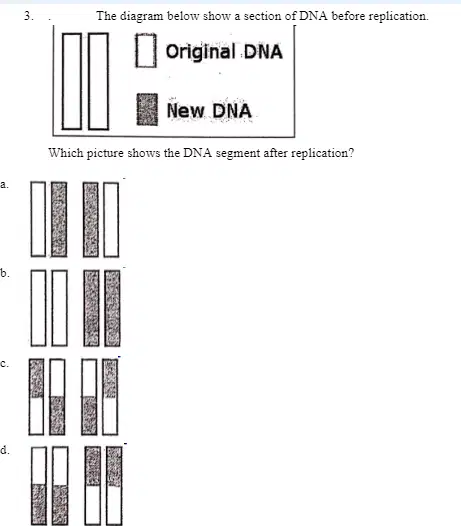
The diagram at the top shows a section of DNA before replication. Which picture shows the DNA segment after replication?

a)

A

b)

B

c)

C

d)

D

2.

How are DNA and RNA similar and different?

a)

DNA is double stranded with A,T,C,G as it's bases, and cannot leave the nucleus. RNA is single stranded with A,U,C,G and can leave the nucleus

b)

RNA is double stranded with A,T,C,G as it's bases, and cannot leave the nucleus. DNA is single stranded with A,U,C,G and can leave the nucleus

3.

What is the central dogma of biology?

a)

RNA > DNA > Protein

b)

DNA > RNA > Protein

c)

Protein > DNA > RNA

4.

What is the mRNA strand that will match the DNA strand AGC CAT GTA TAC?

a)

TCG GTA CAT ATC

b)

UCG GUA CAU AUG

c)

TGG GUA CAU UTG

5.

What is transcription?

a)
The process of making a protein from an RNA sequence.
b)
The process of making a DNA copy of an RNA sequence.
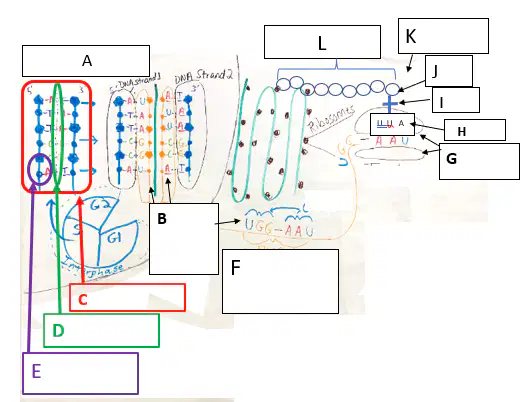
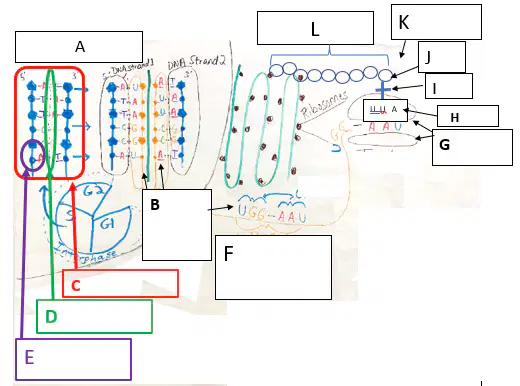
c)

mRNA converts DNA into proteins.

d)

mRNA copies DNA inside the nucleus.

6.

What is the process of converting mRNA into a protein sequence at the ribosome called?

a)

Transcription

b)

Translation

c)

Decifering

7.

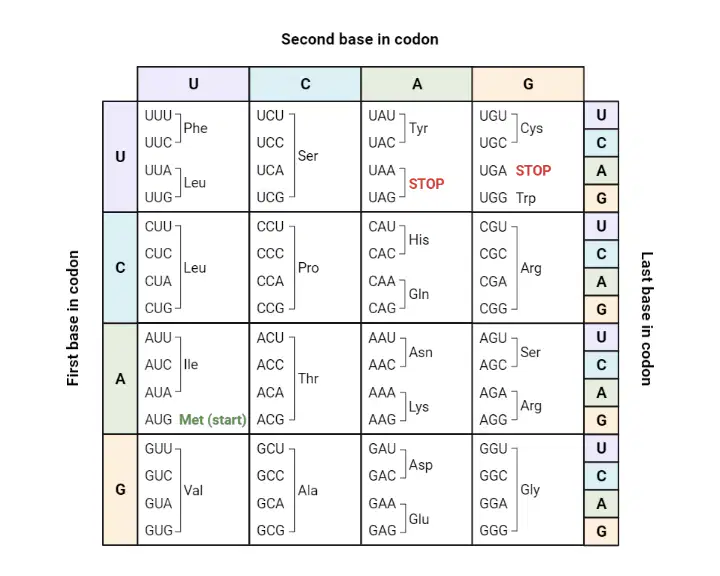
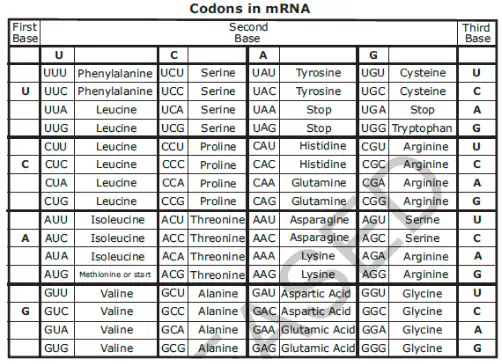
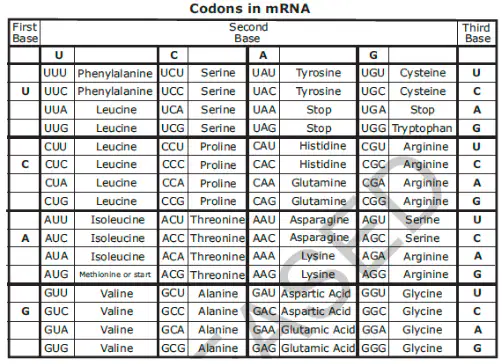
What amino acid does GCA code for?

a)
glycine
b)
valine
c)
alanine
d)
aspartic acid
8.

What is a possible mRNA codon for Valine?
a)
AUG
b)
UAA
c)
CGA
d)
GUC
9.

Use the chart to transcribe and translate the following DNA Code to its final Amino Acid Sequence:

DNA – TAC CGC TCC GCC GTC ACT

mRNA - _______________________

Amino Acids:  ________________________


a)
Methionine-Alanine-Arginine-Arginine-Glutamine-Stop
b)
Methionine-Alanine-Arginine-Glutamine-Stop
c)
Methionine-Arginine-Arginine-Glutamine
d)
Methionine-Alanine-Arginine-Arginine-Glutamine
10.

What type of mutation has occurred in this situation?

Original DNA strand: ATC-TAC-AGT.

Mutated DNA strand: ATA-TAC-AGT.

a)
deletion
b)
substitution
c)
insertion
d)
duplication
11.

How could an organism pass a mutation on to offspring?
a)
Reproduction
b)
Mutation inheritance
c)
Genetic modification
d)
Mutation transfer
12.

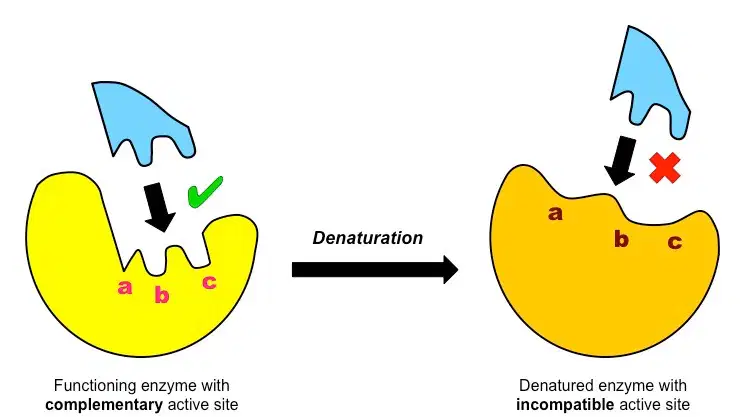
What does it mean for an enzyme to denature?

a)
An enzyme denatures when it gains a new shape and function.
b)
An enzyme denatures when it becomes more efficient at its function.
c)
An enzyme denatures when it becomes inactive.
d)
An enzyme denatures when it loses its shape and function.
13.

What are the monomers of DNA?

a)
amino acids
b)
carbohydrates
c)
nucleotides
d)
lipids
14.

What are the three main functions of proteins?

a)
Energy storage, cell division, and immune response
b)
Cell communication, DNA replication, and waste elimination
c)
Nervous system function, muscle contraction, and blood clotting
d)

Build/Repair tissue, enzymes, and transportation of functional molecules
15.

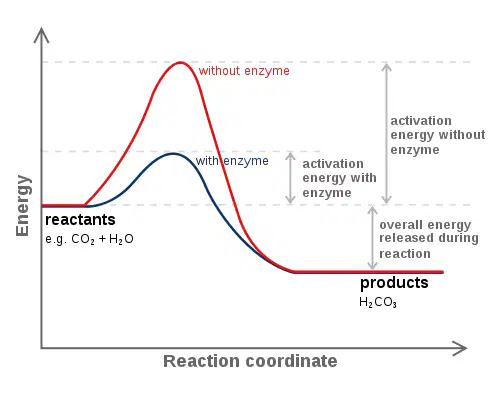
How do enzymes speed up biological reactions?
a)
By increasing the activation energy
b)
By inhibiting the reaction
c)
By changing the pH of the environment
d)
By lowering the activation energy
16.

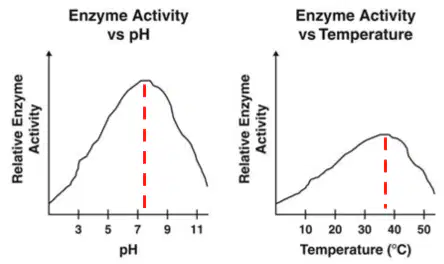
At what pH AND temperature does this enzyme work best? (Graph on the left shows enzyme activity at different pH levels, and the graph at the right shows enzyme activity at different temperatures.)

a)
pH 7 and 40°C
b)
pH 7 and 20°C
c)
pH 9 and 50°C
d)
pH 5 and 30°C
17.

Match the correct biomolecule: protein, lipid, carbohydrate, nucleic acid with the correct function.

a)

Carbohydrates

1.

Quick Energy & monosaccharides

b)

Lipids

2.

Long term energy, cell membrane, warmth

c)

Proteins

3.

Build/repair tissue, enzymes, insulin

d)

Nucleic Acids

4.

store genetic information

e)

Carbohydrate

5.

Cellulose-type of sugar

18.

Match the correct biomolecule: protein, lipid, carbohydrate, nucleic acid with the correct function.

a)

Carbohydrates

1.

Enzyme is an example

b)

Lipids

2.

Amino Acid is a building block

c)

Proteins

3.

Made of nucleotides

d)

Nucleic Acids

4.

Building blocks are fatty acids

e)

Nucleic Acid

5.

Examples include DNA & RNA

19.

How are prokaryotic cells and eukaryotic cells similar?

a)
They both have a nucleus.
b)
They both have membrane-bound organelles.
c)
They both have a cell membrane.
d)
They both contain genetic material and are capable of reproducing.
20.

How are prokaryotic and eukaryotic cells different?

a)
Prokaryotic cells have a nucleus and membrane-bound organelles, while eukaryotic cells lack a nucleus and membrane-bound organelles.
b)
Prokaryotic cells lack a nucleus and membrane-bound organelles, while eukaryotic cells have a nucleus and membrane-bound organelles.
c)
Prokaryotic cells and eukaryotic cells have the same structure and function.
d)
Prokaryotic cells are larger in size compared to eukaryotic cells.
21.

What is the primary function of mitochondria in cells?

a)

Mitochondria are responsible for producing energy through cellular respiration

b)

Mitochondria are involved in protein synthesis

c)

Mitochondria are responsible for cell division

d)

Mitochondria are responsible for detoxification of harmful substances

22.

What role do chloroplasts play in cells?

a)
Store energy
b)
Produce ATP
c)
Regulate cell division
d)
Conduct photosynthesis
23.

What molecules make up cell membranes?

a)

proteins and lipids

b)

sugars and carbohydrates

c)

amino acids and carbohydrates

d)
lipids, proteins, nucleic acids, and carbohydrates
24.

If you place an animal cell in a PURE FRESH WATER environment, what will likely happen to the cell?

a)
The cell will remain unchanged
b)
The cell will shrink and become dehydrated
c)
The cell will swell and may burst (lysis)
d)
The cell will divide and reproduce
25.

What is the major difference between active and passive transport?

a)
Active transport requires a membrane protein, while passive transport does not.
b)
Active transport moves substances against their concentration gradient, while passive transport moves substances along their concentration gradient.
c)
Active transport is faster than passive transport.
d)
Active transport requires energy, while passive transport does not.
26.

Diffusion is the movement of molecules from a ______________________ concentration to a ____________________ concentration.

a)
lower, higher
b)
lower, equal
c)
higher, equal
d)
higher, lower
27.

Which change in this experiment is most likely to increase the volume of oxygen gas that accumulates in the top of the tube?

a)

Replace the beaker with a large container

b)

Use fewer plants

c)

Move the light source closer to the beaker

d)

Reduce the amount of water

28.

What is photosynthesis?

a)

Converts Light energy into chemical energy. Also produces carbon dioxide and glucose

b)
Photosynthesis is the process by which plants convert carbon dioxide into oxygen.
c)
Photosynthesis is the process by which plants absorb water and release oxygen.
d)
Photosynthesis is the process by which plants convert sunlight into heat energy.
29.

Write the chemical formula for photosynthesis.

a)

Sunlight + 6CO2 + 6H2O -> C6H12O6 + 6O2

b)
C6H12O6 + 6O2 -> 6CO2 + 12H2O
c)
C6H12O6 + 6O2 -> 6CO2 + 6H2O
d)
6CO2 + 6H2O -> C6H12O6 + 6O2 + Energy
30.

How would the oxygen levels of a room change if you moved a houseplant away from a brightly-lit window into a dark corner?

a)
The oxygen levels would increase.
b)
The oxygen levels would stay the same.
c)
The oxygen levels would fluctuate.
d)
The oxygen levels would decrease.
31.

What is cellular respiration?

a)
The process by which cells convert carbon dioxide and water into glucose and oxygen.
b)
The process by which cells convert glucose and oxygen into carbon dioxide, water, and energy in the form of ATP.
c)
The process by which cells convert glucose and oxygen into carbon dioxide and water.
d)
The process by which cells convert glucose and oxygen into carbon dioxide and energy in the form of glucose.
32.

Write the chemical formula for AEROBIC respiration.

a)
C6H12O6 + 6O2 → 6CO2 + 6H2O + energy (ATP)
b)
C6H12O6 + 6O2 → 6CO2 + 6H2O + glucose
c)
C6H12O6 + 6O2 → 6CO2 + 6H2O + light
d)
C6H12O6 + 6O2 → 6CO2 + 6H2O + heat
33.

What is the primary function of ATP?

a)
store genetic information
b)
provide energy for cellular processes
c)
facilitate cell division
d)
regulate body temperature
34.

How are photosynthesis and cellular respiration similar and different?

4 lines
35.

What is the difference between aerobic and anaerobic respiration?

a)
Aerobic respiration is a faster process than anaerobic respiration.
b)
Aerobic respiration requires oxygen, while anaerobic respiration does not.
c)
Aerobic respiration occurs in the presence of light, while anaerobic respiration occurs in the absence of light.
d)
Aerobic respiration produces more ATP than anaerobic respiration.
36.

What is the difference between haploid and diploid cells?

a)
Haploid cells have half the number of chromosomes as diploid cells.
b)
Haploid cells have no chromosomes.
c)
Haploid cells have the same number of chromosomes as diploid cells.
d)
Haploid cells have double the number of chromosomes as diploid cells.
37.

If an organism's diploid number is 10, what is its haploid number?

a)
5
b)
2
c)
8
d)
15
38.

How are sexual and asexual reproduction similar and different?

a)
Sexual reproduction involves the fusion of gametes from one parent, resulting in offspring with genetic variation.
b)
Asexual reproduction involves the production of offspring with the involvement of gametes or the fusion of genetic material from two parents.
c)
Sexual reproduction involves the production of offspring without the involvement of gametes or the fusion of genetic material from two parents.
d)
Sexual reproduction involves the fusion of gametes from two parents, resulting in offspring with genetic variation. Asexual reproduction involves the production of offspring without the involvement of gametes or the fusion of genetic material from two parents.
39.

Meiosis begins with ONE diploid, somatic cell, but ends with ________________ genetically different gametes.

a)
two
b)
six
c)
eight
d)
four
40.

How does meiosis most benefit a species?

a)
Genetic diversity and sexual reproduction
b)
Asexual reproduction and genetic stability
c)
Mutation and genetic variation
d)
Mitosis and genetic diversity
41.

How does crossing over during meiosis lead to genetic variation?

a)
Crossing over during meiosis leads to the formation of identical offspring.
b)
Crossing over during meiosis does not lead to genetic variation.
c)
Crossing over during meiosis only occurs in somatic cells and not in gametes.
d)
Crossing over during meiosis leads to genetic variation by exchanging genetic material between homologous chromosomes.
42.

How many cells are produced during mitosis?

a)
1
b)
2
c)
4
d)
3
43.

Put the following terms in the correct order: G2, Mitosis, S, Cytokinesis, G1.

a)
G2, Mitosis, S, Cytokinesis, G1
b)
Mitosis, G1, S, G2, Cytokinesis
c)
Cytokinesis, G1, S, G2, Mitosis
d)
G1, S, G2, Mitosis, Cytokinesis
44.

Place the following steps of mitosis in the correct order: Telophase, Prophase, Anaphase, Metaphase.

a)
Metaphase, Prophase, Anaphase, Telophase
b)
Prophase, Metaphase, Anaphase, Telophase
c)
Anaphase, Prophase, Metaphase, Telophase
d)
Telophase, Anaphase, Prophase, Metaphase
45.

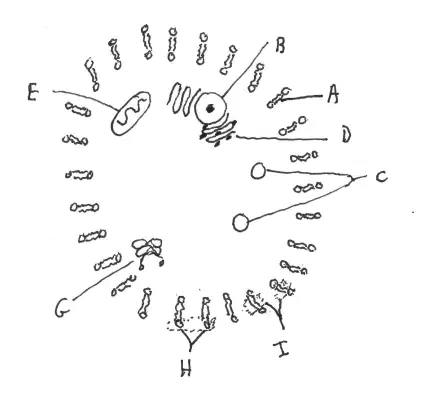
What phase of mitosis is shown here?

a)
Telophase
b)
Anaphase
c)
Prophase
d)

Metaphase

46.

What is the correct picture of prophase?

a)

A

b)

B

c)

C

d)

D

47.

What is the purpose of mitosis? Why do organisms need it?

a)
Mitosis is the process of cell death.
b)
Mitosis is only necessary for single-celled organisms.
c)
Mitosis is a form of reproduction in organisms.
d)
The purpose of mitosis is to allow for growth, repair, and replacement of cells in multicellular organisms.
48.

Which of the following occurs during meiosis, but not mitosis?

a)

Crossing over

b)

Nuclei are reformed separate

c)

Sister chromatids

d)

DNA replication

49.

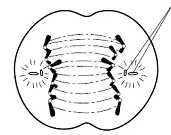
What phase of mitosis is shown below? (The figure shows a cell undergoing mitosis.)

a)

Telophase

b)
Anaphase
c)
Metaphase
d)
Prophase
50.

What are the structures called that are labeled B in the figure above? They are the structures that form the spindle fibers that move chromosomes.

a)

Chromosomes

b)

Centrioles

c)

Chromatids

51.

Which organelle is reponsible for cellular respiration?

a)

Mitochondria-Cell Respiration

b)

Nucleus-Stores genetic information

c)

Vacuole-Storing food and water

d)

Golgi-Packages parts

e)

Cell membrane-controls homeostasis

52.

The location where transcription takes place

a)

Nucleus

b)

Cytoplasm

c)

Ribosome

53.

What is E pointing to and what type of chemical bond is used?

a)

Nucleotide which has weak covalent bonds

b)

Nitrogen Base and strong hydrogen bonds

c)

Nucleotide which has strong covalent bonds

d)

Nitrogen Base and weak hydrogen bonds

54.

The place where translation occurs

a)

I. tRNA

b)

F. Cytoplasm

c)

A. Nucleus

d)

G. Ribosome

55.

Which letter represents the protein?

a)

L

b)

I

c)

G

d)

J

56.

What are the building blocks of proteins building block of the protein

a)

Nucleotides

b)

Amino Acids

c)

Fatty Acids

d)

Saccharides

57.

What is the main function of mRNA in protein synthesis?

a)

Transcribe and carry genetic information from the nucleus to the ribosome

b)

Translate DNA into proteins in the nucleus

c)

Transcribe DNA into proteins in the nucleus

58.

Why are hydrogen bonds needed between bases in DNA?

a)
To prevent the formation of the double helix structure.
b)
To provide flexibility and allow for the single-stranded structure to form.
c)

Hydrogen bonds are weak and allow the bases to separate easily for transcription.

59.

Which organelle is responsible for photosynthesis?

a)

C

b)

A

c)

E

d)

D

60.

Which organelles are in plant cells but not Animal cells?

a)

A,C,E

b)

A,D,E

c)

C,D,E

d)

A,B,C

61.

How is energy released?

a)
Energy is released through photosynthesis.
b)
Energy is released through sound waves.
c)
Energy is released through gravitational force.
d)

Energy is released when the chemical bonds are broken

62.

Where is the energy stored in molecules?

a)
cell membrane
b)
chemical bonds
c)
cytoplasm
d)
nucleus