
 Worksheets
Hydrosphere Test Review
Total questions: 64
Worksheet time: 52mins
The source of most irrigation and drinking water is
a. flowing surface water such as streams and rivers
b. surface water reservoirs such as lakes and ponds
C. the ocean
d. underground
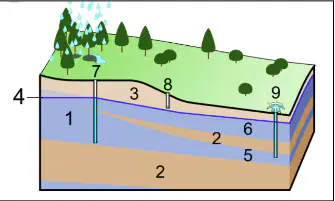
In the image, which number is an example of a confined aquifer?
a. 2
b. 5
C. 6
d. 9

In the image, which number is an example of an aquitard?
a. 2
b. 3
C. 8
d. 9
Which of these was NOT a primary cause of the Dust Bowl?
a. prolonged drought
b. poor farming techniques
C. weather
d. surface water quickly draining into cracks in the soil
Which of these is NOT true about water?
a. water expands as a solid
b. water is a nonpolar molecule
C. water has a neutral pH
d. water has a high specific heat
The reason water striders can sit on the top of a body of water is due to which property?
a. cohesion
b. evaporation
C. adhesion
d. inversion
Which process brings water into the ground?
a. transpiration
b. condensation
C. infiltration
d. evaporation
Which is not true about aquifers?
a. confined aquifers recharge slowly
b. an aquifer consists of a layer of permeable rock and the water in its pores
C. artesian wells cannot be drilled directly into an aquifer due to tremendous water pressure
d. water in an unconfined aquifer cannot be recharged

In the picture, what is represented by letter C?
a. infiltration
b. runoff
c. groundwater
d. transpiration

In the picture, what is represented by letter B?
a. infiltration
b. runoff
c. groundwater
d. transpiration
Which of the following is NOT true of acid rain?
a. It is caused by a mixing of air pollutants with water vapor.
b. It raises the pH of rain water.
C. It can strip trees of leaves and needles.
d. It can damage statues and buildings.
Which of the following is NOT true of headwaters?
a. The water is usually cold.
b. The water usually flows quickly.
C. The water contains a wide variety of organisms.
d. The water usually has little sediment.
The area in which freshwater meets saltwater is called
a. an estuary.
b. a watershed.
a headwater.
C. a waterfall.
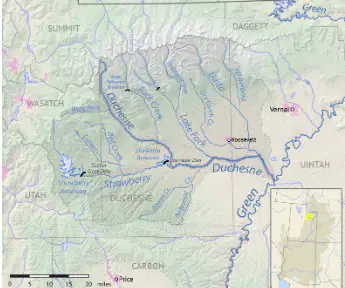
Which of the following rivers is NOT a tributary of the Duchesne River?
Green River
b. Strawberry River
C. Rock Creek
d. Uinta
Which of the following rivers would contain the most biodiversity?
Green River
b. Strawberry River
C. Rock Creek
d. Uinta
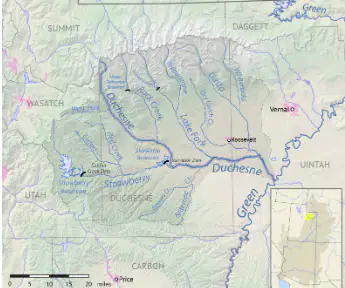
Which location would likely have the lowest elevation?
a. Wasatch
b. Summit
C. Dagget
d. Uintah
Which type of irrigation has the most efficient water usage?
a. flood
b. furrow
C. spray
d. drip
Which type of irrigation is the least expensive to install and use?
a. flood
b. furrow
C. spray
d. drip
When groundwater is pumped from aquifers, it can leave dissolved salts behind on the surface of the soil. This process is known as
a. evapotranspiration
b. salinization
C. artesian welling
d. recharging


What is it called when plants give off water vapor?



Use the map below. Name 1 tributary that empty into the Yellowstone River.
(a)
Eutrophication is caused by
excess nutrients building up in the water.
industrial point-source pollution.
unlined landfills and septic tanks.
wastewater from homes mixing with drinking water.
How does eutrophication cause the death of aquatic organisms
the build up of carbon dioxide in the water
the lack of nitrogen in the water
the lack of carbon dioxide in the water
the lack of oxygen in the water
The two critical nutrients in eutrophication are... (select two)
nitrates
phosphates
carbon dioxide
dissolved oxygen
In eutrophication, dissolved oxygen levels decrease because
bacteria use it as they decompose organic material
algae uses it during photosynthesis
it reacts with hydrogen to form H2O (water)
fish use it up as they consume algae
Which would most likely happen if too many nutrients entered an estuary?
Nutrients would be used up by the fish and plants, keeping the estuary in balance.
Algal blooms would lower dissolved oxygen levels, causing fish to suffocate.
Algal blooms would decrease, leaving few food resources for fish.
Nutrients would sink to the bottom, increasing soil deposition.
Why should farmers be concerned about unused nitrate fertilizer contaminating surface water and groundwater supplies?
Unused nitrates reduce algae growth.
Unused nitrates increase oxygen in the water.
Excessive amounts of nutrients cause overpopulation of fish.
Excessive amounts of nutrients speed up the eutrophication process.
What can be a source of nitrates for eutrophication in rivers?
fertilisers
plastic bottles
paper
sewage
What is the very next thing that happens after fertilisers enter a river in eutrophication?
Fish die due to a lack of oxygen
Plants below the surface die due to a lack of sunlight
The number of aerobic bacteria increases
Fast growth of plants
Which is the correct order of changes that occur during eutrophication?
Aquatic plants cannot photosynthesize and die. Algal blooms blocks light from entering lower levels of a pond or lake. The fish and other aquatic organisms die. The bacteria decompose the algae, and they use up a lot of oxygen during this process. The algae die.
Algal blooms blocks light from entering lower levels of a pond or lake. Aquatic plants cannot photosynthesize and die. The algae die. The fish and other aquatic organisms die. The bacteria decompose the algae, and they use up a lot of oxygen during this process.
Algal blooms blocks light from entering lower levels of a pond or lake. Aquatic plants cannot photosynthesize and die. The algae die. The bacteria decompose the algae, and they use up a lot of oxygen during this process. The fish and other aquatic organisms die.
Aquatic plants cannot photosynthesize and die. Algal blooms blocks light from entering lower levels of a pond or lake. The bacteria decompose the algae, and they use up a lot of oxygen during this process. The algae die. The fish and other aquatic organisms die.

The pH of healthy water is _______________.
0-5
6.5-8.5
9-14
_______________ water quality is indicated by a few number of bio-indicator organisms in one place
Poor
Good
Temperature, turbidity, and water movement are the _____________ factors used to determine water quality.
physical
chemical
biological
Fish, algae, insects, and plants are _________________ factors used to determine water quality.
physical
chemical
biological
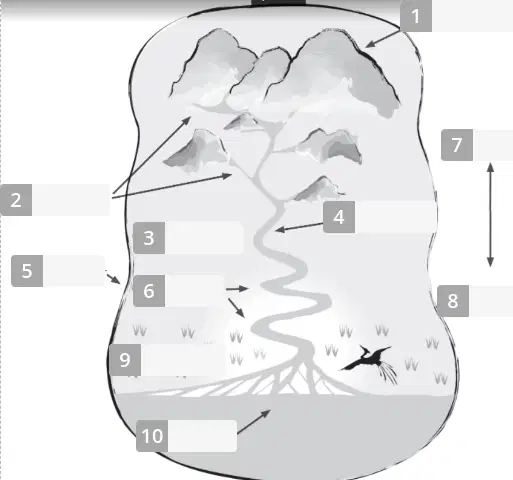
Match the following
1
river source/ headwaters
2
tributaries
3
floodplain
4
main river
5
watershed boundary/ divide
Match the following
6
meanders
7
upstream
8
downstream
9
wetlands
10
river mouth

