
NEW
Font size
 Worksheets
Review --- Forces and Newton's Laws
Total questions: 47
Worksheet time: 1hrs 5mins

When a bird is flying, their wings are pushing DOWN against the air. In turn, the air pushes __________ against their wings allowing them to fly.
DOWN
UP
FORWARD
BACKWARD

When a swimmer is swimming, their arms push BACKWARDS against the water. In turn, the water pushes __________ against their arms allowing the swimmer to swim.
DOWN
UP
FORWARD
BACKWARD

When a heavy football player and a light one run into each other, who exerts more force? (pushes harder)
The light one
They exert the same force on each other
The heavy one
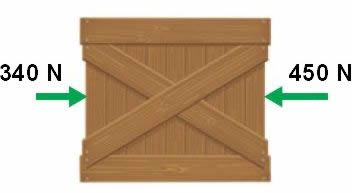
What happens when unbalanced forces act on an object at rest?
the object remains at rest
the object begins moving in an unpredictable direction
the object begins moving in the direction of the net force
the object begins moving opposite to the direction of net force
Balanced forces do not change the state of motion of an object.
True
False
None of these
Don't Know
The grip of the player's hands on the ball
the air resistance of the ball
the force of the ball against the bat
smaller
equal
larger
You kick a soccer ball. What is true about the force on you and the ball?
The force on the ball is bigger.
The force on you is bigger.
Both forces are the same.


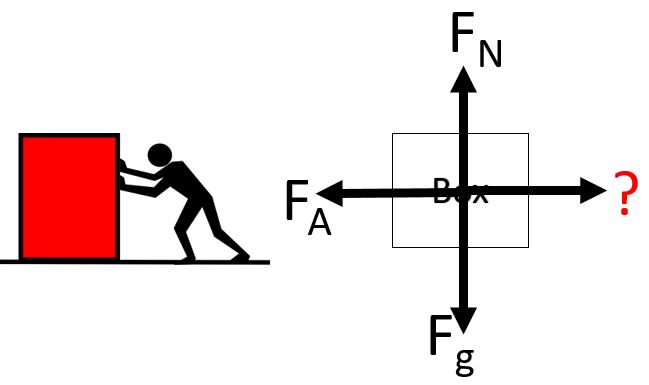

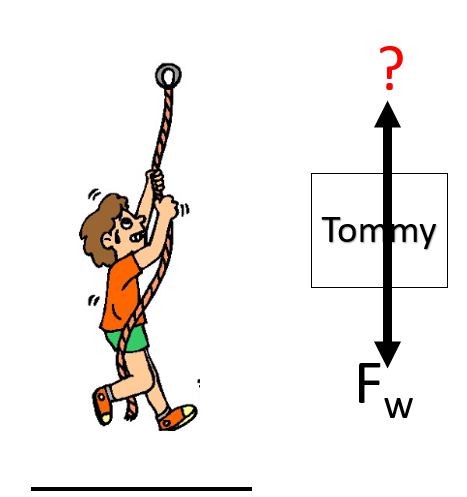
What information is found in a free-body diagram?
the time needed for an object to be in motion
the type of surface an object is resting on
the speed of an object in motion
individual forces acting on an object
Which direction must all arrows point in a free-body diagram?
towards the object
away from the object
towards the greatest force
towards gravity (downward)
According to Newton's First Law, what is the cause of any change in velocity?
tension force
inertia
a net external force
a comprehensive internal system
How is the inertia of an object measured?
by it's change in velocity
by the normal force
by it's density
by it's mass
What is Newton's 2nd Law?
F = ma
for every action there is an equal and opposite reaction
an object at rest stays at rest
law of inertia
What is Newton's First Law
F=ma
Every action has an equal and opposite reaction
Friction
An object at rest stays at rest, an object in motion stays in motion.
Your car has a mass of 2500 kg and a force of 5000 N. How fast will it accelerate?
20 m/s2
2 m/s2
0.5 m/s2
120 N
A 20 kg bike accelerates at 10 m/s2. What is the force on the bike?
25 Newtons
20 Newtons
200 Newtons
10 Newtons

What is the net force?
40 N left
400 N right
0 N Balanced
40 N right
Force is measured in what units?
newtons
grams
kilograms
meters per second
Joe applies a 60 N force to a 20 kg cart, what is the acceleration of the cart?
1200 m/s/s
0.33 m/s/s
20 m/s/s
3 m/s/s
What type of force is always in the opposite direction of the motion?
gravity
the normal force
weight
friction
The mass of a wagon is 40 kg. The wagon accelerates at 8 m/s2 . What is the force?
38.25 Kg
320N
5N
3.825Kg
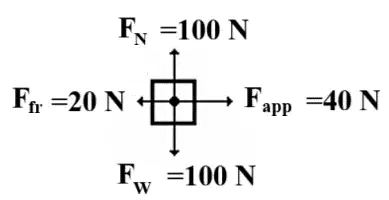
What direction is this object moving?
Right
Left
It is not moving.
Down
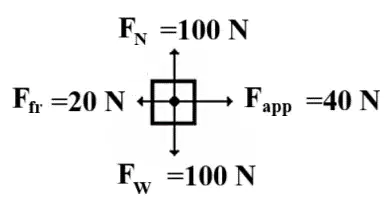
What is the net force on this object?
260 N
60 N
20 N, left
20 N, right
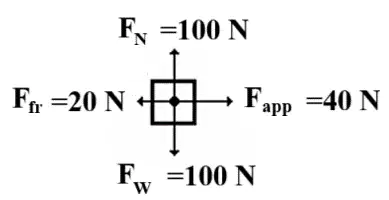
What is the acceleration of this object?
ΣF = ma
5 m/s2
0.2 m/s2
1.96 m/s2
100 N

What is the mass of this object?
Fw = m g
100 N
10.2 kg
100 kg
90 kg
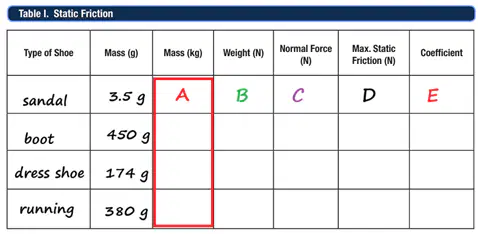
In the lab, how did you determine the values for the column marked with a red A?
use the spring scale
solve for the unknown variable
move the decimal in the mass value 3 places to the left; or, divide by 1000
multiply by 9.8

How did you determine the values for the column marked B in green?
Divide the mass (g) by 1000, or move the decimal to the left.
Multiply the mass (kg) by 9.8.
It's the same as the mass (kg).
Use F = ma, and solve for the unknown.
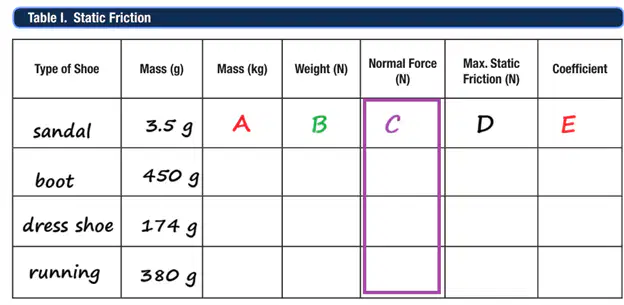
How did you determine the values that belong in the purple column marked C?
It is the same value as the Weight (N).
Divided by 9.8
Used F = ma, and solved for the unknown variable.
Used the spring scales.

How did you determine the values that go in column D?
It is equal to the Normal Force (N)
Multiply the Mass (kg) by 1000, or move the decimal point.
Use the triple-beam balance.
Use the spring scale attached to the shoe.
If two surfaces are in contact and moving relative to one another, then the friction between them is called
air resistance
kinetic friction
static friction
molecular friction
Static friction acts upon objects that are ----
stationary
moving
not in contact
magnetic
Which is greater?
static friction
kinetic friction

What is us in this equation?
the direction of static friction
the normal force
the friction force
coefficient of static friction
If an object is "at rest", can we assume no forces are acting on it?
yes, because the object is not moving
yes, because friction holds the object in place
no, because gravity acts on all objects on Earth at all times
no, because the normal force cancels out the force of gravity
Newton's second law of motion relates which variables?
force, mass, and acceleration
force, friction, and inertia
force, mass, and weight
action and reaction forces
Which statement correctly describes the normal force?
Always parallel to the contact surface.
Always in the same direction as the motion.
Always opposite the motion of the object.
Always perpendicular to the contact surface.
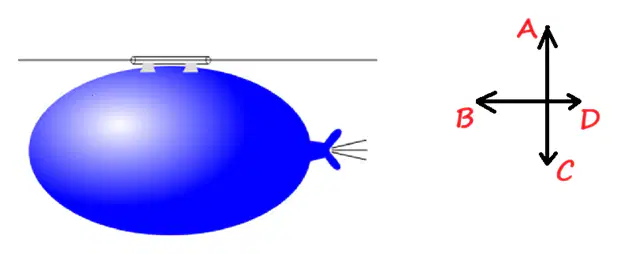
A free-body diagram of the forces acting on the balloon is shown in the diagram. Which type of force is represented by letter A?
Tension
Normal
Friction
Applied
A free-body diagram of the forces acting on the balloon is shown in the diagram. Which type of force is represented by letter D?
Tension
Normal
Friction
Air Resistance
How is weight different from mass?
They are the same.
Weight is a force and includes the effect of gravity.
Mass is a force acting on an object.
Weight is a force that opposes the motion of an object.
What equation is used to determine the weight of an object with a mass of 50kg?


All of these equations could be used.
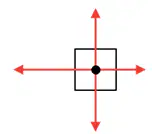
According to the free-body diagram, describe the motion of the object.
The object is speeding up.
The object is slowing down.
It is moving at constant speed.
The object is not moving.

Using the free-body diagram, describe the motion of the object.
The object is at rest.
The object is moving at constant speed to the right.
The object is moving at constant speed to the left.
Any of these options are possible.

