
 Worksheets
Refraction and Lenses
Total questions: 42
Worksheet time: 35mins
Name
Class
Date
1.

What are 2 types of lenses?
a)
Concave Lens & Convex Lens
b)
Concave Lens & Magnifying Lens
c)
Convex Lens & Magnifying Lens
2.

Is a concave lens thicker or thinner in the middle?
a)
Thicker
b)
Thinner
3.

Is a convex lens thicker or thinner in the middle?
a)
Thicker
b)
Thinner
4.

What kind of lens is a magnifying glass?
a)
Convex Lens
b)
Concave Lens
5.
Complete this sentence: Concave lenses bend light ___________ from each other.
a)
Away
b)
Towards
6.
Complete this sentence: Convex lenses bend light __________ from each other.
a)
Towards
b)
Away
7.
A converging lens has a focal length of 30 cm. A 5 cm tall candle is placed at a distance of 10 cm in front of the lens. Determine the image distance.
a)
- 45 cm
b)
-30 cm
c)
-15 cm
d)
6 cm
8.
What type of image is formed when rays of light actually intersect?
a)
real
b)
virtual
c)
projected
d)
curved
9.
A convex lens has a focal length f. If an object is placed at 2f at what distance will the image appear?
a)
2f
b)
f
c)
between f and 2f
d)
infinity
10.
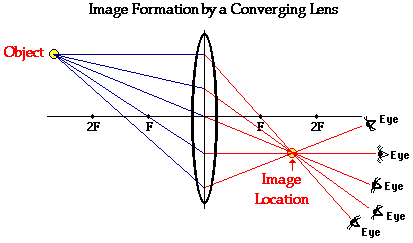
This image is.....
a)
inverted and smaller
b)
inverted and larger
c)
not inverted and smaller
d)
not inverted and larger
11.

This image is...
a)
Inverted and smaller
b)
inverted and bigger
c)
not inverted and smaller
d)
not inverted and bigger
12.
An incident ray that is parallel to the principal axis...
a)
will reflect parallel to the principal axis
b)
will refract through the focal point
c)
will reflect through the center of curvature
d)
will continue along the same path through the lens
13.
a real image...
a)
is produced by virtual rays and can be projected on a screen
b)
is produced by real rays and cannot be projected on a screen
c)
is produced by virtual images and cannot be projected on a screen
d)
is produced by real rays and can be projected on a screen
14.
Convex lenses can produce...
a)
Real, erect images
b)
Virtual, inverted images
c)
Real, inverted images
d)
no images form
15.

An object of height 4 cm is placed 10 cm away from a concave lens of focal length 6 cm as shown below.Image is
a)
virtual.inverted
b)
virtual,upright
c)
real,inverted
d)
real,upright
16.
a measure of how much a light ray bends when it enters that medium
a)
index of refraction
b)
reflection
c)
thermogram
d)
mirage
17.

Which is the angle of refraction?
a)
Angle 1
b)
Angle 2
18.
Speed of light in a vacuum is
a)
represented by the symbol "c"
b)
3.00 X10⁸ m/s
c)
both answers are correct
19.
Light has the highest velocity in which medium?
flint glass n=1.70
barium glass n=1.60
crown glass n=1.523
water n=1.33
diamond n=2.45
flint glass n=1.70
barium glass n=1.60
crown glass n=1.523
water n=1.33
diamond n=2.45
a)
diamond
b)
water
c)
flint glass
d)
barium glass
20.
Light has the lowest velocity in which medium?
flint glass n=1.70
barium glass n=1.60
crown glass n=1.523
water n=1.33
diamond n=2.45
flint glass n=1.70
barium glass n=1.60
crown glass n=1.523
water n=1.33
diamond n=2.45
a)
diamond
b)
water
c)
flint glass
d)
barium glass
21.
A candle is placed on the principal axis of a convex lens at a distance of 30 cm from the lens. The focal length of the lens is 10 cm. The image formed will be
a)
Real, inverted, and reduced
b)
Real, inverted, and enlarged
c)
Real, upright, and enlarged
d)
Virtual, upright, and enlarged
22.
an image that forms where light seems to come from
a)
virtual image
b)
real image
c)
diffuse reflection
d)
regular reflection
23.

How does light behave as it enters these mediums?
a)
continue its path as straight line.
b)
bends toward the normal
c)
bends away from the normal
d)
reflects
24.
Which does not describe rainbows?
a)
they are really circular
b)
sunlight gets separated in raindrops
c)
sunlight is internally reflected in the rear of a raindrop
d)
different colors of light refract at the same angle
25.
Which term describes lenses that are thinner at the edges than at the center?
a)
converging lenses
b)
diverging lenses
c)
concave lenses
26.
A material or substance that a matter wave travels through is ________
a)
a block
b)
a wall
c)
a medium
d)
an electromagnetic spectrum
27.

Glass has a _____________ index of refraction than air.
a)
Equal
b)
Greater
c)
Less
d)
Impossible to say
28.
An object is located 15 m from a converging lens with focal length 10 m.If the object is 2 cm tall, find the image height if the image is located at 30 m.
a)
4 m
b)
-4m
c)
1m
d)
-1m
29.
A converging lens has a focal length of 30 cm. A 5 cm tall candle is placed at a distance of 10 cm in front of the lens. Determine the image distance.
a)
- 45 cm
b)
-30 cm
c)
-15 cm
d)
6 cm
30.
Light waves need matter to travel.
a)
True
b)
False
31.
The index of refraction for a material is the ratio of the speed of light in a vacuum to the speed of light in a material.
a)
true
b)
false
32.
Concave lenses always cause light rays to spread out and can only form ________ ____________
a)
virtual images
b)
real images
c)
concave lens
d)
concave mirror
33.
Critical angle is the angle of incidence that produces an angle of refraction at......
a)
180 degrees
b)
90 degrees
c)
20 degrees
d)
120 degrees
34.
Total internal reflection is the complete reflection of a light ray back into its original medium.
a)
true
b)
false
35.
Materials that have small critical angles are likely to cause most of the light entering them to be totally internally ____________
a)
reflected
b)
refracted
c)
faster
d)
slower
36.
What is the index of refraction of a material if light travels 2x10⁸m/s in it?
a)
6
b)
1.5
c)
0.67
d)
1.67
37.
The formula to calculate the refractive index is
a)
n=cv
b)
n=v/c
c)
n=c/v
d)
v=nc
38.
What is the index of refraction of a refractive liquid if the angle of incidence in the air is 35 degrees and the angle of refraction is 14 degrees?
a)
1.33
b)
2.21
c)
2.37
d)
1.72
39.
If the angle of incidence of light traveling through air, and then striking water is 30 degrees what is the angle of refraction? (n=1 air, n=1.33 water)
a)
15 degrees
b)
22 degrees
c)
43 degrees
d)
17 degrees
40.
The separation of white light into its component colors is known as:
a)
polarization
b)
refraction
c)
reflection
d)
dispersion
41.
Light travels at 1.76 EE 8 m/s through an optical medium. What is the medium?
diamond n=2.45
flint glass n=1.70
barium glass n=1.60
crown glass n=1.523
diamond n=2.45
flint glass n=1.70
barium glass n=1.60
crown glass n=1.523
a)
Crown Glass
b)
Barium Glass
c)
Flint Glass
d)
Diamond
42.
Rainbows are produced when
a)
light exits many raindrops at different angles
b)
the sun causes a rainstorm
c)
the spectrum causes a rainstorm
d)
the sun comes out after a storm
100 %

