
 Worksheets
Unit 3 Study Guide (cells and transport)
Total questions: 50
Worksheet time: 3hrs 30mins
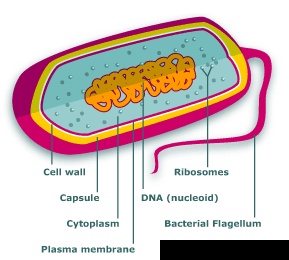
You are looking through a microscope at a substance that appears to have a membrane, DNA, ribosomes, and nucleus. Which type of cell are you most likely viewing?
an animal cell
a bacterial cell
a virus
a protein
The presence of which of the following characteristics differentiates prokaryotic and eukaryotic cells?
mitochondria
cytoplasm
nucleus
ribosomes
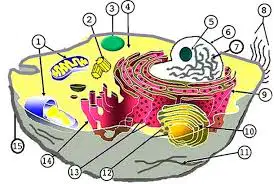
What is the function of the organelle indicated by the arrow number 1?
to manufacture proteins
to facilitate waste removal
to generate energy
to store excess water
Prokaryotes have very few cellular structures. Ribosomes are an important structure contained in both prokaryotic and eukaryotic cells. Which of the following would be the best explanation for why organisms made up of all cell types must have ribosomes?
Proteins pass on genetic information.
Ribosomes are considered to be membrane-bound organelles.
DNA makes ribosomes.
Ribosomes are necessary to make the proteins coded for by DNA.
Which of the following organelles regulates the entry and exit of molecules to and from the cell?
Lysosomes
Golgi bodies
Mitochondria
Cell membrane
The structure of the cell membrane contributes to the overall function of the cell in what way?
It provides a rigid support that provides structure for the entire organism.
It contains a small opening that can store water the cell needs to survive.
It carries signals from one cell to the next, allowing cells to work together.
It allows for the passage of certain substances into and out of the cell.
Active and passive transport are both essential to maintaining proper functioning of cells. Which of these best describes the difference between active transport and passive transport?
passive transport requires energy to move molecules up a concentration gradient, active does not.
Passive transport can only move specific particles across a membrane, active transport can move any particle.
Active transport requires energy to move molecules up a concentration gradient, passive does not.
Active transport moves molecules in animal cells, passive transport moves molecules in plant cells.
Which of these best describes the function of the semi permeable membrane in plant and animal cells?
to release ATP during the process of cellular respiration
to capture light energy in order to perform photosynthesis
to generate all the energy responsible for cellular metabolism
to regulate movement of material into and out of the cell
Which of the following best explains why cell walls are found only in plant cells?
Cell membranes alone cannot support the pressure created by the amount of water in a plant cell.
Cell walls aid in photosynthesis, which occurs only in plant cells.
Cell walls are more selectively permeable than cell membranes.
Since animals contain significantly more water than plant cells, they do not require a cell wall
What is the cell membrane composed of?
A phospholipid bilayer with many other organic compounds.
Long amino acid chains
A phospholipid bilayer only
DNA and ribosomes
What is the cell membrane composed of?
A phospholipid bilayer with many other organic compounds.
Long amino acid chains
A phospholipid bilayer only
DNA and ribosomes
Which of the following contains a nucleus?
eukaryotes
bacteria
organelles
prokaryotes
Which of the following is a function of the nucleus?
Controls most of the cell's processes
Contains the information needed to make proteins
Stores DNA
All of the answers are a function of the nucleus
Prokaryotes lack
a nucleus.
a cell membrane.
genetic material.
cytoplasm.
Which organelle would you expect to find in plant cells?
smooth endoplasmic reticulum
mitochondria
ribosome
chloroplast
Which of the following structures serves as the cell's boundary from its environment?
mitochondria
cell membrane
chloroplast
channel proteins
Which organelle converts the chemical energy stored in food into compounds that are more convenient for the cell to use?
mitochondria
golgi apparatus
chloroplast
endoplasmic reticulum
Which organelle breaks down compounds into small particles that the cell can use?
mitochondria
golgi apparatus
lysosome
endoplasmic reticulum
A(an) ________ is an example of a prokaryotic cell.
animal cell
virus
bacteria
plant cell
Site of protein synthesis
nuclues
ribosome
lysosome
vacuole
Which organelle uses energy from sunlight to make food molecules?
Mitochondria
Chloroplast
Ribosome
Lysosome
Modifies, sorts, and packages proteins that come from the endoplasmic reticulum.
ribosome
lysosome
mitochondria
golgi apparatus
If a cell is placed in salt water, water leaves the cell by
diffusion.
osmosis.
active transport.
exocytosis.
A cell moves particles using energy against the concentration (low to high concentration) gradient by
active transport
passive transport
facilitated diffusion
osmosis
Diffusion is the movement of particle from
an area of equilibrium to an area of high concentration.
an area of low concentration to an area of high concentration.
an area of high concentration to an area of low concentration.
all of the answers describe what occurs in diffusion.
Type of cell transport that does not require energy is called
Active Transport
Exocytosis
Endocytosis
Passive Transport
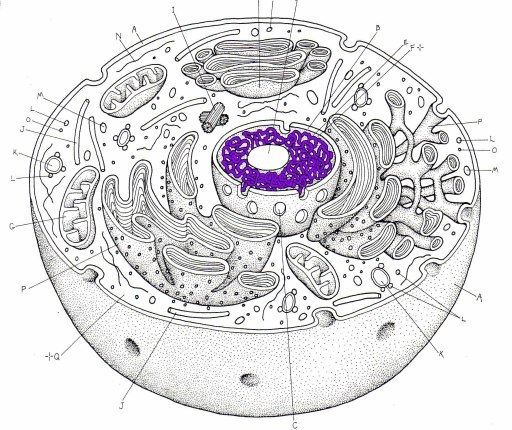

Four cells were examined under the microscope. The following table shows the organelles that were identified in each cell. Based on the table above, which of the following is the best conclusion?
Cells A and B are plant cells.
Cells B and D are plant cells.
Only cell B is a plant cell.
Only cell C is a plant cell.

The organelle where lipids are synthesized along with proteins and other materials that are exported from the cell:
Endoplasmic Reticulum
Golgi Apparatus
Vacuoles & vesicles
Nucleus

The organelle that captures the energy from sunlight and converts it into chemical energy stored in food during photosynthesis:
Chloroplast
Mitochondrion
Cell Wall
Nucleus

What is the LARGE blue circular organelle named?
Nucleus
Golgi Body
Cell Wall
Vacuole


Active transport is movement of particles through the cell membrane from a region of ...1... to a region of ...2... using energy in the form of ...3...
1: lower concentration, 2: higher concentration, 3: NADPH
1: higher concentration, 2: lower concentration, 3: NADPH
1: higher concentration, 2: lower concentration, 3: ATP
1: lower concentration, 2: higher concentration, 3: ATP

Which type of passive transport uses proteins to help molecules pass through the membrane?
Cell membranes are described as selectively permeable.
Four students were asked to explain what this means. Which one is correct?
Student 1: Cell membranes prevent all materials from entering the cell.
Student 2: Cell membranes only provide structural support for the cell.
Student 3: Cell membranes regulate which substances can enter and exit the cell.
Student 4: Cell membranes allow water and water-soluble substances to enter the cell.
Some celery sticks were placed in salt water. What type of solution are they in? What will happen to the celery sticks?
hypotonic, the cells will swell
hypertonic, the cells will shrink
Some celery sticks were placed in pure water. What type of solution are they in? What will happen to the celery sticks?
hypotonic, the cells will swell
hypertonic, the cells will shrink

The cell shows water moving in and out equally, which means it was placed in a ___ solution.
Isotonic
Hypertonic
Hypotonic

