
Font size
 Worksheets
EE Weather Practice Assessment 2023
Total questions: 101
Worksheet time: 1hrs 25mins
What is the percentage composition of nitrogen in air?
78%
75%
86%
This gas makes up 21% of air.
carbon dioxide
nitrogen
oxygen
water vapor
The layer of the atmosphere containing the auroras is _?_.
What separates the layers of the atmosphere from one another?
changes in pressure
changes in color
changes in altitude
changes in temperature
When a person climbs a mountain, what happens to the air pressure around him?
It decreases
It remains constant
It increases
It decreases, then increases
Why is Earth's atmosphere important?
It is beautiful.
Life on Mars could not exist without it.
It prevents pollution from happening.
Life on Earth could not exist without it.
What is the highest layer of our atmosphere?
troposphere
thermosphere
stratosphere
exosphere


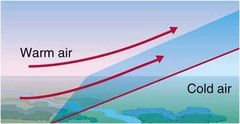


Where on the surface of the Earth will the air pressure be greatest?
At the highest mountain top
Anywhere on dry land
At or below sea level
On any body of water

Choose all that apply: Wind and weather move over land because...
uneven heating and cooling of the Earth causes air pressure changes, creating winds
uneven heating and cooling of the Earth causes cool, dense air to replace warm, less dense air, creating winds
uneven heating and cooling of the Earth causes isobars to spread out, creating winds
uneven heating and cooling of the Earth causes isobars to get closer, creating winds
Air pressure is determined by...
the density of air particles in a given volume
the mass of each air particle in a given volume
the size of each air particle in a given volume
the weight of air particles in a given volume
After a cold front passes through an area, the weather will be...
warmer and stormy
cooler and clear
cooler and stormy
warmer and clear
When a warm front arrives, the area will experience...
cooler temperatures, higher air pressure, and storms
cooler temperatures, higher air pressure, and gentle rain
warmer temperatures, lower air pressure, and storms
warmer temperatures, lower air pressure, and gentle rain
Choose all that apply. Airmasses that develop over land in tropical latitudes are characterized by...
warm air
cool air
humid air
dry air
Winds always move ...
in random directions
from areas of high pressure to areas of low pressure
from areas with warm temperatures to areas with cold temperatures
from land toward oceans
Choose all that apply. Components of weather that are important parts of forecasts include...
Temperature and air pressure
Relative humidity and wind speed
Fronts and pressure systems
Cloud cover and precipitation
An air mass travels north over the Pacific Ocean, from the tropics, and then eastward across the United States. Which weather pattern can be expected?
warm and wet
cool and wet
warm and dry
cool and dry
How do the conditions for a tornado differ from the conditions for a hurricane?
Tornadoes form over land, while hurricanes form over bodies of water.
Tornadoes never form when there is rain, while hurricanes always form with rain.
Tornadoes form under low pressure, while hurricanes form under high pressure.
Tornadoes form in a stable atmosphere, while hurricanes form in an unstable atmosphere.

A model is shown. The blue warm water from the jar rises to the top of the bowl. This model is MOST likely showing which event?
the convection currents that form thunderstorms
the way heat is transferred from a gas grill to food
the exchange of oxygen and carbon dioxide in lungs
the direction in which a hurricane moves
The reading on a barometer rises when ......
air pressure increases.
air pressure decreases.
air humidity increases.
air humidity decreases.
The narrow belts of strong winds in the upper troposphere are called ...
jet streams.
the doldrums.
the prevailing westerlies.
the trade winds.
Earth's rotation causes wind and water currents to turn. This is called the ...
Coriolis Effect.
Stowell Effect.
Copernicus Effect.
Doppler Effect.


A ________________ is an intense storm with strong winds, heavy rain, lightning, and thunder.
tornado
hurricane
thunderstorm
What is the source of energy that causes the winds?
the moon
the sun
the rotation of the Earth
Why does warm air rise?
Warm air is more dense than cooler air.
Warm air is less dense than cooler air.
Warm air has more pressure than cooler air.
Warm air has a higher dew point than cooler air.
The Coriolis effect causes ___________.
the Earth to rotate on its axis
earthquakes
global winds to move in a curved path instead of a straight line
the Earth to revolve around the sun
When gas, oil, and coal are burned, ___ is added to the atmosphere which increases Global Warming.
Carbon Dioxide
Oxygen
Chlorofluorocarbon
Hydrogen
Two of the greenhouse gases that are produced by human activities and contribute to global warming include ________ and __________.
water vapor and ozone
argon and CO2
carbon dioxide and methane
oxygen and nitrogen
The windless, rainy area near the equator is called the ____________.
Tropic of Cancer
Stratosphere
Polar Easterlies
Doldrums
On either side of the equator, early sailors relied on steady winds called ___________.
the doldrums
polar easterlies
jet streams
the trade winds
Where is the ozone layer
Troposphere
Stratosphere
Mesosphere
Thermosphere
Why would the Gulf Stream have clouds over it?
Cold water makes air above it fall
Cold water moving quickly makes clouds
Warm water moving quickly makes clouds
Warm water evaporates, making clouds

Which global wind is located at number 1?
trade winds
doldrums
Polar easterlies
horse latitudes

Which global wind is located at number 2?
trade winds
prevailing westerlies
doldrums
horse latitudes

Which global wind is at number 3?
trade winds
horse latitudes
doldrums
polar easterlies

Which global wind is located at number 4?
trade winds
horse latitudes
prevailing westerlies
doldrums

Which global wind is locater at number 5?
trade winds
doldrums
horse latitudes
prevailing westerlies

Winds occur because hot air rises and cool air sinks in a process called:
conduction
convection
radiation
magnetism
Wind is caused by convection currents due to:
Too much Taco Bell
Differences in elevation
The uneven heating of the Earth by the sun
The currents in the ocean
Due to the Coriolis effect, global winds in the northern hemisphere deflect:
clockwise
counter-clockwise
Due to the Coriolis effect, global winds in the southern hemisphere deflect:
Clockwise
Counter-clockwise
Constant, predictable winds that move over long distances are called:
land breezes
mountain breezes
global winds
sea breezes

How is wind named?
by the direction toward which the wind is blowing
by the direction from where the winds originate (come from)
by the Department of Atmospheric Affairs
by the amount of air pressure.
Which is true of cold air?
It is lighter and more dense.
It is more dense and sinks.
It rises because it is less dense.
It is less dense and has less air pressure.
What type of winds blow constantly, predictably, and over long distances?
land breezes
local winds
global winds
sea breezes
The greater the pressure difference, the _______ the air moves.
slower
faster
more natural
higher
Local winds blow over:
short distances
long distances
the poles
the equator
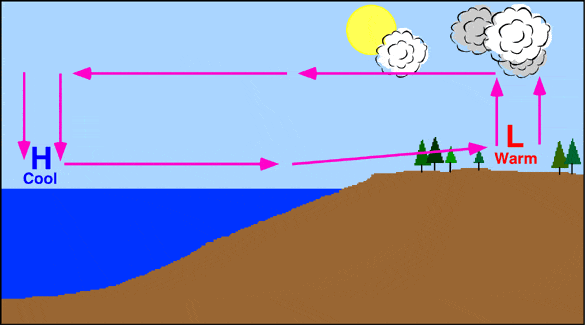
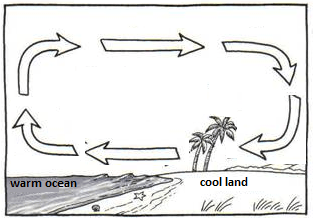
land breeze
cool air moves down a mountain slope toward a valley
warm air rises up a mountain slope from a valley
cool land air flows to the ocean at night, causing warm ocean air to rise
cool ocean air flows to land during the day, causing warm land air to rise
sea breeze
cool mountain air moves down a mountain slope towards a valley
warm air rises up a mountain slope from a valley
cool land flows to the ocean at night, causing warm ocean air to rise
cool ocean air flows to land during the day, causing warm land air to rise
The amount of water vapor in the air is known as ___.
dew point
humidty
relative humidity
rain
Humidity can be found by comparing the temperatures of _________________.
Barometers
Psychrometers
Hydrometers
Anemometers

