
 Worksheets
AP Bio Unit 3 MC Test Review
Total questions: 50
Worksheet time: 48mins
Label the parts of the enzyme model

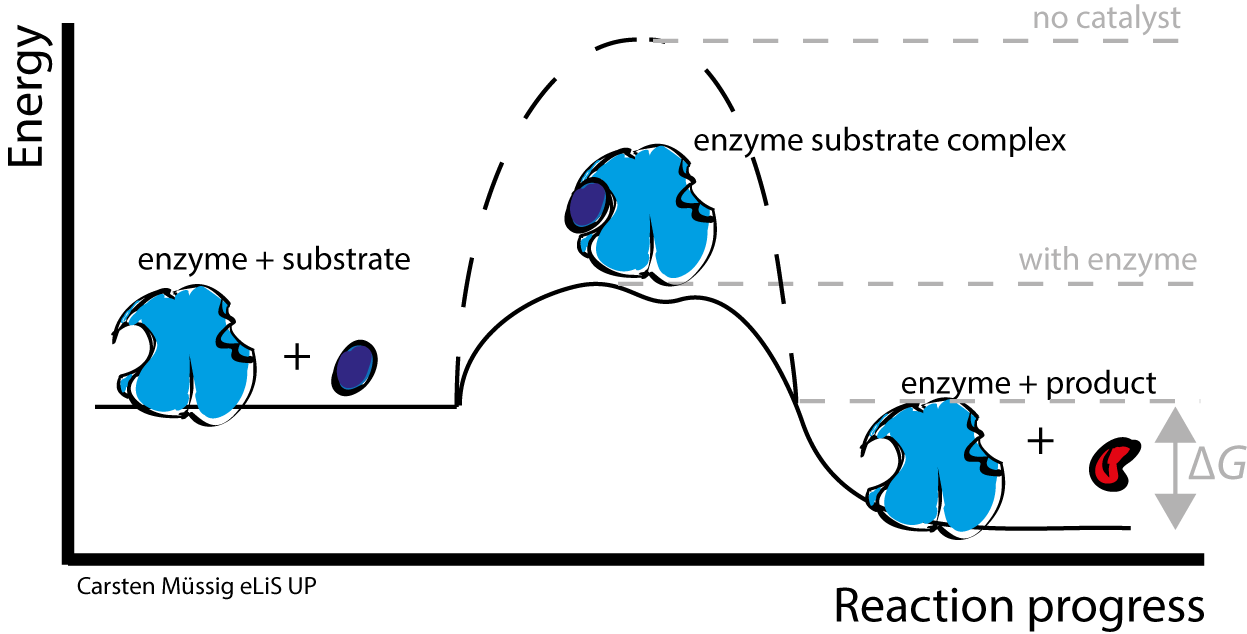
Enzyme can be used again and again
True
False
Which term most precisely describes the cellular process of breaking down large molecules into smaller ones?
catabolism
metabolism
anabolism
dehydration
Match the following
Binds to active site to slow reaction
Competitive
Binds at a different spot on enzyme to change shape
Allosteric
Binds to active site
Substrate
Speeds up a chemical reaction without being used up
Catalyst
Part of enzyme where reactants bind to
Active Site
Enzyme X has an optimum rate of reaction at 97 degrees Fahrenheit. How would rate of reaction be affected if temperature fell to 92 degrees Fahrenheit?
increase - not as hot
decrease - no substrate would be produced
increase - more substrate would be produced
decrease - cause a change in the shape of the protein


Which environmental conditions can cause denaturation of the enzyme?
slight increase in temperature
extreme increase in temperature
decrease in temperature
extreme increase in temperature and pH changes
Describe why an increase in temperature increases the rate of the reaction.
increase in temperature increases the speed/kinetic energy of particles
increase in temperature activates more enzyme to increase the rate
increase in temperature results in increase in substrate available
increase in temperature allows for a tighter fit in the active site
Inhibitor that binds to the active site
Competitive inhibitor
Noncompetitive inhibitor
How do you overcome a competitive inhibitor?
Add more ATP
Add more inhibitor
Add more products
Add more reactants
How does an increase in substrate affect reaction rate?
Decrease forever
Increase forever
Decrease until enzyme saturated
Increase until enzyme saturated
Where does the substrate bind on an enzyme?
Active site
Enhancer
Promoter
TATA box
What molecule is responsible for powering cellular processes?
ATP
Glucose
Membrane Potential
Sucrose
What is the input for the Calvin cycle?
CO2
H2O
NADPH
ATP
G3P
Describe the pathway of electrons in the light reactions.
H2O → PSI → ETC → PSII → NADPH
H2O → PSII → ETC → PSI → NADPH
H2O → PSII → ETC → PSI → NADH
H2O → PSI → ETC → PSII → NADH
What is the best reason that plants do not perform photosynthesis at night?
They close their stomata at night to rest
They do not have an energy source to power the light reactions
Only a few types of plants are nocturnal
There is less carbon dioxide released into the air at night
What are the net products of photosynthesis?
6 CO2, 6 H2O, Energy
6 O2 and 6 H2O
C6H12O6 and 6 O2
6 CO2 and C6H12O6
What does CAM plants store?
H20
CO2
Sunlight
Carbon Dioxide
CAM plants have a different adaptation to what climate
cold and wet
hot and dry
both
none of the above
In C4 plants, the Calvin cycle....
Takes place at night
Only occurs when the stomata are closed
Takes place in the mesophyll
Takes place in the bundle-sheath cells
What are C3 plants?
These plants are the best when it comes to storing water due to their extremely dry environments
These plants mostly just reduce the rate of photorespiration
plants that do the calvin cycle in the mesophyll cells
In C3 photosynthesis, the reactions that require ATP take place in
the light reactions alone
the calvin cycle only
both the light reactions and the calvin cycle
the citric acid cycle

The main problem encountered by C3 plants in hot conditions is:
Transpiration
PhotoRespiration
Dehydration
Starvation
Which type of plant fixes carbon only at night?
C3
C4
CAM
all of these
Which step of photosynthesis synthesizes G3P?
Calvin Cycle
Glycolysis
Krebs Cycle
Light Reactions
How many carbon dioxides are used in the Calvin Cycle?
1
2
3
6
What enzyme used is for carbon fixation?
ATP Synthase
Decarboxylase
PEP Carboxylase
Rubisco
What is the function of the electron transport chain between Photosystem II and Photosystem I?
establish electrochemical gradient of protons
to funnel electrons into photosystem I for the Calvin cycle
transport electrons to oxygen to make water
to synthesize ATP using ATP synthase
What are the outputs of the Citric Acid Cycle (Krebs Cycle) for one molecule of ACETYL CO-A?
1 ATP, 3 NADH, 1 FADH2, 2 CO2
1 ADP, 3 NADH, 1 FAD+, 2 CO2
1 ATP, 3 NAD+, 1 FADH2, 2 CO2
1 ADP, 3 NAD+, 1 FAD+, 2 CO2
What are the products of the light-dependent reactions of photosynthesis?
ATP & NADH
CO2 & H2O
NADPH & ATP
Organic Compounds & O2
Which of the following are electron carriers for the electron transport chain in cellular respiration?
NADPH
FADH2
NADH
NADH & FADH2
The final electron acceptor of aerobic respiration is _______ and this allows _______________ to continue.
oxygen, electron flow
water, citric acid cycle
carbon dioxide, aerobic respiration
NAD+, chemiosmosis
Which reaction moves the cellular respiration process from the cytoplasm to the mitochondria?
glycolysis ---> pyruvate
pyruvate ---> acetyl CoA
acetyl CoA ---> PGA
PGA ---> PGAL
Which step is anaerobic?
Glycolysis
Krebs Cycle
Oxidative Phosphorylation
Which process precedes fermentation?
Calvin Cycle
Glycolysis
Krebs Cycle
Oxidative Phosphorylation

What process performed by the bacteria caused the low pH?
Fermentation/Glycolysis
Krebs Cycle
Oxidative Phosphorylation
All of the above
The main purpose of fermentation is to
produce oxygen
replenish NAD+ for glycolysis
replenish oxaloacetic acid for the Krebs cycle
produce ATP
The reduction of acetaldehyde allows...
NAD+ to be regenerated from NADH
The oxidation of pyruvate
NADP to be regenerated from NADPH
The oxidation of ethanol

