
 Worksheets
2 Cell Energy Practice Test Biology
Total questions: 66
Worksheet time: 33mins
Name
Class
Date
1.
The body consumes carbohydrates to produce energy that is used for cellular processes. Into what molecule is this energy converted for use in the cell?
a)
AMP
b)
ATP
c)
DNA
d)
RNA
2.
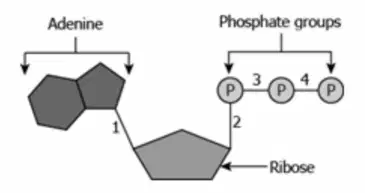
(2.1) The diagram shows the structure of an ATP molecule with its bonds labeled. Which bond is responsible most often for the production of energy during cellular respiration?
a)
1
b)
2
c)
3
d)
4
3.

Which bond must be broken for energy to be released?
a)
1
b)
2
c)
3
d)
4
4.

The diagram shows the structure of ATP.Which bond, when broken, will form ADP?
a)
bond 1
b)
bond 2
c)
bond 3
d)
bond 4
5.
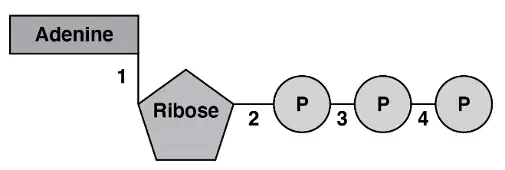
Muscles need energy to contract. The immediate source of energy is provided by ATP stored in the cells. The image shows the structure of ATP.Based on the image, which number of the bond that breaks first to release energy for the muscle cells to contract and relax.
a)
1
b)
2
c)
3
d)
4
6.

Figure 8–1 Which structures shown in Figure 8–1 make up an ATP molecule?
a)
A and B
b)
A, B, and C
c)
A, B, C, and D
d)
C and D
7.
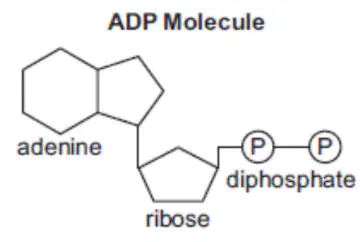
The model shows an ADP molecule involved in the body's energy cycle.Which statement best describes the relationship between ADP and ATP?
a)
The addition of thymine to adenine will decrease the energy to form ATP from ADP.
b)
The substitution of deoxyribose for ribose will provide energy to form ATP from ADP.
c)
The addition of a phosphate group to ADP forms ATP and results in a net gain of energy.
d)
The subtraction of a phosphate group from ADP forms ATP and results in a net loss of energy.
8.

The model shows an ADP molecule involved in the body's energy cycle.Which statement best describes the relationship between ADP and ATP?
a)
Adding a phosphate group to ADP forms ATP and stores energy.
b)
Changing the sugar in ADP to deoxyribose stores energy for ATP.
c)
Removing a phosphate group from ADP creates ATP and leads to a release of energy.
d)
Combining thymine with adenine decreases the energy needed to form ATP from ADP.
9.
Why is ATP important?
a)
it is a major component of carbohydrates
b)
it stores the genetic material needed for cells to make proteins
c)
it stores energy needed for cells to undergo life processes
d)
it speeds up reaction times for that metabolic processes are possible
10.
Energy is released from ATP when
a)
a phosphate group is added.
b)
adenine bonds to ribose.
c)
ATP is exposed to sunlight.
d)
a phosphate group is removed.
11.
When is energy released from ATP?
a)
A chemical bond is broken and a phosphate is removed.
b)
A chemical bond is formed as a phosphate is added.
c)
A chemical bond is formed as a phosphate is removed.
d)
A chemical bond is broken as a phosphate is added.
12.
ATP releases energy when a bond is broken between which of the following?
a)
the second and third phosphate groups
b)
adenine and ribose
c)
adenine and a phosphate group
d)
ribose and a phosphate group
13.

The diagram shows an ATP molecule with four bonds labeled.Which statement best explains the structure and function of ATP?
a)
When bond Z is formed, energy is released for cellular activities.
b)
When bond Z is broken, energy is released for cellular activities.
c)
When bond Y is formed, energy is stored for cellular activities.
d)
When bond Y is broken, energy is stored for cellular activities.
14.
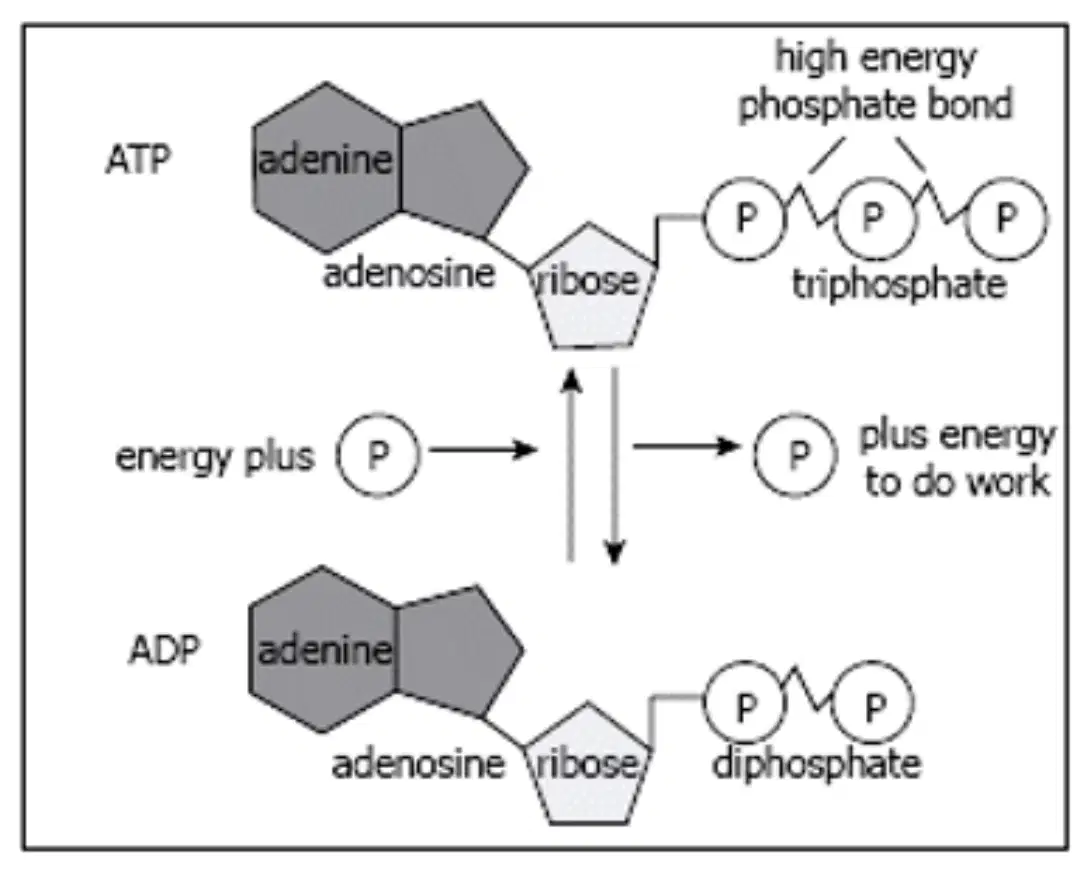
The model represents the ATP-ADP cycle.How does ATP release energy?
a)
A phosphate group is added to ADP.
b)
An adenine molecule is removed from ATP.
c)
A ribose sugar is added to ADP.
d)
A phosphate group is removed from ATP.
15.
How is energy released from ATP
a)
when an adenine base is added
b)
when an additional phosphate group is added
c)
when the ribose sugar is changed to deoxyribose
d)
when the last phosphate group is removed/broken off
16.
Muscle cells contract as actin filaments slide across the surface of myosin filaments, causing the ends of the muscle cells to pull together. This process requires energy in the form of ATP. Which process explains how energy is made available for muscle contraction?
a)
combining ADP and phosphate ions
b)
combining AMP and phosphate ions
c)
removing a phosphate from ATP
d)
removing the adenine base from ATP
17.
Energy is released from ATP when
a)
a phosphate group is added.
b)
adenine bonds to ribose.
c)
ATP is exposed to sunlight.
d)
a phosphate group is removed.
18.
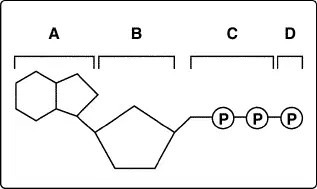
Figure 8–1 In Figure 8–1, between which parts of the molecule must the bonds be broken to form an ADP molecule?
a)
A and B
b)
A and C
c)
B and C
d)
C and D
19.
Energy is released from ATP when
a)
a phosphate group is added.
b)
adenine bonds to ribose.
c)
ATP is exposed to sunlight.
d)
a phosphate group is removed.
20.
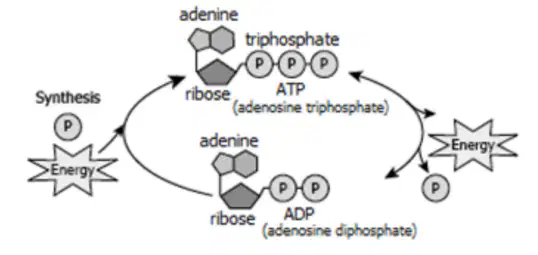
The diagram shows how a cell utilizes ATP to generate energy.Which change results in the release of energy?
a)
formation of a bond between adenine and ribose
b)
breaking the bond between two phosphate groups
c)
formation of a bond between ribose and a phosphate
d)
breaking the bond between adenine and a phosphate
21.
How does the ATP molecule provide energy for cellular processes?
a)
Oxygen is added to deoxyribose to form ribose.
b)
Bonds between phosphates are broken.
c)
Bonds between phosphates are formed.
d)
Oxygen is removed from ribose to form deoxyribose.
22.
ADP stores energy when a bond is formed between which of the following?
a)
the second and third phosphate groups
b)
adenine and ribose
c)
adenine and a phosphate group
d)
ribose and a phosphate group
23.
Which of the following is produced by the Calvin Cycle?
a)
oxygen gas
b)
ADP
c)
high-energy sugars
d)
carbon dioxide
24.
What is a product of the Calvin cycle?
a)
oxygen gas
b)
ATP
c)
high-energy sugars
d)
carbon dioxide gas
25.
During photosynthesis, what occurs in the light dependent reactions?
a)
carbon dioxide is released
b)
oxygen is released
c)
water molecules are created from hydrogen and oxygen
d)
NADP is produced
26.
The source of oxygen produced during photosynthesis is
a)
carbon dioxide.
b)
water.
c)
the air.
d)
glucose.
27.
If carbon dioxide is completely removed from a plant’s environment, what would you expect to happen to the plant’s production of high-energy sugars?
a)
More sugars will be produced.
b)
No sugars will be produced.
c)
The same number of sugars will be produced but without carbon dioxide.
d)
Carbon dioxide does not affect the production of high-energy sugars in plants.
28.
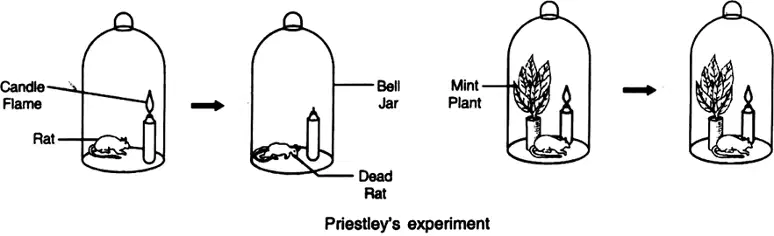
In the late eighteenth century, Joseph Priestley did an experiment using a jar, a mint plant, and a candle. He sealed a small mint plant and a burning candle in a jar filled with some water. The candle went out after a few seconds. Priestley found that, after several days, the candle in the sealed jar could be lit again using sunlight and a magnifying lens. Why could the candle be relit?
a)
The gas in the jar cooled.
b)
Molecules in the jar condensed.
c)
The mint released oxygen into the jar.
d)
The mint used oxygen from within the jar.
29.
As a result of photosynthesis,
a)
our atmosphere is now rich in oxygen gas.
b)
animals can get energy directly from the sun.
c)
plants convert chlorophyll into protein channels.
d)
abundant quantities of carbon dioxide are available to fuel the Calvin cycle.
30.
The major atmospheric byproduct of photosynthesis is
a)
nitrogen.
b)
carbon dioxide.
c)
water.
d)
oxygen.
31.
A student is collecting the gas given off from a plant in bright sunlight at a temperature of 27°C. The gas being collected is probably
a)
oxygen.
b)
carbon dioxide.
c)
ATP.
d)
vaporized water.
32.
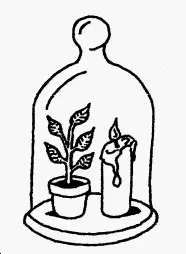
A. B. Figure 8–4 In Figure 8–4, why might the candle in jar A burn longer than the candle in jar B?
a)
Carbon dioxide produced by the plant allows the candle to burn longer.
b)
Chlorophyll produced by the plant allows the candle to burn longer.
c)
Glucose produced by the plant allows the candle to burn longer.
d)
Oxygen produced by the plant allows the candle to burn longer.
33.

A student drew a model of photosynthesis.The teacher tells the student that something is incorrect in their model.What should the student change to make the model scientifically accurate?
a)
Exchange the positions of the light-dependent and light-independent reactions.
b)
Exchange the positions of oxygen and water in the light-dependent reaction.
c)
Move the carbon dioxide to the other side of the light-independent reaction.
d)
Move the ATP and NADPH below the light-independent reaction.
34.

A student designed a model of the process of photosynthesis.A classmate notices that the model is incorrect. What should the student change so that it represents photosynthesis correctly?
a)
Reverse the labels for water and glucose.
b)
Reverse the labels for glucose and carbon dioxide.
c)
Reverse the labels for oxygen and carbon dioxide.
d)
Reverse the labels for light-dependent and light-independent reactions.
35.

A biological process that occurs in both plants and animals is shown below.Which row in the chart below identifies the lettered substances in this process?RowABD1oxygencarbon dioxidewater2glucoseoxygencarbon dioxide3oxygenwatercarbon dioxide4glucosecarbon dioxideoxygen
a)
Row 1
b)
Row 2
c)
Row 3
d)
Row 4
36.
C6 H12O6 + 6O2 ¬ 6CO2 + 6 H2O + MOLECULE AThe process shown in the equation above begins in the cytoplasm of a cell and ends in the
a)
cytoplasm.
b)
mitochondria.
c)
endoplasmic reticulum.
d)
lysosome.
37.
C6 H12O6 + 6O2 + ADP + P ¬ 6CO2 + 6 H2O + MOLECULE AThe equation above summarizes the process known as
a)
photosynthesis.
b)
fermentation.
c)
aerobic respiration.
d)
protein breakdown.
38.
C6 H12O6 + 6O2 + ADP + P ¬ 6CO2 + 6 H2O + MOLECULE A The molecule referred to as Molecule “A” in the equation above is
a)
NADPH.
b)
ATP.
c)
NADH.
d)
ADP.
39.
What is the correct equation for cellular respiration?
a)
6O2 + C6H12O6 ® 6CO2 + 6H2O + Energy
b)
6O2 + C6H12O6 + Energy ® 6CO2 + 6H2O
c)
6CO2 + 6H2O ® 6O2 + C6H12O6 + Energy
d)
6CO2 + 6H2O + Energy ® 6O2 + C6H12O6
40.

Which process is represented by the question mark?
a)
photosynthesis
b)
aerobic respiration
c)
fermentation
d)
chemosynthesis
41.

What process is represented by the arrow in the diagram below?
a)
Cell growth
b)
Cellular respiration
c)
Photosynthesis
d)
Excretion
42.
Which of the following produces the most ATP?
a)
lactic acid fermentation
b)
glycolysis
c)
alcoholic fermentation
d)
electron transport chain
43.
Saccharomyces cerevisiae is a strain of YEAST used by a teacher to demonstrate GLYCOLYSIS to his students. How many ATP molecules should the students expect to be produced for each glucose molecule?
a)
2
b)
8
c)
16
d)
36
44.
When glycolysis occurs,
a)
a molecule of glucose is split.
b)
two molecules of pyruvate are made.
c)
some ATP is produced.
d)
All of the above
45.
Glycolysis provides a cell with a net gain of
a)
2 ATP molecules.
b)
4 ATP molecules.
c)
18 ATP molecules.
d)
36 ATP molecules.
46.
The starting molecule for glycolysis is
a)
ADP.
b)
pyruvic acid.
c)
citric acid.
d)
glucose.
47.
Which of these processes takes place in the cytoplasm of a cell?
a)
glycolysis
b)
electron transport
c)
Krebs cycle
d)
photosynthesis
48.

A cellular process in a green plant is represented by the diagram. What is the name of this cellular process?
a)
Respiration
b)
Photosynthesis
c)
Digestion
d)
Replication
49.
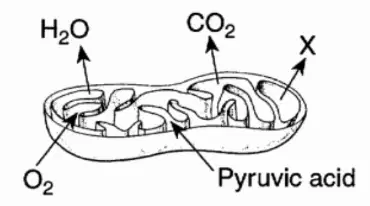
The diagram below represents the reactants and products or a process that occurs in mitochondria. Letter X most likely represents -
a)
ATP
b)
Lactic acid
c)
Chlorophyll
d)
Glucose
50.
Cellular respiration releases energy by breaking down
a)
food molecules.
b)
ATP.
c)
carbon dioxide.
d)
water.
51.
Cellular respiration is called an aerobic process because it requires
a)
light.
b)
exercise.
c)
oxygen.
d)
glucose.
52.
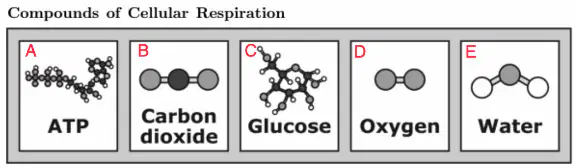
The diagram shows compounds used in cellular respiration. Which of the compounds of aerobic cellular respiration are considered to be reactants?
a)
A, B, and E
b)
B and E
c)
C and D
d)
Only C
53.

The diagram shows compounds used in cellular respiration. Which of the compounds of aerobic cellular respiration are considered to be products?
a)
A, B, and E
b)
B and E
c)
C and D
d)
Only C
54.
What are the reactants in the equation for cellular respiration?
a)
oxygen and lactic acid
b)
carbon dioxide and water
c)
glucose and oxygen
d)
water and glucose
55.
What are the products of cellular respiration?
a)
carbon dioxide and water
b)
carbon dioxide and oxygen
c)
glucose and oxygen
d)
glucose and carbon dioxide
56.
What are the raw materials of cellular respiration?
a)
carbon dioxide and water
b)
carbon dioxide and oxygen
c)
glucose and oxygen
d)
glucose and carbon dioxide
57.
The air bubbles and spongy texture of bread are due to which process?
a)
lactic acid fermentation
b)
glycolysis
c)
alcoholic fermentation
d)
the Krebs cycle
58.
A group of biology students conducted a lab investigation in which they sealed a flask with a balloon. The flask contained a teaspoon of yeast, a teaspoon of sugar, and 200 ml of warm water. The objective was to determine how much carbon dioxide gas was produced. Which statement best explains why the students used yeast?
a)
Yeast is a fungus that undergoes anaerobic respiration in the presence of oxygen.
b)
In the absence of oxygen, yeast breaks down sugar into carbon dioxide and ethanol.
c)
Yeast is a heterotroph that undergoes aerobic respiration in an oxygen rich environment.
d)
In the presence of oxygen, yeast breaks down sugar into carbon dioxide and ethanol.
59.
Bacteria in the intestines of humans (where there is no oxygen present) break down glucose into lactic acid. Which cellular process do these bacteria most likely use to produce energy?
a)
aerobic respiration
b)
photosynthesis
c)
anaerobic respiration
d)
carbohydrate polymerization
60.
After glycolysis, what will happen next in the leaf cells of a tobacco plant in the absence of oxygen?
a)
the Krebs cycle
b)
pyruvination
c)
lactic acid fermentation
d)
alcoholic fermentation
61.
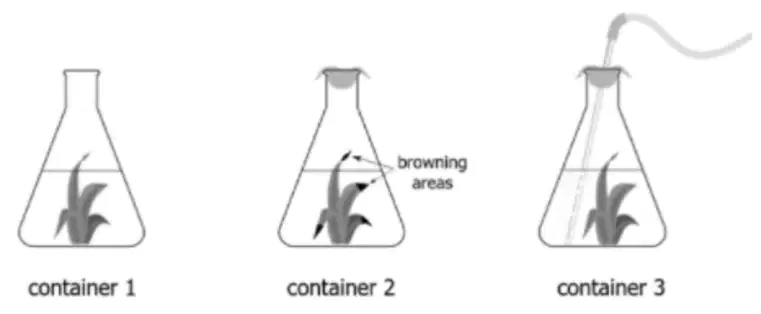
A student creates an experiment to determine the effects of oxygen on the growth of a water plant.The student fills three containers with water and adds an aquatic plant to each.Container 1 is open to the air, container 2 has a lid that prevents the exchange of air, and container 3 has a lid with a tube that pumps air into the container.After three weeks, the student observes that containers 1 and 3 have healthy green plants, while the plant in container 2 has not grown, and the leaves show browning areas.Which explanation provides the reason for the difference in the growth of the plant in container 2?
a)
The plant in container 2 is performing a higher rate of photosynthesis, which causes the leaves to use more sugar.
b)
The plant in container 2 is performing a higher rate of anaerobic respiration which has less energy for growth.
c)
The plant in container 2 is producing more carbon dioxide than oxygen, which leads to higher rates of aerobic respiration.
d)
The plant in container 2 is producing more oxygen than carbon dioxide, which causes it to have more stored energy.
62.
How is aerobic respiration best compared or contrasted to fermentation?
a)
Both require oxygen, but they produce the same amount of energy.
b)
Aerobic respiration converts chemical potential energy into ATP, but fermentation does not.
c)
Fermentation does not require glucose, but aerobic respiration does.
d)
Aerobic respiration requires oxygen and produces more energy.
63.
When athletes run long distances, their muscles become fatigued due to lack of oxygen. Which process helps athletes generate more energy to continue running?
a)
aerobic respiration
b)
anaerobic respiration
c)
chemosynthesis
d)
photosynthesis
64.
As a result of strenuous exercise, during anaerobic cellular respiration, muscles build up an excess of ___.
a)
citric acid
b)
lactic acid
c)
oxygen
d)
carbon monoxide
65.
A runner in a cross country tournament experiences muscle cramps toward the end of the race. After completing the race and resting, the runner's cramps eventually go away.Which statement best explains what has occurred?
a)
The runner did not sufficiently warm up before the race and experienced cramping as the muscles were forced to convert fat into a useable energy source.
b)
As the runner reached the end of the race, fatigued muscle cells began to die at a rate faster than they could be replicated, which resulted in an increased amount of muscle cramping.
c)
As the runner became more fatigued, the muscles did not receive enough oxygen and were forced to perform anaerobic respiration, resulting in cramping.
d)
The runner did not consume sufficient levels of glucose before the race and experienced cramping because the muscles were forced to increase glucose production.
66.

Analyze the diagram below. The diagram shows the gases that enter and leave a plant during the process of photosynthesis. Which gases do arrows 1 and 2 represent?
a)
Arrow 1 is nitrogen, and arrow 2 is oxygen.
b)
Arrow 1 is oxygen, and arrow 2 is nitrogen.
c)
Arrow 1 is oxygen, and arrow 2 is carbon dioxide.
d)
Arrow 1 is carbon dioxide, and arrow 2 is oxygen.
100 %

