
 Worksheets
Unit 6: Developmental Psych Review
Total questions: 100
Worksheet time: 1hrs 3mins
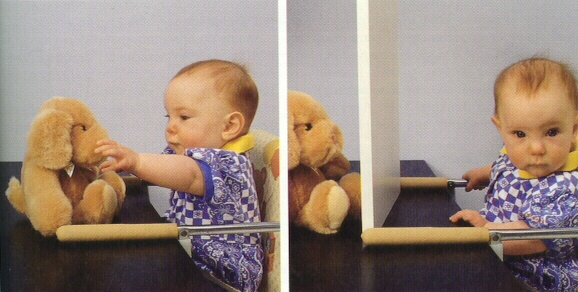
Sally attempts to retrieve her teddy bear after her father hides it under a blanket. This suggests that Sally has developed a sense of
egocentrism.
object permanence.
conservation.
accommodation.
Robby understands her world primarily by grasping and sucking easily available objects. Robby is clearly in Piaget's ________ stage.
preoperational
concrete operational
sensorimotor
formal operational
What did the monkeys do when they were frightened by a loud noise
Hide in the corner of the cage
Shriek at the noise
Run to the cloth mother
Run to the wire mother
Where did the monkeys in the cage spend most of their time
The wire mother
On the floor of the cage
Climbing the cage
The cloth mother
What conclusion can we draw from Harlow's research
The importance of food
Monkeys are better at socializing when they come out the cage
Contact comfort is the most important factor when forming attachment
Contact is equally as important as food when forming an attachment


infants using the Strange Situation model, which labeled infants as secure, and insecure in attachment
According to Harry Harlow what made the mother so important?
the comfort she provided
the food she provided
the protection she provided
the guidance she provided
This study provided evidence that infants seek their parents for emotional support and care, not just for biological nourishment.
Piaget (1932)
Harlow (1953)
Bowlby (1969)
Ainsworth (1970s)
What did Harlow determine by enacting the "Strange Situation" experiment technique where monkeys were left to explore an unfamiliar room with and without its mother?
The monkeys who had a mother in the room would only stay close to the mother and would not venture farther than a few feet.
There was no difference between whether the mother was present or not in the room.
When the surrogate mother was present, the monkey would explore the room freely because of their secure base of attachment.
When the surrogate mother was removed from the room, the monkey would be more confident in their exploration.
Adding new information because it fits an existing schema is
assimilation
accomodation
discrimination
gerneralization
Creating a new schema when new information does not fit an existing one
assimilation
accomodation
discrimination
generalization
In a __________ design, one group of people is followed
and assessed at different times as the group ages.
longitudinal
cross-sectional
cross-sequential
cross-longitudinal
The cognitive and social changes students go through
because
they are born and grow up in an age of
smartphones
would be referred to as a(n)
experimental group.
control group
dominance effect
cohort effect
Brandy has naturally blond hair. Based on this information,
what do we know about Brandy’s parents?
At least one of her parents has a recessive gene for
blond hair.
Each of her parents must have one recessive gene for
blond hair.
Each of her parents must have one dominant gene for
brown hair.
Neither of her parents has a recessive gene for blond hair.
When sets of genes group together, the result can be
multiple traits expressed as a single dominant trait. This is
best explained by the process known as
dominant inheritance.
recessive inheritance.
polygenetic inheritance.
amines.
Which of the following is a disorder resulting from recessive
inheritance?
Turner’s syndrome
Klinefelter’s syndrome
cystic fibrosis
Down syndrome
Which disorder is characterized by having only one X
chromosome in the 23rd pairing?
Tay-Sachs
Turner’s syndrome
Klinefelter’s syndrome
PKU
In a Piagetian model, ________ is a concept or framework that organizes and interprets information.
Memory
Image
Cognition
Schema
In a Piagetian model, ________ is a concept or framework that organizes and interprets information.
Memory
Image
Cognition
Schema
Tyrell understands that his father can also be a son and a brother all at the same time. This suggests that Tyrell is in what stage?
Formal
Concrete
Preoperational
Sensorimotor
Two containers hold the same amount, but Jane thinks that the taller, skinnier glass holds more. This is known as:
Accommodation
Egocentrism
False Belief
Conservation
Travis was very upset when Larry stole some candy, but did not care when Mike put his elbows on the dinner table when he was told not to. What stage of development is Travis in?
Conventional
Postconventional
Preconventional
Joey is watching a horse race. He knows that his dog at home has four legs, a tail, and fur. When he sees the horses, he shouts out “Doggies.” Joey is demonstrating
Assimilation
Accommodation
Conservation
Irreversibility
The correct sequence of Piaget’s stages of cognitive development are
preoperational, concrete, formal, sensorimotor
sensorimotor, preoperational concrete operational, formal operational
Preoperational, sensorimotor, concrete operational, formal operational
concrete, formal, preoperational, sensorimotor
Johnny is playing in his crib when his teddy bear Mr. Peeps falls under the crib. Johnny cries knowing that Mr. Peeps exists somewhere. Johnny is demonstrating
Centration
Object permanence
Reversibility
Egocentrism
Which of the following is the best research method for developmental psychologists?
Case Study
Experimental
Longitudinal
Cross Sectional
Alex believes people are primarily influenced by genes, so he believes _______ plays a more powerful role in human development.
Nature
Nurture
None of the above
If a child is good because they do not want to avoid punishment, which stage are the students in?
Preconventional
Conventional
Postconventional
People at this stage develop their own set of moral guidelines that may or not fit into the law. Things like human rights, justice, and equality are most important even if they have to go against society and have to face consequences.
Preconventional
Conventional
Postconventional
According to Constructivist Theorist, " Collaborative learning is highly benificial to the mental development of a learner.
True
False
Vygotsky's term for the skills - cognitive as well as physical - that a person can exercise only with assistance, not yet independently.
overimitation
zone of proximal development
social mediation
preoperational intelligence
The four stages of Piaget's cognitive development (in order) are:
Sensory-motor, pre-operational, formal operational, concrete operational.
Sensory-motor, formal operational, concrete operational, optional.
Sensory-motor, pre-operational, concrete operational, formal operational.
Sensory-motor, abstract operational, logical operational, formal operational.
Object permanence can be defined as:
Pieces of information continuing to be remembered.
Events and ideas being permanently engrained in the mind.
Objects continuing to exist even after they have left our perception.
Believing you can see things that are not there.
The key feature of the 'pre-operational stage' is:
Thinking logically
Thinking in operational format
Being egocentric
Seeing things from others points of view
The concrete operational stage occurs in what age bracket?
Birth - 2
7 - 11 years
11+ years
2 - 7 years
The two key characteristics of the concrete operational stage (7 - 11 years) are:
Conservation and classifying
Classifying and concentration
Conservation and concentration
Classifying and categorising
Two key features of formal operational stage (11+) are:
Abstract and logical thinking
Concentrated and logical thinking
Conservation and abstract thinking
Logical and conservational thinking
Which of these are criticisms/weaknesses of Piaget's 4 stages of cognitive development?
Some babies/younger children have shown higher levels of cognitive development but are generalised by the theory.
Theory fails to distinguish between 'competence' and 'performance'.
Gives insufficient attention to social influences on performance.
Children don't gain conservation until much later ages.
These are concepts or frameworks that organize and interpret information.
Assimilation
Accommodation
Crystallized Intelligence
Schema
Taking in new information and fitting it into existing schemas
Crystallized intelligence
Fluid intelligence
Assimilation
Accommodation
Changing and revising existing schema in face of new experiences or new information.
Crystallized intelligence
Fluid intelligence
Assimilation
Accommodation
Refers to the process by which a child learns to interact with others around them.
Physical Development
Social Development
Cognitive Development
Spiritual Development
Which of the following best describes a critical period?
A moment in development where the infant is ready to talk
Moments in time where individuals recognize the urge to urinate
Developmental periods where individuals recall past events
A time during development when the individual is ready to move to the next objective
Who developed the 4 stage theory of cognitive development?
Lev Vygotsky
Arnold Palmer
Erik Erikson
Jean Piaget
Which of the following is an example of fine motor development?
control of the torso
the development of leg muscles
the movement of fingers
the development of arm muscles
Which of the following methods of observation is most commonly used when looking at childhood development?
longitudinal method
case-study method
laboratory method
cross-sectional method
What term is used to describe a child’s inability to see the world through anyone else’s eyes except his or her own?
egocentrism
narcissism
disparity
assimilation
According to Piaget, the ability to understand that simply changing the appearance of an object does not change the object’s nature is known as _______.
centration
assimilation
conservation
object permanence
________________ is a term Piaget used to represent the building blocks of knowledge.
Assimilation
Schema
Assimilation
Equilibration
_____________ is using an existing schema and applying it to a new situation or object.
Accommodation
Equilibration
Assimilation
________________ is changing approaches when an existing schema doesn’t work in a particular situation.
Assimilation
Accommodation
Equilibration
ZPD stands for________.
Zone of Probable Development
Zone of Proximal Direction
Zone of Proximal Development
Zone of Proximal Decision
The ZPD is between
anxiety and boredom
anxiety and frustration
stress and calm
learning and relearning
To help in the ZPD the teacher must use
inependent practice
scaffolding
student goal setting
continuos help
The ZPD is between
What the learner can do with help and what the learner cannot do
What the learner can do on their own and what they can do with help
What the learner can do on their own and what the learner will be able to do on their own
___________ believed the stages of development must be met before learning can occur.
Piaget
Vygotsky
______________ believed the learning was a collaboration between the teacher and student.
Piaget
Vygotsky
True or False: Scaffolding refers to doing the task for the child to set an example.
True
False
Vygotsky defined which three types of language?
Social speech
Private speech
Emotional Speech
Silent Inner Speech
According to Vygotsky, children develop their behavior and habits...
from treats/ prizes
from their cultures and through interpersonal experiences
from punishment's/ discipline
from friendships
True or False: According to Vygotsky, unassisted performance alone does give a true idea/picture about a child's level?
True
False
What is an example of Vygotsky's theory?
a child knows that if they cry or scream their parent will give them a treat to clam down
a child will copy and do whatever his or her friends are doing
a child knows that some things are private and shouldn't be shared or talked about due to social norms
a child does not know when they did something wrong so he or she will be disciplined for no reason
According to Vygotsky, why is language important in development?
Language is the main means by which adults transmit info to children.
Language is a powerful tool of intellectual adaptation.
Language is an accelerator to thinking and understanding.
All of the above.

Whether the selected test actually measures the stated variable is know as?
Reliability
Valididty
Accuracy
Precision
Which type of research method is best suited for revealing the meaning of events as experienced by individuals?
Quantitative
Qualitative
A measure of the relationship between two variables.
scientific method
experiment
correlation
dependent variable
This research method is a measure of the extent to which two variables change together, and thus of how well either variable predicts the other
Correlational
Experiments
Case Study
Survey
Observational

The scatter graph shows the relationship between the age of a car and its value.
Describe the correlation shown on the diagram.
Positive
Negative
No Correlation

The scatter graph shows the relationship between the height and arm span of some students.
Describe the correlation shown on the diagram.
Positive
Negative
No Correlation

The scatter graph shows the relationship between two test scores of some students.
Describe the correlation shown on the diagram.
Positive
Negative
No Correlation

The scatter graph shows the relationship between the test score and the time spent revising for a group of students.
Describe the correlation shown on the diagram.
Positive
Negative
No Correlation
Which graph has a negative correlation?


Which graph has a weak and positive correlation?


Which line best fits the scattered plot?


The advantage of this method of research is that the behaviour observed in the subject(s) natural environment is more natural, spontaneous, and varied than that observed in a laboratory.
Observational
Correlational
Experiments
Case Study
Survey

