
 Worksheets
MX 3 Grade 9 Reviewer
Total questions: 50
Worksheet time: 3hrs 53mins
A bond between a metal and a nonmetal is called a(n)
covalent bond
ionic bond
metallic bond
transfer bond
A bond between a nonmetal and a nonmetal is called a(n)
covalent bond
ionic bond
metallic bond
transfer bond
What type of bond involves the sharing of electrons between atoms?
covalent bond
ionic bond
metallic bond
transfer bond
Identify the following compound as ionic or covalent: MgO
ionic
covalent
Identify the following compound as ionic or covalent: Na2SO4
ionic
covalent
Identify the following compound as ionic or covalent: CF4
ionic
covalent
Identify the following compound as ionic or covalent: SO2
ionic
covalent
Identify the following compound as ionic or covalent: CO
ionic
covalent
Identify the following compound as ionic or covalent: Ca(OH)2
ionic
covalent
When naming covalent compounds...
You need roman numerals and no prefixes
You do not need roman numerals or prefixes
You need roman numerals and prefixes
You do not need roman numerals but you do need prefixes
This type of bonding can be described as "I give, I get"
ionic
covalent
metallic
This type of bonding can be described as a "cooperation"
ionic
covalent
metallic

This Lewis Dot Structure for water is correct
True
False
Potassium Chloride is...
Ionic
Covalent
an element from Group 7
Calcium Oxide, CaO
Covalent Bond
Ionic Bond
Calcium Chloride, CaCl2
Covalent Bond
Ionic Bond
Why do ionic bonds form?
so the number of protons equals the number of electrons
to fill the outermost energy level to make the atom stable
so an atom can become unstable
If an aluminum atom has 13 protons (+) and 10 electrons (-), what is it's charge?
Al+3
Al+13
Al+10
Al-10
if NONMETALS are more likely to GAIN electrons, they will form ...
anions
neutral atoms
cations
if NONMETALS are more likely to GAIN electrons, they will form ...
anions
neutral atoms
cations
An ionic bond is the attraction between: (Select ALL that apply)
oppositely charged ions
similarly charged ions
metals and nonmetals
neutral atoms
cations and anions
Which of the following is the correct formula for these two ions: Al+3 & S-2
AlS3
Al2S3
Al3S2
Al3S
If I had a cation with a charge of 2+ how would you describe the formation of that ion?
gained 2 electrons
lost 2 electrons
gained 4 electrons
lost 4 electrons
If I had an anion with a charge of 3- how would you describe the formation of that ion?
gained 2 electrons
lost 2 electrons
gained 3 electrons
lost 3 electrons

Nitrogen, N, will form which of the following ions?
N
N-3
N-5
N+5
Which of the following is the correct formula for Sodium Nitride ( [ Na ] + & [ N ] 3- )
NaN3
Na3N
Na2N3
Na3N2

When assigning ionic charge it is always written as a...
superscript
subscript
coefficient
script

When assigning the number of individual atoms in a chemical formula it is written as a...
superscript
subscript
coefficient
script
The Octet Rule states that in chemical compounds, atoms tend to have
the electron configuration of a noble gas
eight electrons in their valence energy level
more electrons than protons
more protons than electrons
Which of the following is a covalent compound?
BeHCO₃
MgS
AgI
PCl₅
What type of elements are in a covalent bond?
nonmetal bonded to a nonmetal
metal bonded to a nonmetal
metal bonded to a metal
none of the above

Which of the following is the correct Lewis dot structure for the molecule fluorine (F₂)?
A
B
C
D

What is the correct Lewis structure for hydrogen chloride, HCl?
A
B
C
D
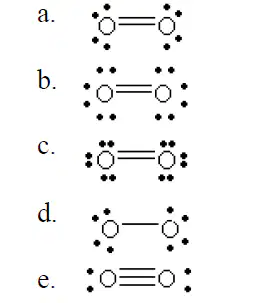
What is the correct Lewis structure for diatomic oxygen, O₂?
A
B
C
D
E

Which of the following is the correct Lewis structure for N₂O, nitrous oxide (laughing gas)?
A
B
C
D
E
Which of these would be covalently bonded?
Sodium, Na and potassium, K
Magnesium, Mg and oxygen, O
Fluorine, F and chlorine, Cl
Helium, He and argon, Ar
Which of these is not a covalent molecule?
K2O
CO2
HCl
CH4
Electronegativity is
the ability of an atom to attract electrons
the ability of an atom to lose electrons
the energy required to remove an electron from a specific atom
the ability of an atom to make a bond
The energy it takes to remove one electron from an atom
Atomic Radii
Ionization Energy
Electronegativity
Electron Afinity
Oxidation Number
The amount of energy released when an electron is added to a neutral atom to form a negative ion
Atomic Radii
Ionization Energy
Electronegativity
Electron Afinity
Oxidation Number

