
 Worksheets
APHG Population Practice Exam
Total questions: 50
Worksheet time: 3hrs 30mins

Which of the following types of population information is shown on the map?
Transnational migration
Internal migration
Agricultural density
Arithmetic density
Physiological density

Population patterns shown on the map indicate that areas around river deltas and upland lake and river valleys have higher densities. Which of the following best explains why these regions are more heavily populated?
These regions have pronatalist policies.
These regions have access to international trade.
These regions experience seasonal climate variation.
These regions have mineral resources.
These regions have higher carrying capacities.

Which of the following best identifies the data for western China, shown on the map?
High carrying capacity
Low population pressure
Clustered population
High arithmetic density
Low arithmetic density
If rural-to-urban migration continues in China, which of the following outcomes is most likely?
Farming will become unsustainable.
Housing shortages in urban areas will be common.
Schools in rural areas will not have enough students to remain open.
Manufacturing areas will face labor shortages.
Wages will increase in urban areas.
Which statement best explains an environmental impact of China's population distribution?
The population distribution shown allows for large-scale agricultural expansion in western China to increase the food supply.
The population distribution shown permits the dispersal of industrial air pollution outside of the region due to prevailing wind patterns.
The population distribution shown directs urban and industrial water pollution along riverways to less populated portions of the country.
The population distribution shown depicts concentration in cities, which results in more open area to protect wildlife and preserve habitats.
The population distribution shown requires more intensive use of limited soil and water resources to increase the carrying capacity of agricultural land.

Which of the following patterns is indicated by the population pyramid shown?
Levels of education and contraceptive usage are high among women.
Government policies encourage women to have multiple children.
The population has a high total fertility rate.
Government policies discourage women from having multiple children.
The population has a low infant mortality rate.
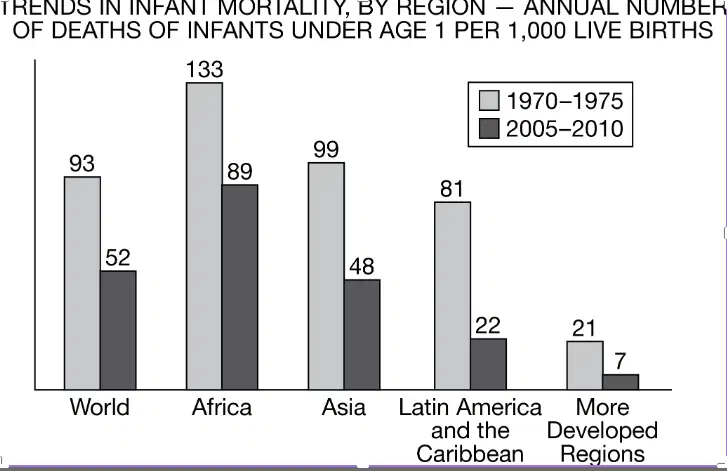
Which of the following statements best explains the trend about infant mortality shown in the bar chart?
The trend can be explained by improvements in political participation and voting in all regions.
The trend can be explained by rural to urban migration and the growth of cities in all regions.
The trend can be explained by industrialization and improved job opportunities.
The trend can be explained by improved health care and nutrition in all regions.
The trend can be explained by improvements in communications and Internet access.
A large number of Turkish people migrated to Germany in the 1960s, when West Germany’s manufacturing economy was booming and Turkey’s economy was predominantly agricultural. Which of the following best describes Turkish migration to Germany?
Political asylum seekers fleeing Communism
Involuntary migrants fleeing transnational wars
Internal rural-to-urban migrants
Internally displaced persons
Voluntary guest workers
Which of the following best explains an effect of migration within the United States between 1950 and 2010 ?
The mean center of the population of the United States shifted to the South and West as workers migrated to areas with more jobs and a warmer climate.
Population increased in the industrial North because of large-scale migration of African Americans from the South.
Rapid suburbanization occurred in the Midwest as retirees migrated from the East Coast.
Large clusters of migrants from other countries settled in the South and West, leading to significant population growth in this region.
Population increased in the northeastern United States as large numbers of college graduates moved to this region to seek employment.
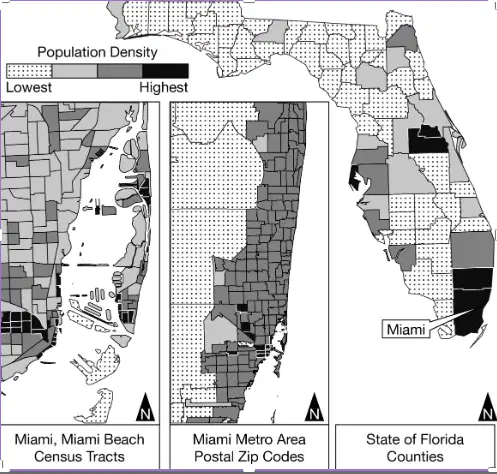
Which of the following identifies how population density is shown in the maps?
At different scales, showing administrative units
In different types of physical regions
In different types of culture regions
In different types of vernacular regions
At the same scale, showing different parts of the country
Which of the following is the best describes an example of transhumance?
Ranchers in Canada who allow their cattle to graze over a wide area of flat land
Herders in Kenya who take their goats to a river basin each day for water
Shepherds in France who move their sheep to mountain pastures each summer
Farmers in Peru who raise their llamas on land that used to be tropical rain forest
Traders in Mongolia who maintain a herd of camels and a herd of yaks
Which of the following processes best explains a decrease in mortality rates worldwide?
Increased rates of female literacy
Increased rates of urbanization
Modern family planning methods
Better hygiene and sanitation practices
Greater female workforce participation

Based on the demographic transition model, which region is best described as exhibiting overall negative rates of growth in stage 4?
South Asia
Eastern Europe
North America
East Asia
Northern Africa

Deaths in Country A often occur due to outbreaks of epidemic disease, while in Country B most people are dying from chronic disorders such as heart disease. Which of the following best describes where these countries fall in the demographic transition model and in which region they are likely located?
Country A : Stage 3, Latin America; Country B : Stage 2, West Africa
Country A : Stage 2, Latin America; Country B : Stage 3, West Africa
Country A : Stage 2, West Africa; Country B : Stage 4, western Europe
Country A : Stage 4, western Europe; Country B : Stage 2, West Africa
Country A : Stage 4, western Europe ; Country B : Stage 2, Latin America
Neo-Malthusian theory can be used to explain which of the following situations?
Brazil’s interior was previously unfit for farming, but recently more land is being cultivated.
Mexico has utilized new technology to shift from being a food importer to being a food exporter.
Malawi previously experienced famine but has improved agricultural yields through subsidies.
India has been able to increase agricultural yields by utilizing bio-engineered seeds.
South Sudan experienced famine during the twenty-first century as a result of war and drought.
South Korea, as of 2018, has the lowest total fertility rate in the world at 1.1. Which of the following best explains a population policy South Korea could enact to promote higher birth rates?
Decreasing the age of retirement so that older Koreans can work in childcare centers
Decreasing the cost of childcare so that families can afford to have more children
Increasing social-security benefits so that retirees can financially support their grandchildren
Decreasing health insurance so that parents pay more for the cost of childbirth
Increasing educational costs for universities so that the government can spend more on preschool
Many countries in sub-Saharan Africa have total fertility rates that exceed 5.0. Which of the following population characteristics is associated with this phenomenon?
High youth dependency ratio
Long life expectancy
Low birth rates
High elder dependency ratio
Zero population growth
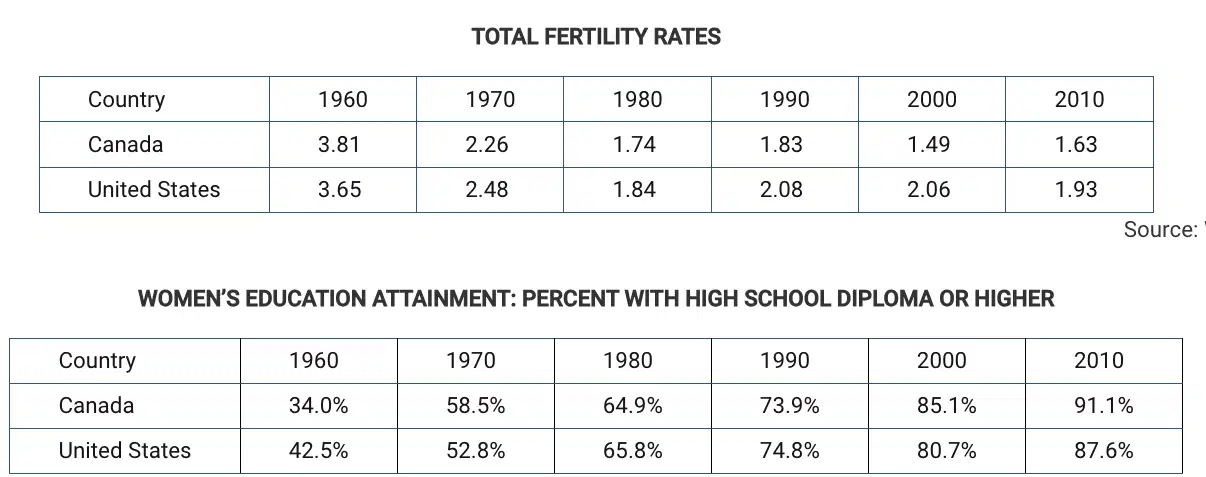
Which of the following describes the relationship between fertility and education in the United States and Canada in recent decades?
The decrease in the percent of women who are more highly educated results in a larger number of children entering school.
The decrease in the percent of women who are more highly educated correlates with the decline in fertility.
The increase in the percent of women who are more highly educated correlates with the increase in fertility.
The increase in the percent of women who are more highly educated correlates with the decline in fertility.
The increase in the percent of women who are more highly educated results in a larger number of children entering school.
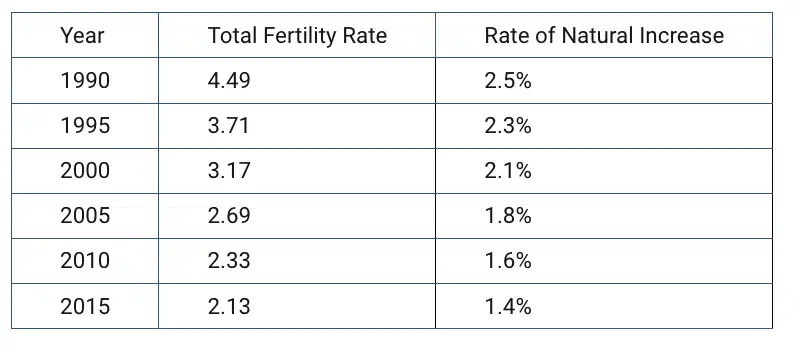
Bangladesh has seen its total fertility rate drop to 2.1, but its population is projected to be higher in 2050 than it is today. Which of the following explains why Bangladesh will continue to experience positive rates of natural increase?
Bangladesh will continue to grow because it will receive a high number of immigrants.
Bangladesh was experiencing low birth rates, but it is predicted to have a baby boom.
Bangladesh’s population will continue to grow as a result of a large youthful population.
Bangladesh will promote pronatalist policies to avoid a diminished workforce.
Bangladesh will continue to grow because a fertility rate of 2.1 is still above replacement level.
Which of the following explains an impact of open-border policies regarding migration within the European Union?
Increased free trade within Europe based on elimination of tariffs, due to the need for economic cooperation between member states
Greater cultural unity within Europe as it becomes a melting pot, due to the use of a common currency
Growing political tensions as immigration increases, due to competition between immigrants and local people for available jobs
Greater restrictions on travel within European Union countries, due to the need for internal security
Less environmental pollution as a result of stricter regulations, due to member states agreeing on a common air-quality policy
From 2010 through 2017 there was a large increase in the number of migrants from Africa to Europe. Which of the following explains a possible impact on the emigrant countries of origin during and after that time period?
Increasing emigration resulted in the governments of the countries of origin providing financial support for emigrants.
As more emigrants sent money home, the influx of money created an economic boom in the countries of origin.
Increasing emigration resulted in a decreased need for language training programs in schools to help emigrants find work.
Many emigrants became unemployed, which decreased the total financial contributions to countries of origin.
Remittances increased diffusion of cultural traits such as customs, religion, and food products from the host countries to the countries of origin.
Immigration of asylum applicants from Africa to the European Union, Norway, and Switzerland increased from approximately 50,000 in 2010 to approximately 200,000 in 2016. In 2017, there were approximately 175,000 asylum applicants. Which of the following best explains the trend in asylum seekers from African countries to Europe since 2010?
Improvement in the level of economic development in African countries led to an increase in the number of asylum seekers.
A decrease in the number of armed conflicts in African countries meant a higher number of asylum seekers traveling to Europe.
Political instability and conflict along with high fertility levels over the long term has led to an increase in asylum seekers.
Low fertility rates and more stable political systems led to an overall decrease in asylum seekers as they found more economic opportunities at home.
An influx of asylum seekers from the Middle East led to a decrease in the number of accepted asylum applications from Africa.
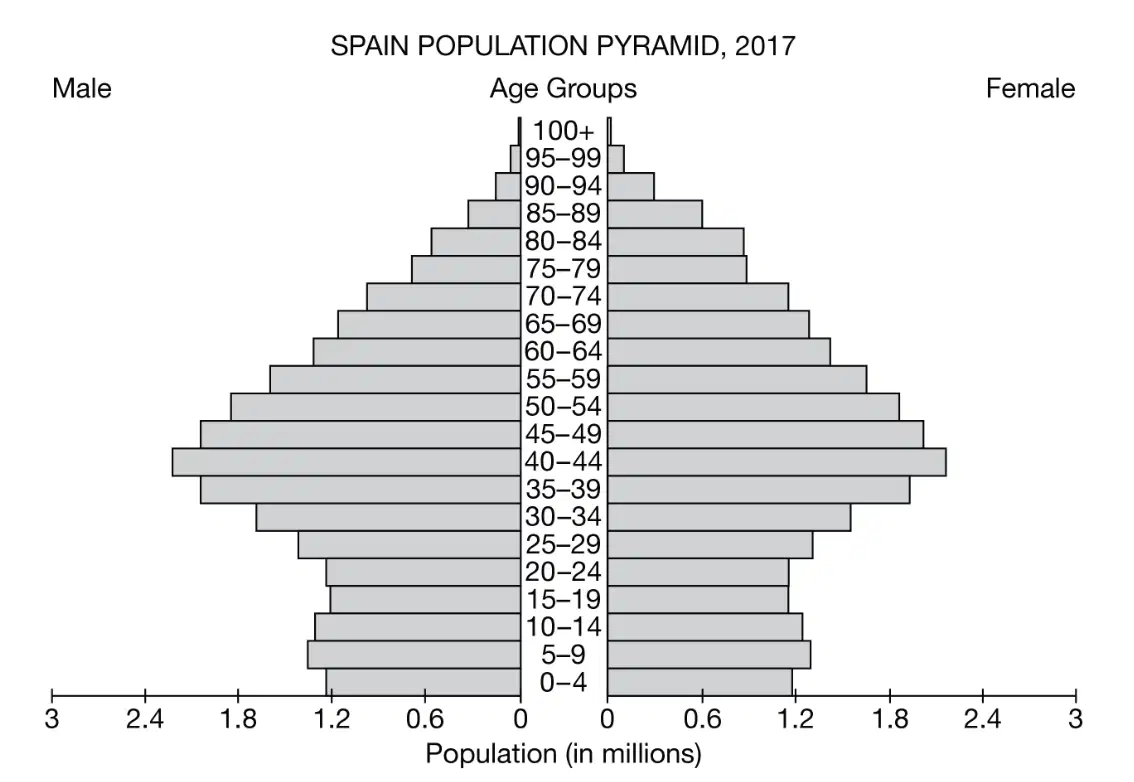
Which of the following explains how data from the population pyramid for Spain would be useful for government policy makers?
Data on the annual number of legal immigrants would be used to establish policy on international refugees.
Data on voters’ party memberships would be used to locate target audiences during political campaigns.
Data on the population of adult women would be used to plan for the numbers of children starting school.
Data on the size of the rural population would be used to set up health clinics for the elderly.
Data on the size of the middle-aged population would be used to plan for retirement and social security benefits.
In 1980 China implemented an antinatalist one-child policy. Which of the following explains an unintended consequence of the policy?
There are more women than men because of a cultural preference for female children.
There are more men than women because of a cultural preference for male children.
China’s total fertility rate dropped below the replacement rate due to strict enforcement of the law.
China’s age structure shifted toward a high youth dependency due to limiting births.
China discontinued the policy to accommodate an unexpected increase in infant mortality rates.
Malthusian theory would explain which of the following possible consequences of high birth rates in a less developed country?
Famine and starvation will occur as demand outpaces agricultural production.
Technological advancements will lead to increased agricultural production.
People will implement family-planning methods as resources grow scarce.
Areas with the greatest population density will import scarce resources.
Farmers will bring more land under cultivation to produce more food.
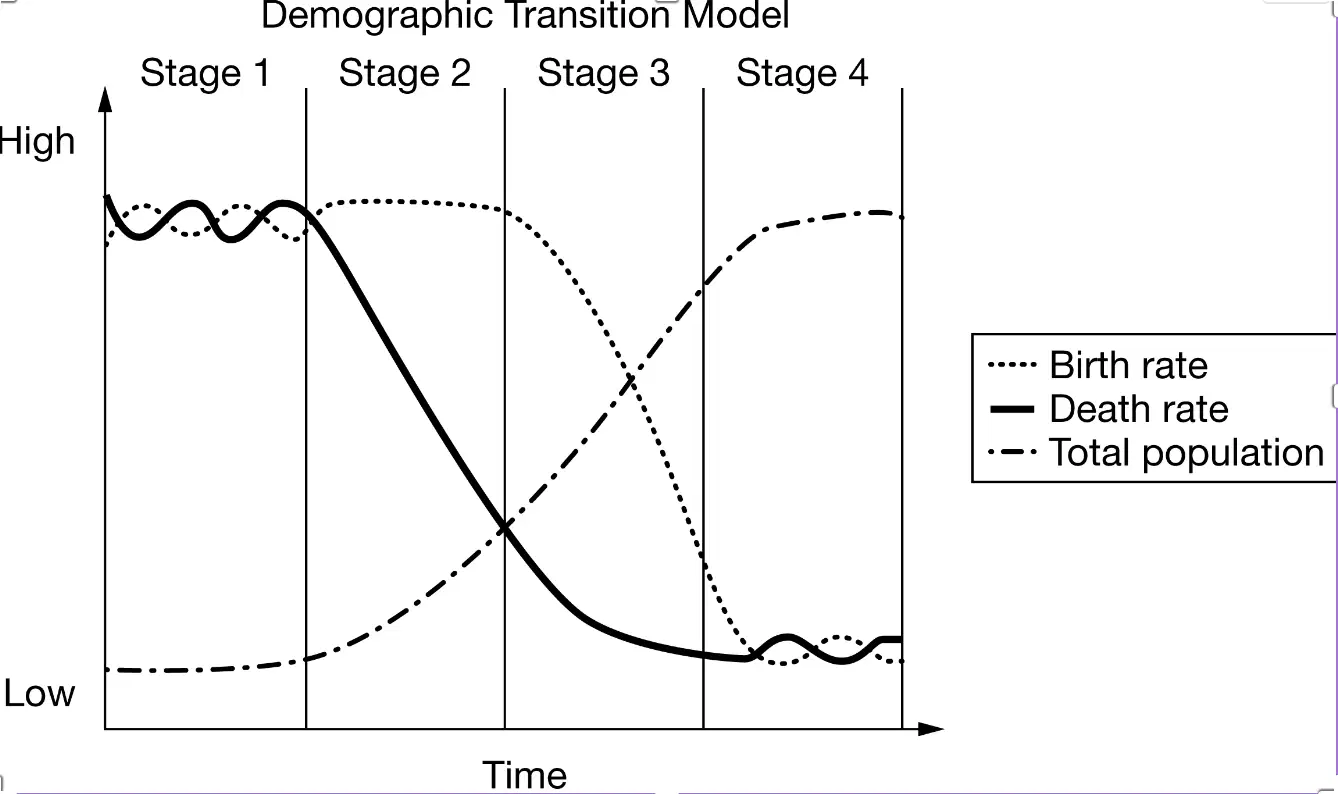
Based on the diagram of the demographic transition model, which of the following correctly describes the expected population change over time?
As birth rates remain high and death rates decrease, the total population remains stable.
As birth and death rates are high, population growth remains high.
As birth rates are higher than death rates, population growth remains high.
As birth and the death rates lower, the total population remains low.
As birth rates drop below death rates, the total population remains stable.
Many European countries provide families one or more of the following: tax credits, flexible parental leave, monthly payments, public-transportation fare reduction, free vaccines, and subsidized childcare. Which of the following would explain why a country such as Belgium would implement the described policies?
Belgium has concerns about gender equality and wants to increase female participation in the workforce.
Belgium has concerns about an aging population and wants to encourage higher birth rates.
Belgium has concerns about a large youth population and wants to encourage lower birth rates.
Belgium has concerns about the ability of immigrants from developing regions to support themselves.
Belgium has concerns about an aging population and wants to encourage lower birth rates.
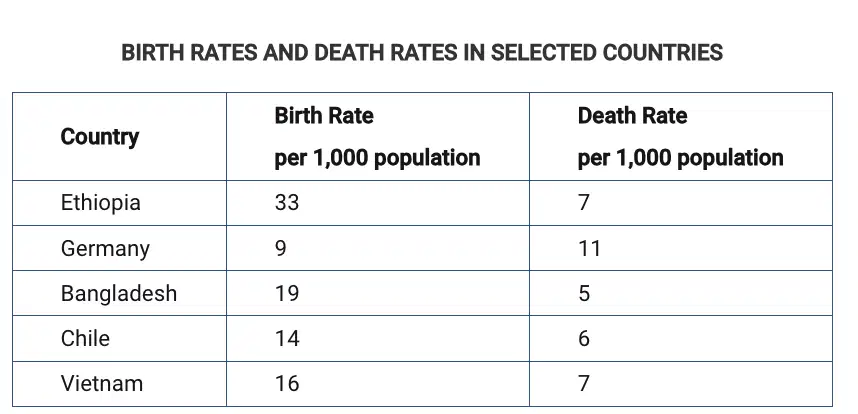
Which of the following statements accurately explains the population dynamics of a country on the table shown?
Women in Ethiopia have increased opportunities to achieve higher levels of education than women in Vietnam.
Chile has a higher rate of emigration than other countries in the table.
Males in Chile have a longer life expectancy than males in Germany.
Germany has a negative rate of natural increase.
Bangladeshi citizens have access to high-quality health care.
Which of the following scenarios explains a demographic push factor for less developed countries?
A large youth population, lacking educational opportunities, seek schooling in more developed countries.
Religious persecution and threats of violence create a refugee crisis in neighboring countries.
A working population, seeking higher wages, emigrate to more developed countries.
Drought threatening agricultural output and food supplies create a refugee crisis in neighboring countries.
An oppressive government discriminates against minorities, forcing ethnic groups to live in rural enclaves.
Which of the following describes forced migration?
Residents from New Orleans, United States, being displaced during Hurricane Katrina
Residents from Sendai, Japan, being displaced during an earthquake and related tsunami
Population movement to cities with more job opportunities created by economic recession
British convicts shipped to Australia in the mid-eighteenth to mid-nineteenth centuries
Northern Europeans moving to southern European countries for health reasons
Japan has a low birth rate and a high life expectancy. Which of the following explains why Japan will struggle with demographic challenges in 30 years?
Too many youth dependents for the education system will require increased taxes.
An aging population needing health care will require more public funding.
Too many workers for available jobs will lead to high rates of unemployment.
A rapidly increasing population will strain the country’s infrastructure.
A rapidly increasing population will strain the available food supply.
A country develops new technologies for farming, which help stabilize and increase food supply. According to Malthusian theory, which of the following would best explain those results?
The new technologies would conserve water and energy supplies.
The new technologies would reduce preventive checks on population.
The new technologies would reduce positive checks on population.
The new technologies would create a rapid decrease in population.
The new technologies would increase the need for preventative checks of population.
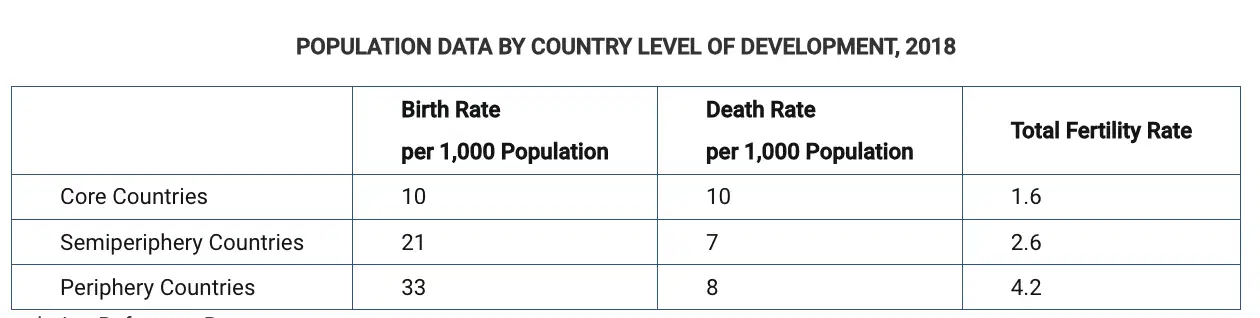
Based on the data shown in the table, which of the following accurately describes changes in the roles of women as countries develop economically?
More women work in agriculture
More women leave the workforce
More women work in professional jobs
Fewer women enroll in secondary school
Most women work in the home
A high level of mobility for international migration and employment is best explained by which of the following demographic groups?
Unmarried men in their late twenties with no children and a university education
Unmarried woman in their twenties with no children and a high school education
Married man in their forties with children and a high school education
Unmarried men in their thirties with children and a high school education
Married woman in their thirties with children and a university education
Which of the following population patterns is common in more developed countries?
High birth rates, leading to younger age structures
An uneven ratio of males to females, leading to lower total fertility rates
Higher population densities in rural areas, leading to scarcity of natural resources
A rapidly increasing working-age population, leading to high unemployment rates
Declining levels of fertility and mortality, leading to older age structures
A population pyramid that is wide at the top and narrow at the bottom most likely represents which of the following populations?
A rapidly expanding population
A stable or declining population
A population with an unusually small percentage of older females
A population of retirees
A population with a large percentage of younger male guest workers
Which of the following describes a concern for a country with an aging population?
As a country’s population ages, the life expectancy for the younger population of the country decreases and healthcare costs decline.
As a country’s population ages, the infant mortality rate decreases and there is an increased need for daycare centers.
As the proportion of older people in the country increases, fewer young workers are available to contribute tax revenues to support programs that provide services to the older population.
As the proportion of older people in the country increases, the sex ratio becomes disproportionally skewed toward males.
As the proportion of older people increases, the total population decreases because older people do not have children.
Which of the following explains an unintended consequence of China’s antinatalist one-child policy?
A dramatic reduction of the birth rate and a decline of the rate of natural increase rate, resulting in lower population growth.
Agricultural families were forced to relocate to the nearest city to search for employment, resulting in increased urban population.
A projected shortage of working-age people to care for the rising elderly population, resulting in an increase in the cost of living for older people.
Decreased spending on childhood expenses, such as education and nursery supplies results in a drop in domestic economic productivity.
A decreased emphasis on education due to the decreasing numbers of school-age children results in a loss of international competitiveness.
Country A is a more developed country with a low birth rate, a low total fertility rate, a high life expectancy, and a high percentage of urban population. Based on this information, which of the following outcomes is most likely to occur in Country A?
Guest workers from less developed countries are needed to fill the labor shortages in urban areas.
Falling birth rates and declining youth populations result in an increase in school construction in urban areas.
Pressures on pension and social security programs are at critical levels as the number of elderly increases.
Provincial and national politicians must tailor their political campaigns to appeal to rural voters.
Suburban house construction declines as elderly populations downsize and seek to be closer to urban amenities.
Which of the following country demographics would be used to explain the need for the pronatalist policies shown?
A country with a birth rate of 43, a death rate of 12, and a rate of natural increase of 3.1, passes a law that requires paid maternity leave.
A country with a birth rate of 11, a death rate of 13, and a rate of natural increase of −0.2 , legislates tax credits for working parents
A country with a birth rate of 16, a death rate of 4, and a rate of natural increase of 1.2, establishes long maternity leave periods from work
A country with a birth rate of 12, a death rate of 10, and a rate of natural increase of 0.2, requires full-day kindergarten.
A country with a birth rate of 20, a death rate of 10, and a rate of natural increase of 1.0 , provides state-subsidized day care centers.
In the nineteenth and early twentieth century, the demographic transition in Europe was best characterized by
a shift in the composition of national populations toward greater ethnic balance
a net population decline resulting from an excess of deaths over births
migration between European countries
large-scale population movements following periods of war or widespread civil unrest
urbanization and falling birth rates

Which of the following describes the most likely cause of death for a citizen of a country in stages 4 and 5 of the demographic transition model?
Infectious diseases due to poor sanitation
Degenerative diseases due to old age and lifestyle
Starvation due to an unstable food supply
Infectious diseases due to a lack of vaccines and antibiotics
Reemergence of previously eradicated diseases
Which statement best describes population growth patterns in the world today?
In the world as a whole, women have an average of five or more children, leading to Malthusian crises.
Fertility rates in low- and middle-income countries worldwide are higher now than 25 years ago.
In the world as a whole, fertility rates have fallen in the last 25 years.
In sub-Saharan Africa, South Asia, and the Pacific, fertility rates have doubled in the last 25 years.
Fertility rates in most high-income countries have risen in the last 25 years.

Which of the following best explains a likely effect of Brazil’s population distribution?
More uniform economic growth throughout the entire country as urban areas expand westward
Increased cultural unity as more people live in close proximity to one another in eastern Brazil
Uneven economic development as eastern Brazil experiences more growth than the sparsely inhabited western regions
The expansion of available farmland as people move to the cities, allowing more rural land to be farmed
More efficient political administration and improved governance as the population becomes more clustered
The nineteenth-century emigration of a large number of Swedes from a particular region of Sweden to Isanti County, Minnesota, as a result of communications from friends and relatives who preceded them there is an example of
brain drain
chain migration
net migration
internal migration
counterurbanization
Which of the following types of migration are correctly explained by the example given?
International migration and forced migration: Family A from Beijing moves to Minneapolis so that the parents can attend graduate school.
International migration and voluntary migration: Family A from Mumbai has convinced their close friends Family B to emigrate to London as they did in order help start up their business.
Internal migration and forced migration: Couple A from Berlin has convinced their close friends Couple B to move to Greece and live in the same retirement community.
Internal migration and voluntary migration: Family A from Baghdad are resettled by the United States for political asylum in Detroit.
Internally displaced persons and forced migration: Couple A from rural Brazil move to São Paulo to find better job opportunities.
A refugee enters the European Union in Italy and is temporarily housed in Germany. He is then granted asylum and is permanently settled in Sweden. Which of the following describes this type of migration that is facilitated by the European Union’s open border policies?
Chain migration within the refugee’s family and social network
Guest worker migration based upon the free movement of labor
As an internally displaced person within a single state
Step migration across member states to a final destination
As a rural-to-urban migrant seeking employment opportunities
Which of the following best explains why, in the late eighteenth and early nineteenth centuries, Thomas Malthus proposed his population theory?
Malthus theorized that, if left unchecked by regular cycles of famine and misery, population would increase beyond the ability to feed itself.
Malthus theorized that the ability of a population to feed itself would increase with the expansion of the population; more people would mean greater knowledge invested in expanding food production.
Malthus theorized that reductions of infant mortality would eventually result in slower population growth rates.
Malthus theorized that agricultural developments in the mid-to-late eighteenth century would result in a significant expansion of food production, therefore alleviating the threat of overpopulation.
Malthus theorized the only way to prevent overpopulation would be to create policies that would limit the number of children a family could have.
Which of the following explains a significant positive impact that the immigration of large populations of Chinese people had on places like Vancouver and Los Angeles?
The increase of large populations of Chinese people established Cantonese as the lingua franca, allowing immigrants and local people to communicate.
The assimilation of Chinese immigrants created stability in their new city neighborhoods, giving the immigrants political power.
Most Chinese immigrants converted to the dominant religions of their new cities, prompting the construction of many new churches.
Chinese immigrants established businesses and religious centers that provided their new cities with greater access to elements of Chinese culture such as arts, cuisine, and religion.
Chinese neighborhoods were established on the outskirts of these cities as agricultural trade centers, introducing Asian crops to North America.
Which of the following explains the major effect of migration flow to Southwest Asia from other regions in Asia?
Students migrate to attend school in the region, increasing the technology labor force.
Women and children migrate to reunify with male relatives living in the region, forming permanent urban settlements.
People with chronic illnesses travel as medical tourists to obtain medical care, growing the health care industry.
Guest workers migrate to the region for jobs in construction and the oil fields, increasing the volume of exports from the region.
Older adults migrate to areas with warmer climates after retiring from their jobs, growing the service industry.

