
Font size
 Worksheets
Epithelial, Connective Tissue Review (Histology Part 1)
Total questions: 82
Worksheet time: 49mins
True or false:
All types of connective tissue are avascular
True
False
True or false:
Bone has a matrix
True
False
True or false:
Bone has a matrix
True
False


Smooth Muscle
Columnar
Transitional
Pseudostratified columnar
vascular and innervated
avascular and innervated

How can you tell a pseudostratified columnar epithelium from a simple columnar epithelium or stratified columnar epithelium?
Look at the basal surface.
Look at the apical surface.
Check if its ciliated or not.
Look at the nuclei.

What type of epithelium?
Stratified columnar.
Simple cuboidal.
Simple columnar.
Stratified cuboidal.

What type of epithelium?
Simple columnar epithelium.
Simple squamous epithelium.
Stratified squamous epithelium
Stratified columnar epithelium.

What type of epithelium?
Non-Ciliated pseudostratified columnar epithelium.
Ciliated pseudostratified columnar epithelium.
Simple squamous epithelium
Stratified squamous epithelium.

What type of epithelium?
Simple squamous epithelium.
Simple cuboidal epithelium.
Stratified squamous epithelium.
Stratified cuboidal epithelium.

What type of epithelium?
Non-Ciliated pseudostratified columnar epithelium.
Ciliated pseudostratified columnar epithelium.
Stratified columnar epithelium.
Simple columnar epithelium.

What type of epithelium?
Stratified columnar epithelium.
Stratified cuboidal epithelium.
Simple cuboidal epithelium.
Simple columnar epithelium.

What type of epithelium?
Relaxed transitional epithelium.
Stratified columnar epithelium.
Simple columnar epithelium.
Distended transitional epithelium.
What are the 3 basic shapes of Epithelial Cells? (Select all that apply)
Cuboidal
Columnar
Orbital
Squamous
A squamous tissue is best classified by:
A thick membrane that allows slow diffusion
Fast absorption and diffusion, and making thick membranes
Fast absorption and diffusion and making this membranes
None of the above
Epithelial tissue regenerate really quickly
True
False
Not having direct blood flow is called
Vascular
Avascular
Tendonitis
Arthritis
Match the following vocabulary to the correct description.
the "filling" between the fibers and the cells
ground substance
all materials found outside of the cells
extracellular matrix
the strongest/largest/most abundant fiber
collagen fiber
this fiber is able to stretch and recoil
elastic fiber
this fiber forms a net-like scaffolding arrangement
reticular fiber
Ignore this (put "ignore this")
(a)
All types of mature connective tissue originate (arise) from embryonic connective tissue known as :
(a)
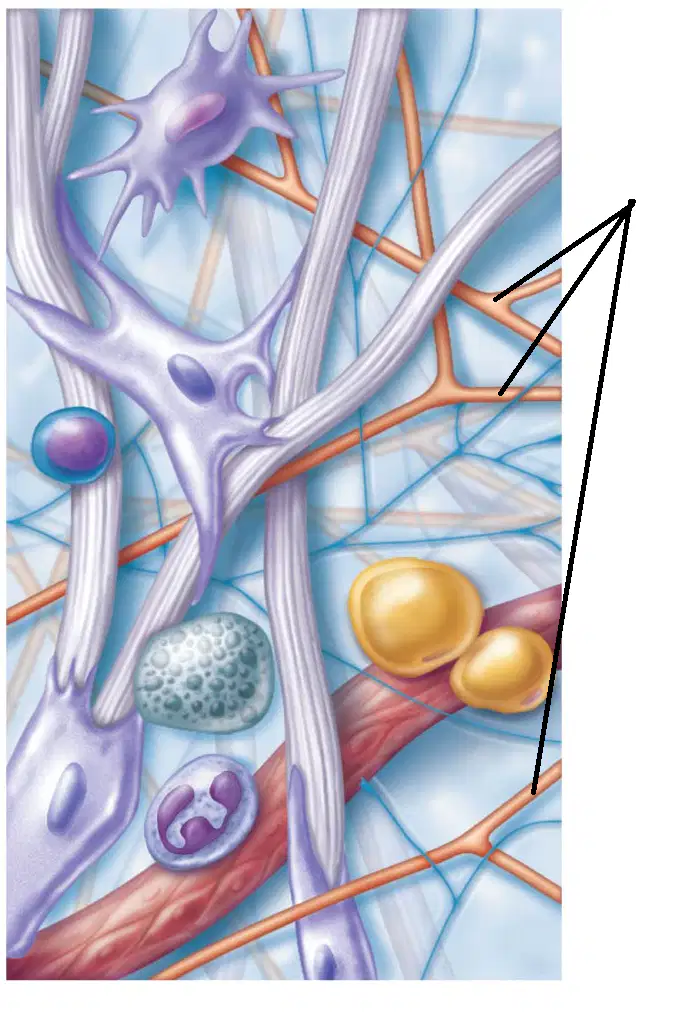
These connective tissue fibers are:
collagen fibers
reticular fibers
elastic fibers
ground substance

These connective tissue fibers are:
collagen fibers
reticular fibers
elastic fibers
ground substance
Ignore this
Ok
Ok
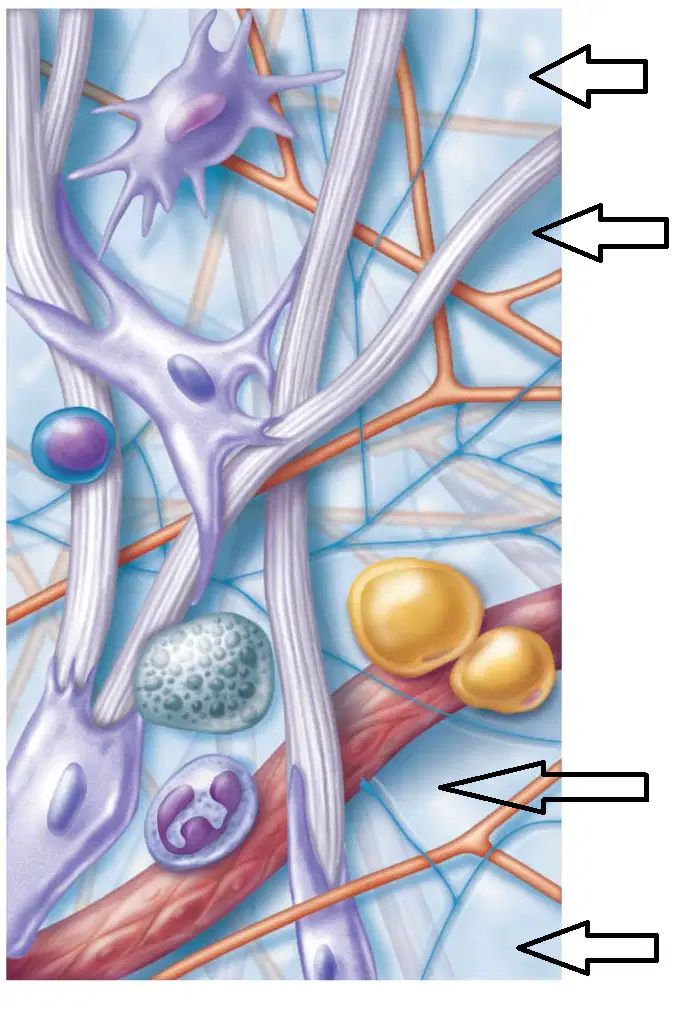
What are the arrows pointing to in this image of generalized CT?
collagen fibers
reticular fibers
elastic fibers
ground substance
extracellular matrix

What type of tissue is this?
Reticular
Vascular
Osseous
Hyaline Cartilage

What type of tissue is this?
Dense
Hyaline Cartilage
Vascular
Osseous

What type of tissue is this?
Reticular
Areolar
Dense
Adipose

What type of tissue is this?
Fibrocartilage
Dense
Adipose
Osseous

What type of tissue is this?
Adipose
Areolar
Reticular
Dense

What type of cartilage is this?
Hyaline
Fibro
Elastic

What type of cartilage is this?
Hyaline
Fibro
Elastic
Which tissue is loosely woven and absorbs fluids?
Reticular
Areolar
Adipose
Cartilage
Which tissue is the beginning of all bones?
Elastic Cartilage
Fibrocartilage
Hyaline Cartilage
Osseous
Which tissue forms your tendons and ligaments?
Osseous
Dense
Areolar
Reticular
Which tissue is found in the lymph nodes and spleen?
Areolar
Reticular
Adipose
Vascular
Which of these connects muscle to bone?
Tendon
Ligament
Aponeuroses
Which tissue is found between the vertebrae?
Hyaline Cartilage
Fibrocartilage
Elastic Cartilage
Which type of cartilage is found in the nose, ears and lips?
Hyaline Cartilage
Fibrocartilage
Elastic Cartilage
Which tissue is also known as fat tissue?
adipose
reticular
dense
areolar
What type of protein fibers are present in areolar CT?
Collagen
Reticular fibers
Elastic Fibers
All three
What cell type is present in adipose tissue?
Fibroblasts
Adipocytes.
Mesenchymal cells.
Macrophages.
Identify the adipose CT:


What cell type is present in reticular CT?
Fibroblasts
Adipocytes.
Mesenchymal cells.
Macrophages.
What is the function of reticular CT?
Binds skin and epithelia to deeper tissue.
Attach bone to bone or bone to muscle.
Withstands stress.
Provides supportive framework.
What is the function of dense regular CT?
Binds skin and epithelia to deeper tissue.
Attach bone to bone or bone to muscle.
Withstands stress.
Provides supportive framework.
What cell type is present in dense regular CT?
Fibroblasts
Adipocytes.
Mesenchymal cells.
Macrophages.
What type of protein fibers are present in dense irregular CT?
Collagen
Reticular fibers
Elastic Fibers
All three
What is the function of dense irregular CT?
Binds skin and epithelia to deeper tissue.
Attach bone to bone or bone to muscle.
Withstands stress.
Provides supportive framework.
What type of protein fibers are present in elastic CT?
Collagen
Reticular fibers
Elastic Fibers
All three
What is the function of elastic CT?
Provides supportive framework.
Allows for stretching and recoiling.
Withstands stress.
Transport
What is the cell type of hyaline cartilage?
Fibroblast
Chondrocytes
Osteocytes
Lacunae.
What is the cell type of hyaline cartilage?
Fibroblast
Chondrocytes
Osteocytes
Lacunae.
Which is hyaline cartilage?


What type of protein fibers are visible in fibrocartilage CT?
Collagen
Reticular fibers
Elastic Fibers
All three
Which is fibrocartilage CT?
Which is elastic cartilage CT?
What is the cell type of elastic cartilage CT?
Fibroblast
Chondrocytes
Osteocytes
Lacunae.
What is the cell type of bone CT?
Fibroblast
Chondrocytes
Osteocytes
Lacunae.
Which is bone CT?
What is the function of blood CT?
Provides supportive framework.
Allows for stretching and recoiling.
Withstands stress.
Transport
What are formed elements of blood CT?
Dissolved protein fibers.
Liquid nature of the ground substance.
A method of transporting nutrients.
Erythrocytes, leukocytes, and platelets.

