
Font size
 Worksheets
BIOCHEM
Total questions: 96
Worksheet time: 49mins
Which of the following will specifically increase the fluidity of the cell membrane?
Decrease in temperature
Increase the unsaturated fatty acids
Increase the saturated fatty acids
Removal of cholesterol
Transport of solute against its concentration gradient:
Primary active transport
Simple diffusion
Facilitated diffusion
Osmosis
Which of the following is NOT TRUE about glycine?
Achiral
Aliphatic
Simplest amino acid
Has and I-configuration
Acidic amino acids:
Are negatively charged at neutral pH
Are ionizable amino acids
Include glutamic acid and aspartic acid
Form H bonds
Which of the following statements differentiates simple passive diffusion from facilitated
diffusion?
Facilitated diffusion is saturable, meaning, the carriers may be fully occupied.
Facilitated diffusion is an active process.
Facilitated diffusion moves against concentration gradient.
Facilitated diffusion is not a carrier-mediated transport process.
Which of the following protein structure is resistant from denaturation?
Primary
Secondary
Tertiary
Quaternary
The organelle which has its own DNA and the site of energy-yielding oxidation reactions:
Nucleus
Golgi Apparatus
Endoplasmic Reticulum
Mitochondrion
Deficiency of Se is associated with decreased efficiency of:
Urease
Nitrate reductase
Glutathione peroxidase
Superoxide dismutase
These are enzymes that facilitate group transfer:
Oxidoreductases
Transferases
Hydrolases
Ligases
Which of the following factors can affect the rate of reaction held by enzymes?
Temperature
pH
[P] = Rate of reaction
[S]
What is the difference between active transport (AT) and facilitated diffusion (FD)?
AT requires protein carriers; FD does not.
AT requires energy; FD does not.
AT requires a concentration gradient; FD does not.
AT requires a membrane; FD does not.
A substrate has the same affinity towards enzyme A and B. However, when all other conditions are identical, a higher molar concentration of the product is seen when enzyme A is used. This means that compared to enzyme B:
Enzyme A has a higher Km
Enzyme A has a lower Km
Enzyme A has a higher Vmax
Enzyme A has a lower Vmax
What is the significance of Km?
A crude measure of the affinity between the enzyme and substrate
Tells how fast the enzyme can generate product under saturating substrate conditions
Measurement of the relationship between the enzyme concentration and substrate concentration
Measurement of the relationship between V0 and pH
The Lineweaver-Burk plot of noncompetitive inhibition shows lines that intersect on the:
X axis
Y axis
Origin
No intersection
In what cell component does fatty acid synthesis occur?
Lysosome
Smooth Endoplasmic Reticulum
Cytosol
Mitochondrion
In diagnosing patients with suspected Cu poisoning, which enzyme must be monitored?
CK
Amylase
Ceruplasmin
Lipase
Which of the following is not found in the cytoplasm?
Cytosol
Inclusions
Mitochondrion
Plasma membrane
Ketogenic amino acids may include all of the following, except:
Phenylalanine
Phenylalanine
Lysine
Asparagine
Lysine and arginine amino acids are ____.
Acidic
Neutral
Nonpolar
Basic
This amino acid is considered as a semi-essential amino acid in humans.
Lysine
Tryptophan
Lysine
Arginine
This structure of peptides refers to the order of amino acids in the polypeptide chain/s:
Primary
Secondary
Tertiary
Quaternary
A fibrous protein that is important component of arterial blood vessels and ligaments.
Keratin
Collagen
Elastin
Fibronectin
Protein present in hemoglobin has a structure known as:
Primary
Secondary
Tertiary
Quaternary
In sickle cell anemia, Glu is replaced by which amino acid?
Val
Lys
Ile
Ala
Which component is not part of a nucleotide?
A nitrogen-containing base
A monosaccharide
An amino acid
A phosphate group
Which base is found in DNA or RNA, but not both?
Uracil
Adenine
Cytosine
Guanine
Compute for the isoelectric point of lysine: pK1 = 2.2, pK2 = 9.2, pK3 = 10.8
10
6.5
5.7
10.7
Which type of RNA is a template for protein synthesis?
mRNA
tRNA
rRNA
dDNA
All amino acids found in proteins are in L configuration except:
Leucine
Thymine
Threonine
Glycine
Which does NOT correctly describe collagen?
It is a structural protein
It is the most abundant fibrous protein
It is globular in shape
It is found in all tissues and organs
Which one of the following statements concerning the peptide shown below is correct?
Val-Cys-Glu-Ser-Asp-Arg-Pro
The peptide contains asparagine.
The peptide contains a side chain with a secondary amino group.
The peptide contains a thioether side chain.
The peptide cannot form an internal disulfide bond.
What is a nucleoside?
Monosaccharide + Base
A polymer of nucleotides
monosaccharides ribose and deoxyribose
monosaccharide + a base + phosphate
Which sequence is not possible?
GAGA
TAU
TATA
TGA
What is the function of myosin in the human body?
as connective tissue found in tendons, bone, cartilage, and blood vessels
control muscle contractions
stores iron in the liver
stores oxygen in tissues
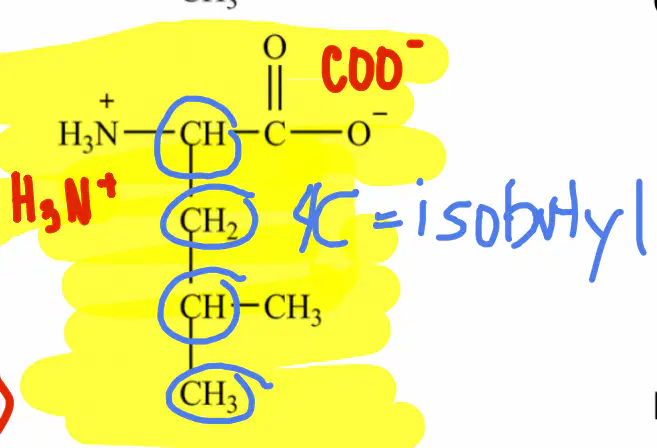
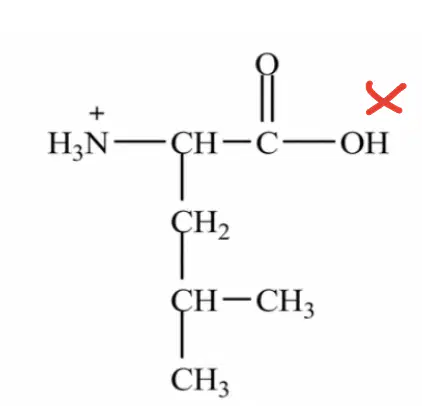
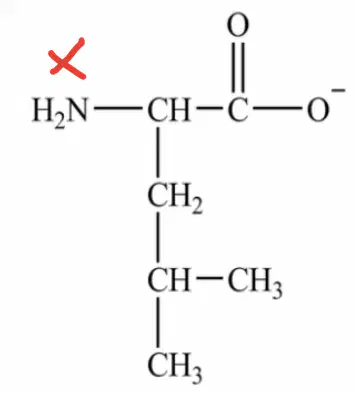
What is the structure of the amino acid leucine at pH 7.4?
Which of the following bonds provides attachment of the sugar to the N-base?
H bond
PD bond
Glycosidic bond
Peptide bond
What is the strongest type of interaction between two cysteine amino acids in a protein?
Hydrogen bonding
London dispersion forces
Disulfide bond
Electrostatic interactions
What is the process of altering the shape of a protein without breaking the amide bonds (peptide bond) that form the primary structure?
Hydrolysis
Competitive inhibition
Denaturation
Oxidation
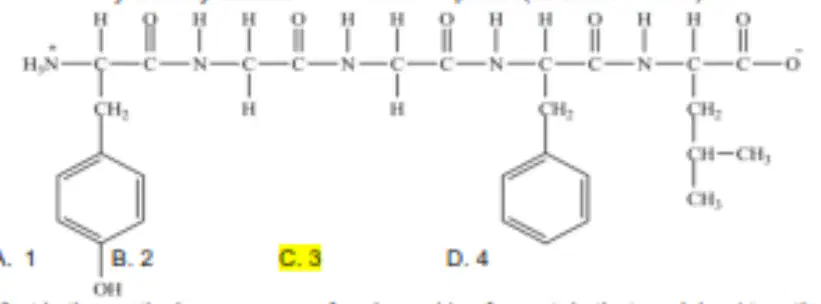
How many chirality centers are in leu-enkephalin (structure shown)?
1
2
3
4
What is the particular sequence of amino acids of a protein that are joined together by peptide bonds called?
The primary structure of a protein
The tertiary structure of a protein
The secondary structure of a protein
The quaternary structure of a protein
Evaluate the two statements:
I. Amino acid [Q] has a nonionic polar side chain.
II. It is also classified as an aliphatic amino acid with hydroxyl group.
Only statement 1 is correct
Only statement 2 is correct
Both statements are correct
Both statements are incorrect
This amino acid contains the indole functional group.
Histidine
Arginine
Tryptophan
Proline
Helical formation of helix is a characteristic of what protein structure?
primary
secondary
tertiary
quaternary
The main mode of linkage in primary protein structure is:
Hydrogen bonds
Peptide bonds
Salt bridges formation
Covalent bonds
Hydrogen atom at 2’ of the ribose ring indicates that the nucleic acid is:
RNA
DNA
ATP
ADP
Which of the following base pairs is bound by a triple bond?
Adenine and Thymine
Guanine and Thymine
Adenine and Cytosine
Cytosine and Guanine
The chromatin structure is an example of _____ structure.
Primary
Secondary
Tertiary
Quaternary
Each amino acid in the chain is called:
Carboxyl
Amino
Residue
Peptide
This is not a feature of a genetic code:
Degenerate
Unambiguous
Overlapping
Universal
These cause neurodegenerative diseases to cause improper folding of proteins:
Chaperones
Protein denaturation
Domain
Prion
Which among the following is not a characteristic of a peptide bond?
Has freedom of rotation
Side chains are free to rotate on either side
Partially double bond
Rigid and planar
5’-3’ exonuclease activity is exhibited by what type of DNA polymerase?
DNA Polymerase I
DNA Polymerase II
DNA Polymerase III
DNA Polymerase IV
Unzipping of dsDNA is catalyzed by:
Polymerase
Helicase
Topoisomerase
Ligase
Which type of mutation is expressed when a DNA sequence changes from GGA TCA CCG GAA…. to GGA TCC CGG….?
a deletion mutation
an insertion mutation
a point mutation
all of the above
A purine that substitutes for a pyrimidine and vice versa is what type of point mutation?
Transition
Transversion
Translocation
Transmission
Which of the following is the complementary RNA strand of the sequence CGATTGAC?
CAGTTAGC
GCUAACUG
TCUAACTG
GCTAACTG
The point where unwinding occurs in DNA is:
Replication fork
Replication bubble
Leading strand
Lagging strand
This is defined as the continual maintenance of active set of cellular proteins required under a given set of conditions:
Amyloidoses
Homeostasis
Proteostasis
Collagenopathies
Nascent proteins are non-functional. Native proteins are functional.
true ; false
false ; true
true ; true
false ; true
These are also known as cage-like chaperones in eukaryotes:
GroEL
Hsp70
PDI
Hsp60
In post-transcriptional modifications of mRNA, the following are observed, except:
Addition of 7-methylguanosine cap at the 3’ end
Addition of Poly(A) tail
RNA Splicing
None of the above
Agents that promote protein denaturation:
Heat
UV Radiation
Strong Cids
All of the choices
Increased levels of b-amyloid is critical in aggravating
Huntington’s Disease
Alzheimer’s Disease
b-Thalassemia
Parkinson’s Disease
Which is the sum of all of the chemical reactions that take place in an organism?
anabolism
catabolism
metabolism
citric acid cycle
Complete 3D conformation:
Primary
Secondary
Tertiary
Quaternary
The addition of a phosphate group to ADP, forming ATP is an example of what type of reaction?
hydration
hydrolysis
phosphorylation
reduction
decarboxylation
Which of the following correctly describe/s collagen?
Triple helix
In every 3rd amino acid residue, proline is observed
Gly-X-Y sequence
What is the essence of having P in the structure of collagen?
Flexibility
Integrity
Kinks
Rigidity
Which of the following cofactor/s is/are needed in the hydroxylation of proline and lysine?
Iron
Oxygen
Vitamin C
All of the above
How many reactions in the citric acid cycle generate FADH2?
0
1
2
3
This protein is found in lungs with rubber-like properties:
Hemoglobin
Myoglobin
Keratin
Elastin
A storage protein of oxygen:
Hemoglobin
Myoglobin
Keratin
Elastin
CO poisoning is caused by increased levels of:
Methemoglobin
Carboxyhemoglobin
Myoglobin
Hemoglobin
Glycolysis converts _____:
polysaccharides to glucose
glucose to pyruvate
fatty acids to thioesters
amino acids to urea
Which is not one of the three major products that are formed in glycolysis?
glucose
ATP
NADH
pyruvate
True statements concerning hemoglobin, except:
It has a hyperbolic shape in its oxygen dissociation curve
It has 4 polypeptide subunits
It is a quaternary structure type of protein
All are correct
Which process requires the coenzyme NADH?
glucose to pyruvate
pyruvate to acetaldehyde
pyruvate to lactate
pyruvate to acetyl CoA
Which factors increase the rate of gluconeogenesis?
high glycogen reserves
low carbohydrate diet
high carbohydrate diet
low oxygen concentration
Where does the electron transport chain process take place?
in the inner membrane of mitochondria
in the outer membrane of mitochondria
in the intermembrane space of mitochondria
in the matrix of mitochondria
Glucogenic amino acids _____
are converted to acetyl CoA
are converted to the thioester acetoacetyl CoA
are catabolized to pyruvate or an intermediate in the citric acid cycle
can be converted to ketone bodies
The electron transport chain (ETC) is the final common pathway by which electrons derived from the different fuels of the body flow to oxygen. Where does ETC occurs?
) Outer mitochondrial membrane
Cytosol
Golgi complex
Inner mitochondrial membrane
Which of the following is called transamination?
Conversion of amino acids to hydroxyl acids
Conversion of amino acids to keto acids
Loss of ammonia from amino acids
Formation of ammonium salts from ammonia
The energy producing reaction:
Metabolic
Catabolic
Anabolic
Amphibolic
Which one of the following statements concerning glycolysis is correct?
The conversion of glucose to lactose requires the presence of oxygen
Hexokinase is important in hepatic glucose metabolism only in the absorptive period following consumption of a carbohydrate-containing meal
Fructose 2,6-bisphosphate is a potent inhibitor of phosphofructokinase
The regulated reactions are also the irreversible reactions
It is the building block of essential fatty acids.
Malonyl CoA
Phosphoribosyl pyrophosphate
Acetyl CoA
HMG CoA
Insulin promotes the storage of fat and glucose in specialized target cells. What pancreatic cell type is responsible for secreting this hormone?
A cell
B cell
D cell
F cell
Ketogenic amino acids may include all of the following, except:
Phenylalanine
Isoleucine
Lysine
Asparagine
Which of the following biochemical pathways occur in the cytoplasm?
Decarboxylation of Pyruvate
Krebs Cycle
HMP Pathway
Fatty Acid Synthesis
The process where 6-carbon glucose molecule is split into two molecules of pyruvic acid.
glycolysis
citric acid cycle
calvin cycle
TCA
A molecule that carries energy within cells.
NADH
ATP
NADPH
glucose
Which of following is not a product of citric acid cycle?
carbon dioxide
NADH
FADH2
oxygen
If oxygen is not present, this step will happen after glycolysis.
citric acid cycle
ETC
fermentation
glycogenesis
What are the products of aerobic respiration?
Acetyl CoA and oxygen
Carbon dioxide and water
Lactic acid
Ethanol
What are the reactants in the equation for cellular respiration?
oxygen and lactic acid
carbon dioxide and water
glucose and oxygen
water and glucose
Where does the Krebs Cycle take place?
mitochondria
chloroplast
cytoplasm
nucleus
Which is the correct order of the steps of cellular respiration?
Glycolysis > Krebs cycle > ETC
Glycolysis > ETC > Krebs cycle
Krebs cycle > ETC > Glycolysis
ETC > Glycolysis > Krebs cycle

