Wayground logo

Free Printable Worksheets

Font size

S
M
L
XL
Worksheets

Unit 5: Investigating Weather, Climate, and the Water Cycle

Total questions: 35

Worksheet time: 3hrs 27mins

Name
Class
Date
1.
What is the water cycle?
a)
the 3 forms of water
b)
the movement of water on, above, or below the surface of the Earth
c)
when water melts
d)
when clouds form
2.
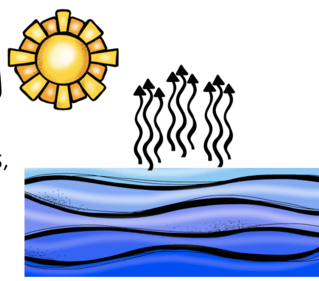
What part of the water cycle does this picture show?
a)
condensation
b)
precipitation
c)
evaporation
3.
Which of these is an example of precipitation?
a)
snow
b)
air
c)
clouds
d)
vapor
4.
Which best explains why runoff is important?
a)
It returns water to other locations on Earth
b)
It increases the chance of flooding
c)
It makes evaporation occur faster
d)
It increases condensation
5.
Snow, sleet, hail, and rain are all examples of  ________________. 
a)
evaporation
b)
condensation
c)
accumulation
d)
precipitation
6.
What follows evaporation during the water cycle? 
a)
Water evaporates into water vapor
b)
Water vapor condenses and forms a  cloud
c)
Water precipitates to the ground
d)
Water runs down into the hydrosphere
7.
What is it called when plants give off water vapor as a waste product?
a)
condensation
b)
evaporation
c)
sublimation
d)
transpiration
8.
Which of these is an example of precipitation?
a)
sleet
b)
air
c)
clouds
d)
vapor
9.
The water cycle has no start and no end.
a)
True
b)
false
10.
Water moves directly from a lake to the air by which of the following processes?
a)
Condensation
b)
Evaporation
c)
Precipitation
d)
Sedimentation
11.
Which of the following describes water changing from liquid to solid?
a)

ice forming on a lake
b)

dew forming on grass
c)
snow melting into a puddle
d)
water evaporating from a pond
12.
Most of Earth's water is found
a)
underground
b)
in lakes
c)
in oceans
d)
in rivers
13.
Evaporation happens when the sun ___________ water and turns it into vapor.
a)
cools
b)
heats up
c)
freezes
d)
lights up
14.
What does this illustration show?
a)
Sunrise
b)
The Water Cycle
c)
Sunset
d)
the recycling of snow
15.

What is the energy source for the water cycle?

a)

the sun

b)

water

c)

the Earth

d)

the moon

16.

What part of the water cycle does this picture show?

a)

condensation

b)

precipitation

c)

evaporation

17.

What part of the water cycle does this picture show?

a)

condensation

b)

precipitation

c)

evaporation

18.

How much of our planet is estimated to be covered with water?

a)

10%

b)

25%

c)

50%

d)

75%

19.

Evaporation is __________________.

a)

when water changes from a solid to a liquid

b)

when water changes from a liquid to a gas

c)

when water changes from a gas to a liquid

d)

none of the above

20.

Label A

a)

condensation

b)

precipitation

c)

evaporation

21.

Label B

a)

condensation

b)

precipitation

c)

evaporation

22.

How do the sun and ocean interact to form?

a)

A. Energy from the Sun causes water in the ocean to evaporate. Cooler air causes the water vapor to condense to form a cloud.

b)

B. The absorption of sunlight by ocean water near the surface forms a cloud.

c)

C. Heat from the Sun attracts clouds that move towards the ocean.

d)

D. Energy from the Sun causes water to become water vapor. The water vapor becomes a cloud during precipitation.

23.
Precipitation happens when clouds of water droplets are too ______________.
a)
cold
b)
light
c)
heavy
d)
hot
24.
What is the weather conditions in an area over a long period of time?
a)
climate
b)
temperature
c)
elevation
d)
precipitation
25.
Changes from minute-to-minute, hour-to-hour, day-to-day
a)
Climate
b)
Weather
26.
Texas has long, hot summers.
a)
Climate
b)
Weather
27.
Meteorologists forecast this.
a)
Climate
b)
Weather
28.
It snowed for three days last week.
a)
Climate
b)
Weather
29.
What is climate?
a)
 What's going on with the atmosphere at any particular time
b)
The type of weather that occurs during a particular season
c)
An area's pattern of weather over a long period of time
d)
How much sunshine an area gets 
30.

If a person is describing the daily changes in temperature and precipitation, they are referring to an area's ________.

a)

weather

b)

climate

c)

geography

d)

geology

31.

Students at an elementary school set up a weather station in 1985. The fifth-grade classes have been responsible for measuring and recording the daily temperature, wind speed, wind direction, precipitation, and cloud cover every year. Which characteristics of the area would students be able to describe only after 30 or more years?

a)

geology

b)

climate

c)

geography

d)

weather

32.

A student read a brochure about the Piney Woods of Texas and learned the average annual rainfall is 40-52 inches (100-150 cm) each year and the humidity is typically high. The information the student read is called

a)

a weather forecast

b)

local erosion factors

c)

regional climate data

d)

last year's weather data

33.

Tara is studying the water cycle. She knows that in order for evaporation to happen, there needs to be a source of energy that generates heat. What is the main source of energy that powers the water cycle?

a)

sun

b)

oceans

c)

clouds

d)

water vapor

34.
Condition of the air such as temperature, cloud cover, wind and rain describe
a)
climate
b)
gravity
c)
weather
35.

Which best describes climate?

a)

Summers are typically hot and dry.

b)

It rained this week.

c)

Yesterday it was cold and windy.