
 Worksheets
Chapter 5 Exam (Ionic / Covalent Bonding)
Total questions: 50
Worksheet time: 6hrs 49mins

What type of bonding does this picture show?
Ionic
Covalent

What type of bonding does this picture show?
Ionic
Covalent
Generally, atoms form bonds so that _______________.
Each atom loses its electrons
Each atom has a stable electron configuration
Each atom has an unstable electron configuration
Each atom gains electrons
Generally low melting and boiling points
Ionic compounds
Covalent compounds
Generally high melting & boiling points
Ionic compounds
Covalent compounds
Poor electrical conductivity
Ionic compounds
Covalent compounds
Conducts electricity well when melted or dissolved
Ionic compounds
Covalent compounds
MgO
Ionic bond
Covalent bond
Metallic bond
Non-metallic bond
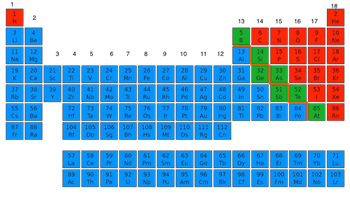
The chemical bond between a non-metal and another non-metal will be a ________ bond.
metal
ionic
covalent
polar
The chemical bond between a metal and a non-metal will be a _____ bond.
metal
ionic
covalent
polar
Carbon and Oxygen will make a ___________ bond.
ionic
covalent
metallic
NaCl
ionic
covalent
metallic
Cations have a _____________ charge.
positive
negative
neutral
Anions have a ____ charge.
positive
negative
neutral
In ionic bonding, valence electrons are _______.
shared
transferred
destroyed
In covalent bonding, valence electrons are ______.
shared
transferred
destroyed
Why do all bonds form?
filling the outermost energy level to be stable
to make all atoms the same
to make other atoms unstable
to make all atoms different
Why don't noble gases form bonds?
They all have a full octet
Noble gases do form bonds
They only bond when with eachother
none of these answers are correct

How Many Oxygen atoms?
1
2
3
4

How many total atoms?
1
2
3
4

How many Oxygen atoms?
3
6
9
12
Name the following: MgO
Magnesium Oxide
Monomagnesium monoxide
Magnesium monoxide
Magnesium (II) oxide
Name the following: CF4
Carbon fluoride
Monocarbon tetrafluoride
Carbon tetrafluoride
Carbon fluorate
Name the following: N2O5
Nitrogen oxide
Dinitrogen pentoxide
Nitrous oxide
Nitrogen pentoxide
Name the following: CuO
Copper oxide
Copper (II) oxide
Monocopper monoxide
Copper monoxide
Name the following: NH3
Nitrogen hydrogen
Nitrogen trihydrogen
Mononitrogen trihydride
Nitrogen trihydride
Name the compound: N2O5.
dinitrogen pentaoxide
binitrogen pentaoxide
nitrogen oxide
pentanitrogen dioxide
Name the compound: MgCl2
magnesium chloride
magnesium dichloride
monomagnesium chloride
manganese chloride
Name the compound: P4O8
tetraphosphorus octoxide
phosphorus oxide
tetrapotassium octoxide
potassium oxide
Name the compound: SF6
sulfur heptafluoride
sulfur hexafluoride
monosulfur hexafluoride
monosulfur heptafluoride
Name the compound: Zn3P2
zinc phosphide
trizinc diphosphide
zinc phosphate
zinc phosphite
Write the formula: iodine heptafluoride
IF7
I2F14
IHF7
IF6
Write the formula: carbon monoxide
CO
CO2
OC
C2O4
Lithium nitride
Li3N
LiN
Li3(NO3)2
LiNO3

Where are the transition metals located on the periodic table?
blue square
red square
yellow square
TRICKY!! Think of their ions first.
In the compound TiO2, Titanium has a charge of
+4
+3
+2
+1
What is the formula for tin(IV) bromide?
(a)

What is the correct name for this compound?
fluorine chlorine
iron chloride
iron(II) chloride
iron(I) chloride

What is the correct name for this formula?
lead(IV) iodide
lead iodide
lead iodine
lead(I) iodide

