
 Worksheets
Science Quiz
Total questions: 122
Worksheet time: 5hrs 38mins
Matter is anything that –
does not take up space.
changes color.
has mass and takes up space.
floats in water.
If the mass of a rock is greater than the mass of a cotton ball, the rock has –
less matter
more matter
less volume
more volume
A student wants to collect 20 milliliters (mL) of water from a forest stream so she can observe the tiny organisms that live in the water. Which would be the best tool for measuring exactly 20 mL of water?


The texture of a dog’s fur describes how it –
smells
feels
looks
tastes
A balance would be the best tool for measuring which of the following?
the texture of soil
the length of a stick
the mass of a rock
the color of a leaf

Which state of matter is shown by model B?
solid
liquid
gas
Characteristics of matter used to identify a substance.
matter
properties
measurement
Anything that takes up space and has mass
matter
shape
texture
property
The amount of matter in a solid, liquid, or gas
density
texture
mass
volume
The amount of space matter takes up
density
texture
mass
volume
How easily a substance dissolves in a liquid describes the property of
density
solubility
volume
color
How easily light bounces off a substance is
thermal conductivity
magnetism
reflectivity
electric conductivity
The ability of a substance to conduct heat
reflectivity
magnetism
thermal conductivity
electric conductivity
A property of substances made of iron or steel is
reflectivity
magnetism
electric conductivity
texture
Physical properties are observable and ________.
changeable
moveable
measurable
An electric conductor allows electricity to flow through it freely.
true
false
Which of the following could be classified as a substance that has the physical property of magnetism?
aluminum
iron
wood
plastic
Which property determines whether one substance will sink or float in another substance?
texture
density
volume
temperature
At room temperature helium does not have a definite shape or volume. Which state is it in?
solid
liquid
gas
plasma
Elise wants to classify matter based on a physical property. She uses a triple beam balance. What property is she measuring?
volume
density
magnetism
mass
Which type of matter is classified as a conductor of thermal energy?
metal
wood
cotton
plastic
CJ wanted to compare the strength of three different magnets. Which procedure would allow CJ to
classify the magnets according to their magnetic strength?
measure the density of each of the magnets
observe how many paper clips each magnet will attract
test to see how well thermal energy moves through each magnet
investigate whether each of the magnets sinks or floats in water
A company collects cans to recycle. Some cans are made
of aluminum, and others are made of
steel. What physical property could be used to separate and classify the different types of cans?
size
shape
magnetism
solubility
Salt dissolves in water. This is an example of
texture
density
solubility
color
_______ are materials that stop or slow the flow of energy.
conductors
insulators
properties
molecules
Sand is soluble in water.
true
false
How do you know if a substance is not soluble in water?
It will not dissolve
It dissolves quickly
It creates a new substance
Which of the following properties best describes a paperclip?
Silver, soluble in water, conductor of electricity
Silver, magnetic, insulator
Silver, nonmagnetic, insulator
Silver, magnetic, conductor of electricity
What property can be investigated by exposing different materials to heat?
shape
thermal conductivity
electric conductivity
magnetism
What property do a steel screw, an iron nail, and a paperclip have in common?
nonmagnetic
soluble in water
magnetic
insulators
Students are investigating a group of objects. They want to know which objects can conduct electricity. What do the students need for their investigation?
An energy source and a circuit
A circuit and a magnet
A heat source and a magnet
Which term names the type of matter made of one kind of atom?
solid
compound
molecule
element
Which one of the following is a compound?
NaCl
O2
Hydrogen
He2

Two oxygen atoms bond together, which vocabulary word best describes this type of matter?
molecule
compound
element
atom

H2O is most accurately described as a ___________________.
molecule
compound
element
atom
Is this a molecule, compound or both?
O2
Molecule
Compound
Both
What is being described here:
Any two or more elements joined together.
Molecule
Compound
Both
Is this a molecule, compound or both?
O2
Molecule
Compound
Both
What is being described here:
Any two or more elements joined together.
Molecule
Compound
Both
What is being described here:
Any two or more different elements joined together.
Molecule
Compound
Both

atom, molecule or compound?
Atom
Molecule
Compound

atom, molecule or compound?
Atom
Molecule
Compound
How many Oxygen atoms are in H2O?
1
2
0
4


How many Oxygen atoms are in water?
1
2
0
4
Which of the following cannot be broken down into something simpler?
A compound
An element
A mixture
True or False: All compounds are molecules, but NOT all molecules are compounds.
True
False
The idea that everything is made of small particles is called...
Atom
Element
Molecule
Atomic Theory
Matter is
Anything that glitters and has gold
Anything that is from space and has mass
Anything that takes up space and has mass
Anything that is important
Solubility in water is
whether matter dissolves in water
whether water is matter
amount of matter in an object
how heavy an object is in water
What is volume?
It is boiling water
When an ice cube turns to liquid
A mixture of solid and liquid
The amount of space an object takes up
What tools can you use to measure volume?
gradated cylinder, measuring cup and beaker
measuring cup, beaker and bowl
gradated cylinder, beaker and Starbucks cup
all of the above
When water is boiling, water begins to
turn into ice
dissolve
evaporate
melt
Mixture is
when you have no idea what to do
physical properties
a combination of two or more substances
a combination of two or more substances that maintain their physical properties
An example of a mixture is
trail mix
iron filings and sand
water and oil
all of the above
Solution is
a combination of two or more substances
the answer to a problem
a combination of two or more substances whose physical properties of substances may change
a combination of two or more substances whose physical properties of substances change
An example of a solution is
salt water
cola
glass cleaner
sugar water
What causes the change in the process of condensation
It goes from a gas to a liquid due to cooling
It goes from liquid to gas due to cooling
it goes from liquid to solid due to cooling
It goes from solid to liquid due to melting
What cause the change in the process of evaporation?
It goes from gas to liquid due to cooling
It goes from liquid to gas due to heating
It goes from liquid to solid due to condensation
It goes from solid to liquid due to freezing
What are the changes in matter?
melting
freezing
boiling
evaporting
all of the above


A student drops a rock and a cork in a cup of water as shown.
The student observes that the cork floats while the rock sinks in water. What can be concluded from the observation?
The cork is more dense than the rock and water
The rock is more dense than the cork and water
The rock is more dense than the cork but less dense than the water
The cork is more dense than the water but less dense than the rock


Sammy poured oil and water into a glass and mixed the liquids. He let the liquids sit in the glass for 8 hours and the 2 liquids separated as shown in the picture.
What happened to the 2 liquids?
The oil is more dense than water, and it dissolved in the water
The oil is less dense than water, and it dissolved in the water
The oil is more dense than water and cannot dissolve in water
The oil is less dense than water and cannot dissolve in water
The following are conductors EXCEPT-


Which of these is a conductor?


Which is TRUE about an insulator?
It can be a good conductor.
It allows heat to pass through easily.
It slows energy transfer.
It provides heat to keep materials warm.

A cook uses the ingredients listed below to prepare a meal.
Which table correctly shows the physical properties of these ingredients when placed in hot water?


Some students investigate the properties of four objects using a hand lens, a magnet, and a beaker containing water. Their observations are recorded in the table. Which statement identifies a property that could be used to classify these objects into two different groups?
Density can be used to separate objects that sink in water from objects that do not.
Magnetism can be used to separate objects that are attracted by a magnet from objects that are not.
Solubility can be used to separate objects that dissolve in water from objects that do not.
Physical state can be used to separate objects that are solids from objects that are not.
Gas has
tightly packed particles
loosely packed particles
very loosely packed particles
Color, texture, odor, size, and temperature are all
Volume
Mass
Properties of matter
Particles
An example of a mixture is
Ocean Water
Trail Mix
Lemonade
Soda
A _______________ is a mixture of two or more types of matter evenly spread out and not easily separated.
Mixture
Atoms
Matter
Solution


Which object is NOT magnetic?
NO MAGNETICO
Aluminum Can
Iron Nail
Steel Bolt
Nickel coin
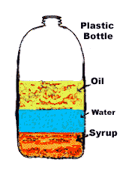
Which liquid is the least dense?
MENOS DENSO
oil
water
syrup
plastic bottle
Which of these tables correctly identifies the solubility of each substance in water?


A great conductor of energy is:
wood
plastic
metal
cloth
What is NOT an example of an insulator in the kitchen?
An oven mitt
Pots and pans
A wooden spoon
A plastic measuring cup
The handle of a frying pan is often coated in rubber because rubber provides...
Heat insulation
Heat conduction
A low melting point
A nonstick surface
Rusting is a _________ change.
Physical
Static
Chemical
Thermal
What can you do to a cake batter to cause a chemical change?
Mix it
Cool it
heat it
Freeze it
Mass, volume, and density are physical properties of:
matter
Motion
Temperature
Energy
What is a solid?
A substance that does not have a definite shape or volume
A substance with a definite volume but not definite shape
A substance whose particles glide past each other
A substance with definite shape and volume
Glass breaking is an example of a:
Physical change
chemical change
Volume is the measure of how much space an object takes up
True
False
Only a physical change can be reversed
True
False
Is baking a up cake a chemical or physical change?
Physical
Chemical
A _____________ is a change that does not result in a new substance.
Chemical change
Positive change
Physical change
Neutral
In which does a physical change occur?
Cookies baking in the oven
Water freezes into ice
Rusting is a chemical process meaning the process is ________ to reverse.
Easy
Simple
Difficult
Physical
Hammering wood together to make a playhouse is an example of a:
Chemical change
Physical change
Changing the shape of a substance is an example of a __________
Physical change
Chemical change
Color change
Major change
When ice melts into water it goes through a chemical change
True
False
Which states of matter have a definite volume?
Solid and gas
Solid and liquid
Gas and liquid
All of them
Which are signs of a chemical change?
color change, temperature change, burning, emitting light
staying the same size but not shape
keeping the same mass
changing the appearance
Matter is
Anything that glitters and has gold
Anything that is from space and has mass
Anything that takes up space and has mass
Anything that is important
What causes the change in the process of freezing?
It breaks due to rust
It dissolves due to baking soda and vinegar
It goes from liquid to solid due to cooling
It goes from liquid to solid to heating

