
 Worksheets
EOY Science 1
Total questions: 121
Worksheet time: 1hrs 29mins
Why don't we see a lot of stars in the daytime?
They are covered up by the clouds.
They are very far away from earth.
The sun blocks out the other stars.
The sun's brightness overwhelms the brightness of the stars.
Why is the sun up sometimes but not other times?
The sun sets every day.
Earth spins once per day.
The clouds cover the sun.
The sun spins once per day.
Why do we see differen stars and different times of year?
Earth is in different places in orbit during the year.
Certain stars only come out during different seasons.
No one wants to look at the stars during the winter.
Earth spins once per day.
How does Earth move?
Earth only spins.
Earth goes in orbit around the sun.
Earth spins each day and orbits the sun each year.
Earth doesn't move.
What is the effect of Earth's acis tilted at 24 degrees as it rotates?
It causes gravity.
It causes weather and gives us our changes in seasons.
It provides us with more sunlight.
It helps plants to grow.
How do different stars appears as we see them from Earth?
The farther away the stars are from Earth the brighter they appear.
The closer to Earth the stars are, the smaller they appear.
The closer to Earth the stars are, the larger they appear.
All stars look bright no matter how close or far they are to Earth.
If Earth spins, why don't we fall off?
The atmosphere holds us in.
Earth spins very slowly.
Gravity pulls on all objects.
Earth spins so fast, that the forces hold us in.
Which way is up and which way is down?
Down is always toward Earth because of Earth's pull due to the force of gravity. Up is always the opposite direction from the ground, away from Earth.
Down is always the opposite direction of up.
It depends on where you are.
Down is always away from Earth because of Earth's pull due to the force of gravity. Down is always the opposite direction from the ground, away from Earth.
TRUE or FALSE Stars are all around Earth and in every direction.
TRUE
FALSE
TRUE or FALSE Stars are like the sun, except they are very tiny.
TRUE
FALSE
TRUE or FALSE The sun seems brighter because it is bigger than other stars.
TRUE
FALSE
TRUE or FALSE We only see most stars at night because the sun is too bright in the daytime.
TRUE
FALSE
TRUE or FALSE Earth pulls objects down toward the ground with the force of gravity, so up is away from the ground, anywhere on Earth.
TRUE
FALSE
Stars are very ________________ Earth in every direction.
close to
far away from
quickly moving towards
The sun looks bigger and brighter because it is much _________________ than other stars.
larger
smaller
closer to Earth
older
The (a) is the only star in our solar system. Other stars are far outside our solar system.
The (a) is the only star we can see in the daytime because it looks so bright.
How many times does Earth spin on its axis each day?
once
twice
three times
four times
When do we face towards the sun?
daytime
nighttime
When do we face away from the sun?
daytime
nighttime
The force of gravity pulls things down. How could you describe down?
away from Earth
towards Earth
towards the South Pole
Towards the North Pole
The force of gravity pulls things down. How could you describe up?
away from Earth
towards Earth
towards the South Pole
Towards the North Pole
Throughout the year, we see different stars. If I see Orion in January of 2021, will I see Orion in January of 2025?
yes
no
Throughout the year, we see different stars. If I see Orion in January of 2021, will I see Orion in July of 2025?
yes
no
Earth (a) the sun at the same time as it spins.
What determines the stars we see in the night sky?
if we are facing towards or away from the sun
Earth's position in its yearly orbit
which part of the sky the stars are in
Why don't we see a lot of stars in the daytime?
They are covered up by the clouds.
They are very far away from earth.
The sun blocks out the other stars.
The sun's brightness overwhelms the brightness of the stars.
Why do we see differen stars and different times of year?
Earth is in different places in orbit during the year.
Certain stars only come out during different seasons.
No one wants to look at the stars during the winter.
Earth spins once per day.
How does Earth move?
Earth only spins.
Earth goes in orbit around the sun.
Earth spins each day and orbits the sun each year.
Earth doesn't move.
What is the effect of Earth's acis tilted at 24 degrees as it rotates?
It causes gravity.
It causes weather and gives us our changes in seasons.
It provides us with more sunlight.
It helps plants to grow.
How do different stars appears as we see them from Earth?
The farther away the stars are from Earth the brighter they appear.
The closer to Earth the stars are, the smaller they appear.
The closer to Earth the stars are, the larger they appear.
All stars look bright no matter how close or far they are to Earth.
If Earth spins, why don't we fall off?
The atmosphere holds us in.
Earth spins very slowly.
Gravity pulls on all objects.
Earth spins so fast, that the forces hold us in.
Which way is up and which way is down?
Down is always toward Earth because of Earth's pull due to the force of gravity. Up is always the opposite direction from the ground, away from Earth.
Down is always the opposite direction of up.
It depends on where you are.
Down is always away from Earth because of Earth's pull due to the force of gravity. Down is always the opposite direction from the ground, away from Earth.

Define: ORBIT
an attempt to find out about something
something we observe to be similar over and over again
to move in a regular path around something

Define: YEAR
a period of time that is 24 hours long and includes daytime and nighttime
the length of time it takes for Earth to orbit the sun once
the only star in our solar system
How long does it take for the Earth to orbit around the sun?
1 year
24 hours
6 months
How long does it take the Earth to spin on its axis?
12 hours
24 hours
1 year

An arrangement of stars as seen from Earth is a...
sun
star
constellation
Stars are very ________________ Earth in every direction.
close to
far away from
quickly moving towards
The sun looks bigger and brighter because it is much _________________ than other stars.
larger
smaller
closer to Earth
older
How many times does Earth spin on its axis each day?
once
twice
three times
four times
When do we face towards the sun?
daytime
nighttime
When do we face away from the sun?
daytime
nighttime
The force of gravity pulls things down. How could you describe down?
away from Earth
towards Earth
towards the South Pole
Towards the North Pole
The force of gravity pulls things down. How could you describe up?
away from Earth
towards Earth
towards the South Pole
Towards the North Pole
What determines the stars we see in the night sky?
if we are facing towards or away from the sun
Earth's position in its yearly orbit
which part of the sky the stars are in
What is a scientist who studies stars, planets, and other objects the universe, but not on Earth?
astronomer
astrologist
anthropologist
archaeologist
What is a solar system?
The sun
the planets that orbit the sun
other objects that orbit the sun
all of the above
What is a constellation?
an arrangement of stars as seen from Earth
an arrangement of galaxies
an arrangement of plantes
an arrangement of molecules
What is a pattern?
something that is opposite of another item
something that happens only two times
something that happens one time
something we observe to be similar over and over again
Because the sun looks so bright,
it burns the surface of Earth.
people must wear sunglasses all the time.
it is the only star we see in the daytime.
it helps us see the other stars better.
Why do we not always see the same stars in the same spot in the sky?
the stars move during the day
the Earth orbits around the sun
the Earth spins causing day and night
the stars like to play hide and seek
L1: An engineer is a person who uses ________ knowledge to design something in order to solve a problem.
scientific
solve
food
problem
L2: Almost all of the worlds water is (a) water. The limited amount of fresh water is mostly in (b) and ground water.
L3: A supply of something that is useful is called a (a)
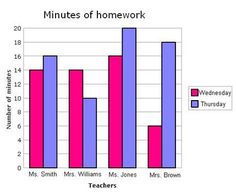
L3: Which day had more minutes of homework?

L3: What happened on Thursday?
Cookie sales went up
Cookie sales went down
Cookie sales stayed the same
6 boxes were sold
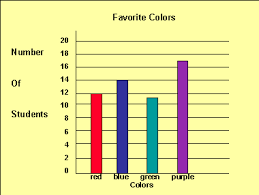
L3: How many students' favorite color is blue?
L4: The amount of available freshwater _______ when people use more than the amount that flows into the area.
increases
decreases
disappears
dissolves
L4: In the Earth system, people and living things are part of the (a)
L4: The Earth system that consists of all the liquid and frozen water is the (a)
L6: The Earth system that is made up of all the air that surrounds Earth is called the (a)
L6: When a gas turns into a liquid, this is called __________.
gas
condensation
precipitation
perspiration
L7- A group of atoms joined together in a particular way is called a...
substance
molecule
atmosphere
resource
L7- water molecules are (a) in water vapor. water molecules are (b) in liquid water.
L7- Rain drops can form when enough water vapor gets ______ and condenses into liquid water.
cold
warm
fast
vapor
L8- Evaporation is when a (a) turns into a (b) .
L8- Water vapor in the (a) comes from liquid water that has evaporated.
L9- True or false: We could be drinking water molecules from Cleopatra's tear.
True
False
L10- True or false: When water changes from gas to liquid or from liquid to gas, water molecules are NOT created or destroyed.
True
False
L10- True or false: When water changes from gas to liquid or from liquid to gas, water molecules are created and destroyed.
True
False
L10- A group of (a) that works together, is called a system.
L11: something new made to solve a problem is called a(n)
design
conservation
condense
property
L13: When water vapor gets ________ to condenses into liquid water.
warmer
colder
smaller
moves
L14: Water vapor (a) as it moves (b) , to where the atmosphere is colder.
L14: When the wind blows towards a mountain, the mountain can direct the wind _______, moving water vapor higher into the atmosphere.
upward
downward
through
between
L16: Match the following
The part of the Earth system that is solid.
geosphere
The part of the Earth system that is made up of all the water on Earth.
hydrosphere
The part of the Earth system that includes all living things.
biosphere
The part of the Earth system that includes all the gasses around the Earth.
Atmosphere.

The Great Blue Heron is a carnivorous bird that can be found in Louisiana’s wetlands. They are expert fishers. Herons trap their prey by walking slowly or standing still for long periods of time. They wait for fish to come within range of their long necks and blade-like bills. Their diets also consist of mice, insects, and other small creatures. The Great Blue Heron depends on the living components of its ecosystem and nonliving components like sunlight and air for growth and survival.
Each organism in the pond ecosystem needs food. Choose the model that best represents how energy flows through the pond ecosystem.
Sun → Rushes → Insect → Small Fish → Heron
Rushes → Insect → Small Fish → Large Fish → Heron
Rushes ← Insect ← Small Fish ← Large Fish ← Heron
Sun ← Insect ← Large Fish ← Heron ← Bacteria
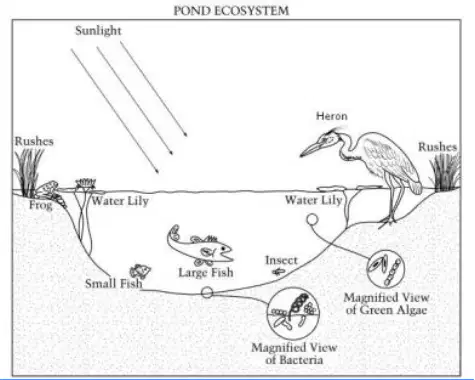
Which statement best explains the model? (Look at the picture)
All food can eventually be traced back to plants. Plants in the pond ecosystem captured energy from the sun.
All food can eventually be traced back to soil. The soil provides plants the energy for the pond ecosystem.
All food can eventually be traced back to dead organisms. Dead organisms in the pond ecosystem provide plants and animals with energy.
All food can eventually be traced back to the sun. Energy from the sun shines on the earth and is captured by plants and animals.
The Australian ecosystem has open spaces with hills covered with plants, such as grass and trees. One animal in this ecosystem is the kangaroo, which is an herbivore. Kangaroos are large marsupials found only in Australia.
British settlers began colonizing Australia in the late 1700s. In 1859, 24 European rabbits were brought to Australia to make new British settlers feel more at home. The feral, or wild rabbits which grew strong and reproduced rapidly, competed with the kangaroos for food and damaged the ecosystem.
In 1950, with approximately 600 million rabbits in Australia, scientists decided to try to lower the number of rabbits by releasing a disease into their environment. The disease killed many of the rabbits, but the dead rabbits created additional problems for the environment. Although there were many dead rabbits, eventually decomposers cleaned them up.
Which TWO ways do European rabbits and kangaroos interact with the Australian environment?
Rabbits and kangaroos obtain air and water from the environment.
Rabbits and kangaroos interact with the Australian environment by providing food for plants
Rabbits and kangaroos get energy from eating other animals.
Rabbits and kangaroos meet their needs in their environment by eating plants for food.
The Australian ecosystem has open spaces with hills covered with plants, such as grass and trees. One animal in this ecosystem is the kangaroo, which is an herbivore. Kangaroos are large marsupials found only in Australia.
British settlers began colonizing Australia in the late 1700s. In 1859, 24 European rabbits were brought to Australia to make new British settlers feel more at home. The feral, or wild rabbits which grew strong and reproduced rapidly, competed with the kangaroos for food and damaged the ecosystem.
In 1950, with approximately 600 million rabbits in Australia, scientists decided to try to lower the number of rabbits by releasing a disease into their environment. The disease killed many of the rabbits, but the dead rabbits created additional problems for the environment. Although there were many dead rabbits, eventually decomposers cleaned them up.
Which of the following would be the most likely result if the population of European rabbits in this ecosystem were to decrease dramatically?
The population of native kangaroos will stay the same.
The population of plants in the Australian landscape will increase.
Rabbits will continue to destroy the Australian landscape.
The population of native kangaroos will decrease.
How does matter move between the organisms that live in the Australian ecosystem?
The sun allows grass to grow → European rabbits graze on grass → Foxes eat European rabbits
European rabbits graze on grass → Foxes eat European rabbits → The sun allows grass to grow
Foxes eat European rabbits → The sun allows grass to grow → European rabbits graze on grass
The sun allows grass to grow → Foxes eat European rabbits → European rabbits graze on grass
Which statement best describes how the matter is transferred between decomposers and plants?
Decomposers are the top of the food chain. Matter and energy from decomposers are released into the ecosystem.
Decomposers break down organisms and return nutrients to the soil. Plants need those nutrients to survive.
Decomposers transfer matter from the air to the soil. The plants consume that matter for energy
Plants are producers. They use energy from the sun to grow.
Which statement best describes what happens to the flow of energy after a kangaroo ingests food from the Australian landscape?
The energy from the plant is returned to the sun.
The energy from the plant is transferred to the soil as the kangaroo eats.
The plant releases energy as the kangaroo eats it.
The energy from the plant is transferred to the kangaroo.
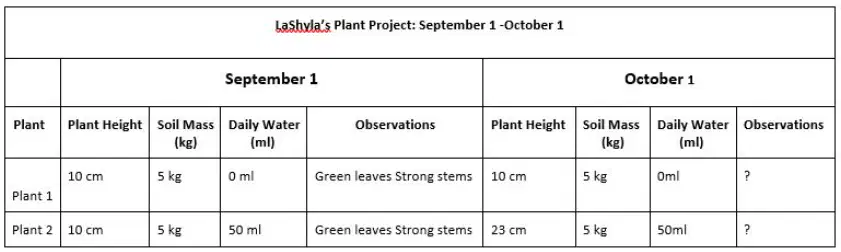
LaShyla's grandmother grows bean plants in her garden. LaShyla observes that several of the plants are not growing well. She is interested in investigating how different factors impact the growth height of the bean plants. LaShyla predicts, "Bean plants need water to grow and to survive".
To test her prediction, she conducts an experiment. She purchases two bean plants and plants them in the same section of her grandmother’s garden. Her experiment is outlined in the chart below.
Which of the following is the most likely outcome of LaShyla's plant project?
Both plants have strong, green stems and leaves.
Both plants have weak stems and brown leaves that are dying.
Plant 1 has strong, green leaves with strong stems. Plant 2 has green leaves with weak stems.
Plant 1 has weak stems with brown and yellow leaves. Plant 2 has strong, green stems and leaves.
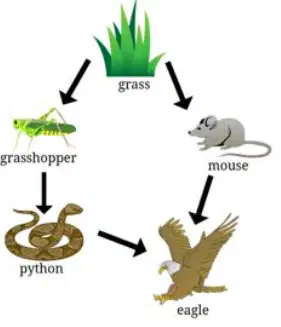
Walter researches a forest ecosystem for his science fair project. He made a model of a forest food web to explain how matter moves among organisms in the ecosystem. He studied his model and realized he could make an improvement.
How could Walter improve his forest food web model to best explain how matter cycles among organisms and the environment?
He should add the right climate to explain how the plants and animals survive in their environment.
He should add decomposers to explain how they break down dead organisms and restore some materials to the soil.
He should add a rabbit to the food chain to include more forest animals and explain how animals compete for grass.
He should add air to explain how the different organisms in the forest use the gases in the air to survive.
the use of evidence to say why one idea is the best
argument
claim
evidence
conclusion
a proposed answer to a question
argument
claim
evidence
conclusion
all the living and nonliving things in an area
environment
habitat
country
region

According to the Healthy Ecosystem Model, what happens to the grass molecules once they are eaten by the zebra?
The grass molecules turn into zebra body molecules.
The grass molecules are released as energy so the zebra can move and grow.
The grass molecules turn into zebra body molecules or are released as energy so the zebra can move and grow.
There is no change to the grass molecules.
According to the Healthy Ecosystem Model, what happens to the zebra molecules once they are eaten by the cheetah?
The zebra molecules turn into chetah body molecules.
The zebra molecules are released as energy so the chetah can move and grow.
The zebra molecules turn into cheetah body molecules or are released as energy so the cheetah can move and grow.
There is no change to the zebra molecules.
After a zebra eats grass, what happens to the grass molecules inside the zebra (use your ideas from the previous unit on chemical reactions) ?
There is a chemical reaction taking place in which the the grass molecules are turning into zebra body molecules.
There is not a chemical reaction taking place.
The zebra is made of grass molecules.
There is a chemical reaction taking place in which the the zebra molecules are turning into grass molecules.
After the chetah eats a zebra what happens to the zebra molecules inside the cheetah (use your ideas from the previous unit on chemical reactions) ?
There is a chemical reaction taking place in which the the cheetah molecules body are turning into zebra molecules.
There is not a chemical reaction taking place.
The zebra is made of grass molecules.
There is a chemical reaction taking place in which the the zebra body molecules are turning into cheetah body molecules.

a diagram that shows what eats what in an ecosystem
ecosystem
food web
environment
organism
Food molecules in an ecosystem can always be traced back to _________.
plants
matter
predators
organisms
What is the source of all energy?
the sun
plants
producers
molecules
What is the difference between a food web and a food chain?
A food web shows numerous paths plants and animals are connected.
A food chain shows the many different paths plants and animals are connected.
A food web only follows just one path as animals find food.
A food chain only follows just one path as animals find food.
What is made of matter?
everything
molecules
atoms
organisms
What is matter made out of?
molecules
organisms
plants
animals
Animals grow by ________
changing food molecules into body molecules that can build their bodies
changing body molecules into food molecules that can build their bodies
getting lots of sleep
changing atoms into molecules
What happens to food molecules in an animal's body?
Some are used to make body molecules, AND some are released as energy that helps the animal move and grow.
To make body molecules
To release energy that helps them move and grow
They disappear
All matter is made of
energy
atoms
electrons
compounds


In chromatography, the food dye separated into different colors because
the molecules shape.
the molecules weight.
the molecules size.
none of the above.
Which solids when mixed with water dissolved?
cumin and pepper
sugar and pepper
citric acid and cumin
sugar and citric acid

Which of Paul’s choices will dissolve most quickly in water?

What happened to the sugar?

What happened in the next 2 minutes?

Milk is a mixture.
Agree
Disagree

Blood is a mixture.
Agree
Disagree
A group of molecules joined together is called an atom.
Agree
Disagree

You can see a water molecule with your eyes.
Agree
Disagree

In gas chromatography, molecules separate by their
size
shape
weight
color

