
 Worksheets
LIAO 2025 SAMPLE QUIZ-GRP 2
Total questions: 120
Worksheet time: 3600secs
Which layer of the atmosphere contains most of the Earth’s weather phenomena?
Stratosphere
Troposphere
Mesosphere
Thermosphere
What is located in the middle of the Milky Way galaxy?
Black hole
Earth
Sun
Moon

What is the component of the universe that is best described as a system of stars, gases, and dust held together by gravity.
Universe
Galaxy
Solar System
Planet

What two elements mostly make up stars?
Hydrogen and Oxygen
Hydrogen and Helium
Helium and Oxygen
Hydrogen and Nitrogen

What's another name for a cosmic snowball?
Comet
Shooting star
Meteoroid
Asteroid

A light year is a measurement of
Time
Distance
Temperature
Mass

Which is not a type of galaxy?
Spiral
Elliptical
Regular
Irregular

In which list are celestial features correctly shown in order of increasing size?
solar system -- galaxy -- planet -- universe
galaxy -- solar system -- universe -- planet
universe -- galaxy -- solar system -- planet
planet -- solar system -- galaxy -- universe
The most commonly accepted scientific theory of how the universe formed.
Inflation Theory
The Big Bang Theory
The Electromagnetic Theory
The Steady State Theory

Weak radiation in space that is left over from the first stages of the Big Bang that theoretically created the universe.
Cosmic Background Radiation
Static
Singularity
Electromagnetic Radiation
States that the universe expands but did not change its density
Multiverse Theory
Steady State Theory
Atomic Universe
Primordial Universe
What are the two things opposing each other that will determine how the universe ends?
Gravity and Expansion Rate
Size and Mass
Gravity and size
Expansion and mass
Eventually, gravity will cause a closed Universe to collapse back in on itself, ending in the ________.
Big Freeze
Big Rip
Big Crunch
None of the above
In the Big Freeze scenario, the universe keeps expanding forever because of_____
Density
Critical Density
Dark matter
Dark Energy
Size of the OBSERVABLE universe
92 billion light years
13.7 billion light years
infinite
really huge
Material that does not emit any light (or not detected yet), but has a significant gravitational effect.
Gravity
Dark Matter
Dark Energy
Hubble Constant
The universe starts shrinking then crushes to an infinitesimally small space and possibly spawns a new big bang - least likely to happen end according to data currently.
Big Rip
Big Crunch
Big Freeze
Big Chill
Season changes due to
Revolution
Rotation
Revolution and tilting of Earth
Orbit
A imaginary vertical line in the middle of Earth is known as
Axis
Orbit
Season
rotation
How many types of Solstices are there?
4
2
1
3
When does Winter Solstice occur?
24 April
21/22 December
21/22 January
None of the above
The day of the year with the most daylight hours is the
Spring equinox
Fall equinox
Summer Solstice
Winter Solstice
What does "Equinox" mean?
Yearly
Something related to springtime
Equal days and nights
It's a type of tradition
________ is a giant single island of continents.
Earth
India
Pangaea
America
Over the years, the temperature of the earth cooled down.
True
False
Which model placed Earth at the center of the universe?
Heliocentric
Geocentric
Elliptical
Astronomic
Who gave improvement in the heliocentric model?
Galileo Galilei
Johannes Kepler
Nicolaus Copernicus
Aristarchus
According to the Giant Impact Hypothesis, what hit Earth to form the Moon?
A comet
Mars
A Mars-sized body called Theia
An asteroid belt
What was the first artificial satellite?
Apollo 11
Columbia
Sputnik 1
Voyager 1
Why is Earth called a giant magnet?
Because of its oceans
Due to its atmosphere
Due to its iron core and rotation
Because of gravity
How many degrees of longitude does each time zone cover?
10°
15°
30°
24°
What percent of the universe is thought to be made of dark energy?
27%
5%
68%
100%

What is motion?
A change in position.
A change in force.
A change in Time
All of the above
For us humans, what is our basic reference frame?
Earth
The Sun
The Universe
The Milky Way Galaxy
What is the purpose of parachutes in spacecraft landings?
To provide power
To slow down the descent
To help with navigation
To speed up the descent
What happens to astronauts' muscles in space?
They grow stronger
They weaken
They become larger
They disappear
What is the role of the sky crane during landing?
To navigate the spacecraft
To help the rover land gently
To provide power
To slow down the descent
What was the name of India’s first satellite?
What are the three types of volcanoes?
Hot, Warm, Cold
Fast, Slow, Moderate
Active, Dormant, Extinct
Big, Medium, Small
Which planet has the largest volcano in our solar system?
Mars
Venus
Earth
Jupiter
What is the largest active volcano on Earth?
Mount Everest
Mauna Loa
Vesuvius
Olympus Mons
How did Rakesh Sharma travel to space?
What's the main goal of the SETI Institute?
What is the name of first-ever space station?
How long does it take the International Space Station to orbit the earth?
90 minutes
60 minutes
6 hours
24 hours
The most widely accepted theory of the Moon formation is ____.
The Great Impact Theory
What is the Theory of General Relativity about?
Electricity
Gravity
Magnetism
Light
What is the shape of milky way galaxy?
Irregular
Oval
Spiral
Barred Spiral
What is in the center of a black hole?
A singularity
Nothing
A wormhole
All of the above
Does a black hole have a gravitational pull?
Yes
No
Which planets do not have any moons?
Pluto & Mercury
Mercury & Venus
Venus & Saturn
Mercury & Uranus

When did Pluto become a dwarf planet?
2010
2014
1806
2006
This dwarf planet is furthest from the Sun and is the second largest dwarf planet.
Eris
Ceres
Haumea
Makemake
This dwarf planet has a distinctive red color and is the 4th dwarf planet from the sun.
Eris
Ceres
Haumea
Makemake
Pluto was declassified has a planet because
It's too small.
It's not a sphere.
It hasn't cleared it's orbit of debris.
It's orbit around the Sun is so strange.
Planet named after the Roman God of sea.
Uranus
Jupiter
Neptune
Saturn
Q2. Planets do not make their own light , rather they _ light?
create
generate
reflect
form
Q6. What separates the inner planets from the outer planets?
Kiper Belt
Triton Moon
Meteor Belt
Asteroid Belt

How long does it take light from the Sun to get to Earth?
8 minutes
8 seconds
12 minutes
13 seconds
A dying star much more massive than the Sun ends its life in an explosion called a (a) .
The region around a black hole from which nothing can escape is known as the (a) .
Name both of Armstrong’s crew mates in the Apollo 11 mission to the Moon (choose 2)
Michael Collins
Richard Moore
David Craft
Edward ‘Buzz’ Aldrin
What was the name of the spacecraft that Michael Collins orbited the moon in?
Columbia
Hawk
Columbus
Eagle
What was the name of the lunar module that landed on the Moon?
Phoenix
Dragon
Eagle
Falcon
On what date did Neil Armstrong walk on the Moon?
July 20, 1969
July 21, 1969
July 19, 1969
July 18, 1969


The Polaris star is used to find which direction?
South
East
West
North

Prism
None of the above

Reflection
Refraction
Diffraction
Dispersion
The process by which stars generate energy in their cores is called the (a) .
The boundary around Earth where space officially begins is called the (a) line.
Light travels in
Zig zags
Up and Down
Straight lines
Circles
A material that allows SOME light to pass through it.
Opaque
Translucent
Transparent
Prism
A prism is an object that
Mixes light
Absorbs light
separates white light into bands of colored light
Diffracts Light
What gives clean air and removes carbon dioxide?
Lower Torso Assembly
Arm and Glove Assembly
Helmet
Portable Life Support System
What shows important suit information and lets astronauts control systems?
Gloves
Liquid Cooling and Ventilation Garment
Display and Control Module
Portable Life Support System
What part protects the legs and feet?
Lower Torso Assembly
Hard Upper Torso
Portable Life Support System
Display and Control Module

Small pieces broken off from Asteroid or Comets are called?
Meteors
Meteorids
Meteorites
Comets

Which of the following is NOT a part of comet?
Coma
Nucleus
Tail
Crust
The outermost layer of the Sun’s atmosphere, visible during a total solar eclipse, is called the (a) .

NASA was founded in _________ to oversee all U.S. space missions
1960
1950
1968
1958

Which planet in our solar system appears to be the brightest?
Jupiter
Mercury
Mars
Venus
Over long periods in space, muscle mass and bone density can decrease by ____ Percent.
10
15
20
25
In December ________ the first cookies were baked in space.
2017
2018
2019
2020
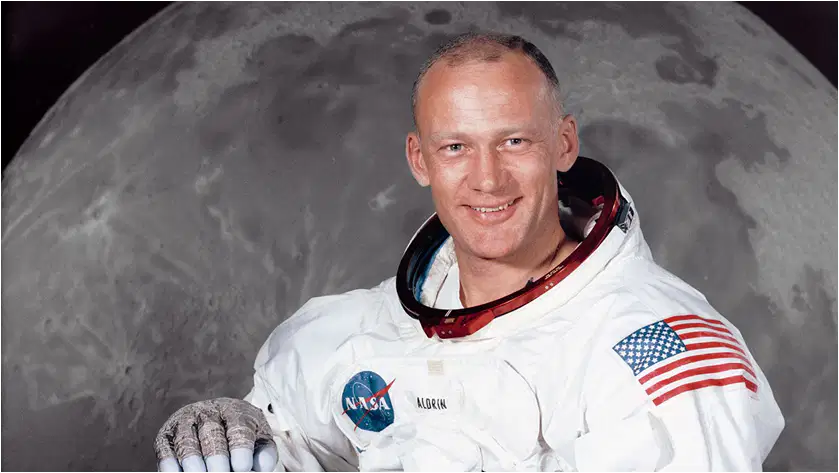
Name this Astronaut.
Neil Armstrong
Yuri Gagarin
Buzz Aldrin
None of the above
Why do astronauts experience taste changes in space?
Because of the food packaging.
Due to fluid shifts in the body.
Due to the lack of sunlight.
Because of the space suits.
Asteroid day is celebrated on the anniversary of
Tunguska event
Vredefort event
Acraman event
Manicouagan event
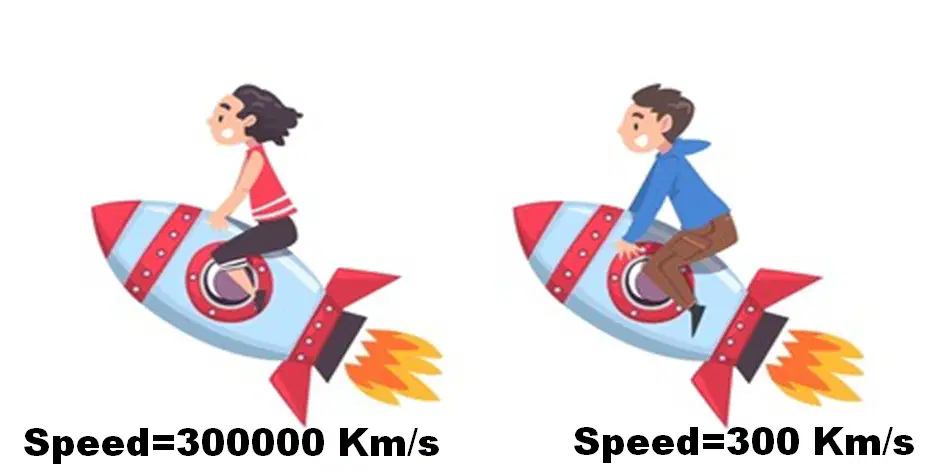
Who will appear shorter in direction of motion?
Girl
Boy
Both
Both will be of same size
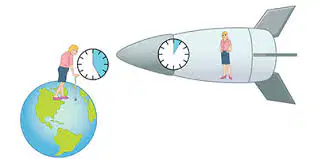
Which phenomenon is shown in the image?
Jet lag
Time Dilation
Length Contraction
None of the above
According to general theory of relativity, massive objects cause a distortion in space time network, which is felt as
Acceleration
Gravity
Speed
Velocity
The joint NASA–ISRO satellite designed to study Earth’s surface and ecosystems is called the (a) mission.
The telescope that succeeded Kepler in searching for exoplanets is called (a) telescope.
What did Voyager 2 discover about Neptune?
The fastest winds in the solar system
The largest storm
The most moons
It's color
What is the current location of Voyager 1 & Voyager 2?
In interstellar space
In the asteroid belt
Near Mars
Near Jupiter
What is the distance of Voyager 2 from Earth?
Over 12 billion miles
Over 10 billion miles
Over 15 billion miles
Over 18 billions
What was the mission budget of Aditya L1?
500 crore
850 crore
400 crore
100 crore
How many payloads does Aditya L1 have?
5
4
9
7
Who is Group Captain Shubhanshu Shukla, according to the sources?
The commander of the AXM 4 mission
The mission pilot for AXM 4
The first Indian to walk on the moon
An ISRO engineer on ground control
On what date did the Axiom 4 mission launch?
June 22, 2025
June 25, 2025
June 25, 2024
July 4, 2025
How many sunrises and sunsets did Shubhanshu Shukla experience each day while on the ISS?
One sunrise and one sunset
16 sunrises and 16 sunsets
300 sunrises and 300 sunsets
He could not see them due to orbit

Which planet in our Solar System has the most number of moons?
Earth
Mars
Saturn
Jupiter
What is the use of Artificial Satellite?
Scientific research
Communications
Weather forecasting
All of the above
Artificial satellites get their energy to work in the form of_______.
Solar energy
Wind energy
Light energy
Sound energy
Currently, there are over 2,787 active _________ satellites orbiting the Earth.
Natural
Artificial
When was SpaceX founded?
1999
2002
2010
2020
Which organization does SpaceX collaborate with?
ISRO
NASA
ESA
ROSCOSMOS
When did Falcon 1 achieve its first successful flight?
2008
2010
2012
2016
What was one of the objectives of Mangalyaan?
Study Mars' surface
Search for life
Test technology
All of the above
What was the launch date of Mangalyaan?
November 5, 2013
September 24, 2014
January 1, 2015
March 15, 2016
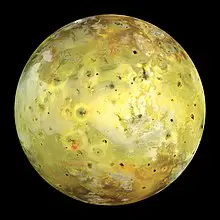
Identify the image of the moon.
Titan
Europa
Mimas
Io

