
 Worksheets
Bio1208 Final Exam Review
Total questions: 42
Worksheet time: 36mins
You are now an experienced Scientist. You have designed an experiment with several treatments. How will you determine if the treatments are significantly different or not?
(a)
You are now an experienced Scientist. You have designed an experiment with several treatments.
What is the single value used to determine which treatments are significantly different?
(a)

Identify the journal in which this article was published.
(a)
What are the two reactants required for photosynthesis to occur?
(a)
Why do the fragments of DNA in gel electrophoresis travel away from the negative electrode?
DNA is negatively charged so attracted to the positive end of the unit
DNA is positively charged attracted to the negative end of the unit
the agarose gel is negatively charged
the agarose gel is positively charged

In gel electrophoresis, where will the largest DNA fragment appear?
closest to the starting wells
farthest from the starting wells
three quarters away from the starting wells
it depends on how many fragments there are
In the standard curve equation, y=mx+b, which letter represents the absorbance value?
(a)
True or False. Is Xanthophyll a type of carotenoid pigment?
Yes, Xanthophyll is a type of carotenoid pigment
No
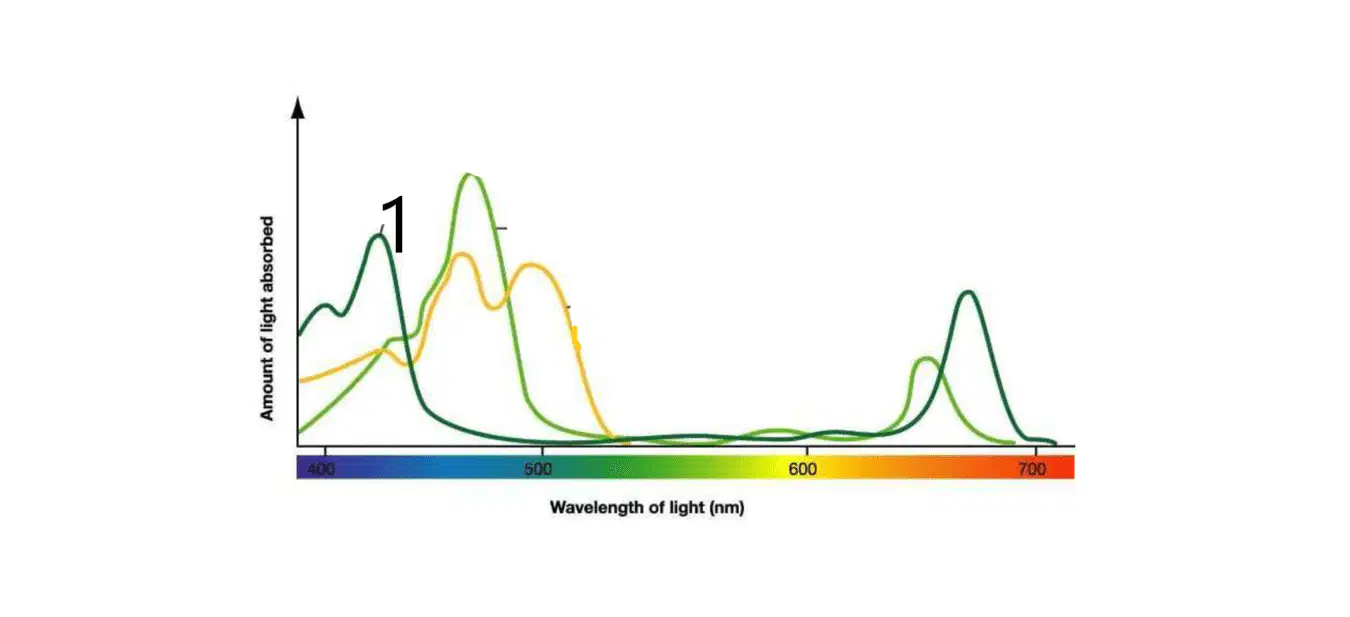
This is a graph of photosynthetic pigments.
The Y-axis represents absorbance, while the X-axis represents wavelength.
What pigment labeled as 1 is most likely to be?
Chlorophyll a
Carotenoids
This is a trick question
Chlorophyll b
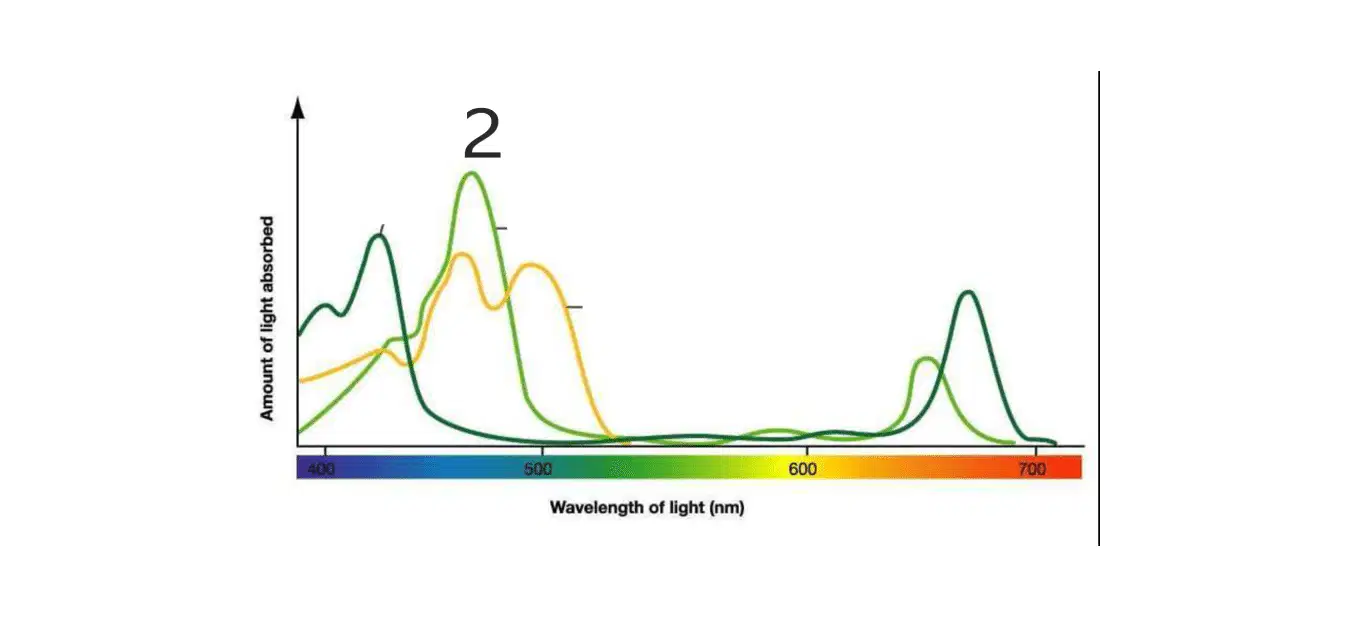
This is a graph of photosynthetic pigments.
Y-axis is absorbance, x-axis is Wavelength.
What pigment labeled as 2 is most likely to be?
Chlorophyll a
Carotenoids
This is a trick question
Chlorophyll b
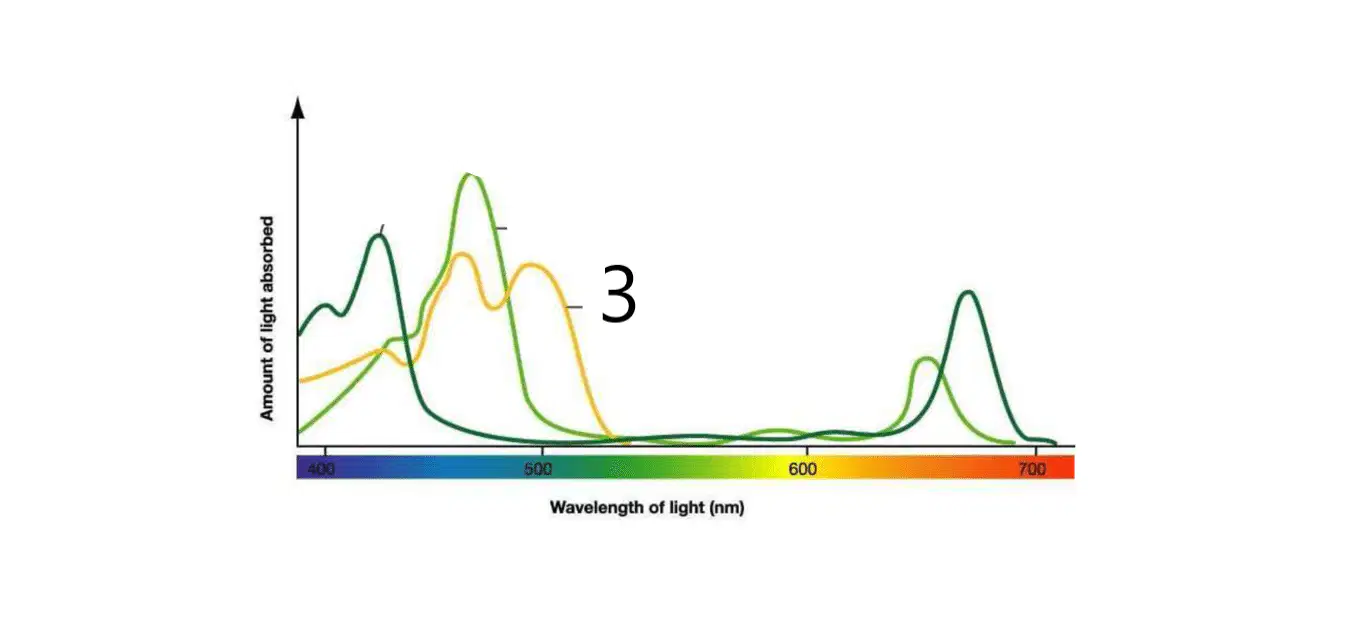
This is a graph of photosynthetic pigments.
Y-axis is absorbance, x-axis is Wavelength.
What pigment labeled as 3 is most likely to be?
Chlorophyll a
This is a trick question
Carotenoids
Chlorophyll b
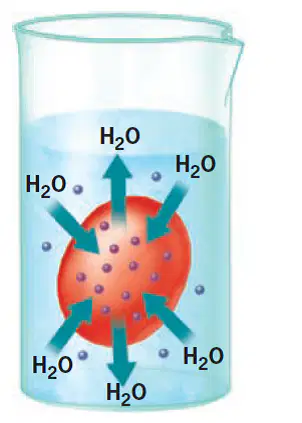
In this figure, the net water is inward a red blood cell (erythrocyte). Therefore, the cell was placed in a __________ solution
acidic
hypotonic
isotonic
hypertonic
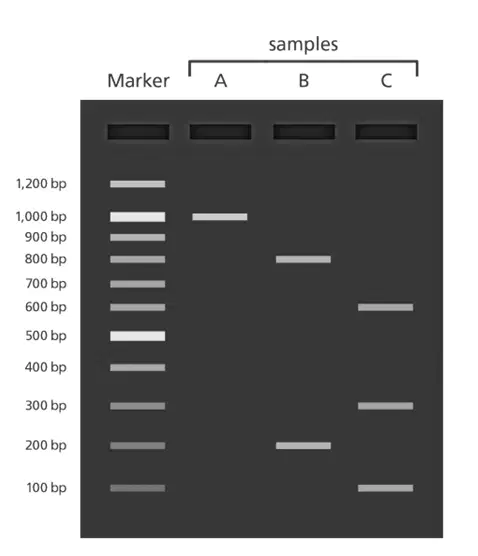
Using the DNA marker (aka Ladder) as a ruler, what is the molecular weight (size) in bp of Sample A?
Using the DNA marker (aka Ladder) as a ruler, what is the size (in bp) of the DNA band(s) of Sample B?
The size of the DNA band of Sample B is 1000 bp
The size of the DNA band(s) of Sample B is 600 and 300 bp
Cannot be determined with the information provided
The size of the DNA band(s) of Sample B is 800 bp and 200 bp
Rupture of erythrocytes is called _________
Antigens
Antibodies
Agglutination
Hemolysis
During osmosis, water moves from ____ to ____ concentration
water moves from high to low concentration
water moves from low to high concentration
water moves when energy is used
You are visiting a friend at the hospital and notice they have an IV into their veins with a distilled water (has no electrolites) solution instead of IV fluid (0.9% NaCl). Is this correct? What most likely happens to erythrocytes?
Absolutely not. Erythrocytes will Expand and hemolyse
It is not a problem as long as the patient is well hydrated
You see your little brother drinking saltwater. Is this a problem?
Yes. It's hypertonic to cells
Yes. It's hypotonic to cells
No. It's isotonic to cells
It's paratonic to cells

In this system, solute molecules in cell 2 are most likely to
remain in cell 2.
adhere to cell 2’s membrane.
diffuse into cell 1.
diffuse into cell 4.
Why do the fragments of DNA in gel electrophoresis travel away from the negative electrode?
DNA is negatively charged so attracted to the positive end of the unit
DNA is positively charged to attracted to the negative end of the unit
the agarose gel is negatively charged
the agarose gel is positively charged
In gel electrophoresis, the largest DNA fragment will appear
closest to the starting wells
farthest from the starting wells
three quarters away from the starting wells
it depends on how many fragments there are
It allows for strands of DNA to be cut into various lengths for testing

This question on DNA fingerprinting is for fun. Comparing DNA banding patter, Which male is the father of the child?
Male 1
Male 2
What is the function of the gel in Gel Electrophoresis?
extract DNA from the liquid
filter the DNA as it moves through the electrophoresis apparatus
buffer the DNA so it keeps moving
charge the DNA so it will move to the opposite side of the system

Based on the plasmid map of pBR322, what is the predicted phenotype of a transformed E.coli bacterium with this plasmid?
(a)
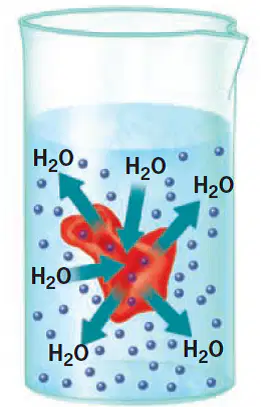
In this figure, the net water flow is outward from a red blood cell (erythrocyte). Therefore, the cell must have been placed in a (a) solution.

In which direction are water molecules in this system most likely to diffuse?
from 1 to 2
from 2 to 4
from 4 to 3
from 3 to 1

A ___ is used in astronomy to break down light like a prism.
telescope
spectroscope
stethoscope
microscope
Colorimetry is concerned with the visible region i.e. (______-______nm) of the spectrum.
400-750
300-670
550-980
350-460

What does the picture below illustrate?
Visible Light Spectrum
Electromagnetic Spectrum
Frequency Indicator
Color Line
How are we able to see the color white?
All colors except red are absorbed
All colors are absorbed
All colors are reflected
All colors except red are reflected
Of the visible spectrum, what color has the longest wavelength?
Blue
Green
Yellow
Red
Violet
A blue t-shirt appears blue because it:
Absorbs blue light
Absorbs white light
All colors but blue are being transmitted
Transmits blue light
All colors but blue are being absorbed
What was the most polar pigment in Spirulina?
(a)
From Molec Lab II, DNA bands were visible in a transluminator after excitation with UV-light. Does this mean that double-stranded DNA fluoresces by itself? Or does a DNA-binding fluorescence dye need to be used?
DNA fluoresces by itself under UV-light
SYBR Green dye specifically binds to DNA and fluoresces under UV-light
DNA cannot fluoresce by itself under UV-light
No dyes were used
Jody was infected with an ampicillin-resistant bacterium. The following antibiotics cannot be used to treat Jody:
(a)
What is the name of the enzyme responsible for the browning of vegetables?
(a)
How can the browning of vegetables be prevented or slowed down?
Keep them in water
Leave vegetables uncovered
Use acidulated water such as vinegar or lemon juice
Use browning resistant genetically engineered vegetables
Place them in the refrigerator

