
 Worksheets
Nerve cells
Total questions: 42
Worksheet time: 24mins
The long, fiber like part of a neuron which the cell sends information to receiving neurons
axon
dendrite
myelin
Node of Ranvier
The part of the neuron that receives messages from adjacent neurons
axon
axon terminal
dendrite
neuron
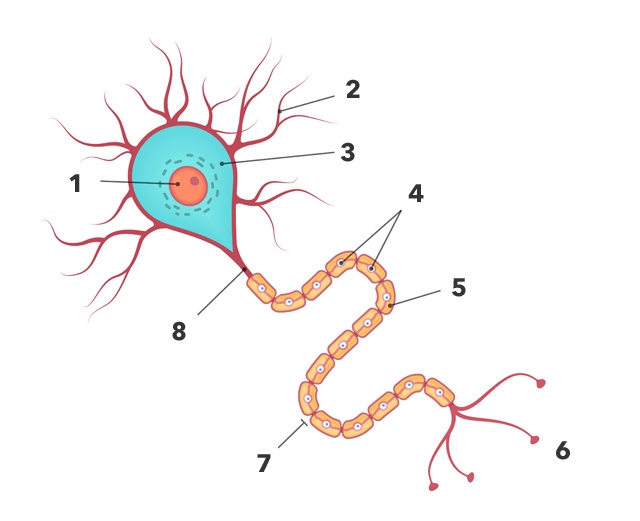
Identify #1
axon
cell body
myelin sheath
nucleus
Identify #2
axon
cell body
dendrite
myelin sheath
Identify #3
axon
cell body
dendrite
myelin sheath
Identify #6
axon terminals
dendrites
dendrite
schwann cells
Myelin, an insulating material, is found in
cell bodies
dendrites
axon terminals
Schwann cells
Gaps between Schwann cells that increase the speed of the transmission of the signal down the neuron are called
axon terminals
dendrites
myelin
nodes of Ranvier
Neuroglial cells that form the fatty myelin sheath on neurons in the CNS are ___________ in the PNS are ________________?
ganglia and oligodendroglia
astrocytes and schwann cells
schwann cells and oligodendroglia
oligodendroglia and schwann cells
Small cells that engulf and destroy microbes and cellular debris in the CNS
microglia
horns
neuroglia
astrocytes

Produce cerebrospinal fluid in the brain & spinal cord
ependymal cells
oligodendrocytes
microglia
astrocytes

Cells that form myelin sheaths on PNS
astrocytes
oligodendrocytes
microglia
Schwann cells

Which type of cell is circled?
Microglia
Astrocytes
Oligodendrocytes
Satellite cells

Which type of cell is circled?
Oligodendrocytes
Satellite cells
Astrocytes
Ependymal cells
When a neuron is at REST,
the inside of the neuron is negatively charged compared to the outside.
the inside of the neuron is positively charged compared to the outside.
there is no charge difference established
none of these is true
Depolarization occurs when
sodium channels open
potassium channels open
sodium channels close
potassium channels close

calcium is responsible for
signaling the release of the neurotransmitter
signaling Na to be released into the membrane
signaling the release of K out of the membrane
serving as the neurotransmitter
all are factors in the speed of action potential EXCEPT
diameter of the axon
the state of the myelin sheath on the axon
temperature
length of the axon
when does the stimuli cause an action potential?
when it reaches threshold
just below the threshold
just above threshold
What value is the resting potential in mV (number and sign only)?
(a)
A myelinated nerve fibre will have the ability to
conduct impulses faster
regenerate
both
During an action potential the membrane potential goes from the resting potential (typically -70 mV) to some positive value (typically about (a) ) in a very short period of time (just a few milliseconds).
The sodium potassium pump...
is energy (ATP) free as sodium and potassium move in and out by diffusion as needed
moves 3 sodium ions into the neuron and 3 potassium out only if ATP is present
moves 3 sodium in to the neuron and 2 potassium without energy from ATP
moves 3 sodium out of the neuron and 2 potassium into the neuron only if there is energy from ATP


What number(s) on the graph represents the THRESHOLD level of stimulus?
1 and 5
2
3
6

Unipolar neuron
Bipolar neuron
Multipolar neuron

Unipolar neuron
Bipolar neuron
Multipolar neuron

Unipolar neuron
Bipolar neuron
Multipolar neuron

