wayground logo

Free Printable Worksheets

NEW

Font size

S
M
L
XL
Worksheets

Q2 Study 7th Grade

Total questions: 73

Worksheet time: 1hrs 2mins

Name
Class
Date
1.

Small grain-shaped organelles that produce proteins for the cell

a)

Cytoplasm

b)

Ribosomes

c)

Lysosomes

d)

Mitochondria

2.

Rigid layer that surrounds the cell of plants and some other organisms such as fungi

a)

Cell Wall

b)

Golgi Apparatus

c)

Chloroplast

d)

Cell Membrane

3.

Large oval structure that acts as the control center of the cell, directing all of the cells’ activities

a)

Vacuole

b)

Ribosome

c)

Golgi Apparatus

d)

Nucleus

4.

Thick, clear, gel-like fluid that fills the region between the cell membrane and the nucleus

a)

Mitochondria

b)

Cytoplasm

c)

Chloroplast

d)

Nucleus

5.

Rod-shaped organelles that convert energy in food molecules to energy the cell can use to carry out its functions

a)

Mitochondria

b)

Golgi Apparatus

c)

Ribosomes

d)

Endoplasmic Reticulum

6.

An organelle that forms a maze of passageways in which proteins and other materials are carried from one part of the cell to another

a)

Cell Wall

b)

Endoplasmic Reticulum

c)

Golgi Appartus

d)

Cytoplasm

7.

Organelle in a cell that receives proteins and other newly formed materials from the endoplasmic reticulum, packages them, and distributes them to other parts of the cell

a)

Golgi Apparatus

b)

Lysosome

c)

Endoplasmic Reticulum

d)

Chloroplast

8.

Organelle in the cells of plants and some other organisms that captures energy from sunlight and changes it to an energy form that cells can use in making food

a)

Cell Wall

b)

Chloroplast

9.

Semipermeable membrane, surrounding a cell that controls what goes into and out of the cell

a)

Cell Wall

b)

Lysosome

c)

Nucleus

d)

Cell Membrane

10.

In which cell type are chloroplasts found?

a)

Animal Cell

b)

Plant Cell

c)

Both

11.

In which cell type are lysosomes found?

a)

Animal Cell

b)

Plant Cell

c)

Both

12.

In which cell type is a cell wall found?

a)

Animal Cell

b)

Plant Cell

c)

Both

13.

In which cell type is a large central vacuole found?

a)

Animal Cell

b)

Plant Cell

c)

Both

14.
Organisms who receive their energy by consuming other organisms.
a)
Chloroplast
b)
Heterotroph
c)
Autotroph
d)
Phototropism
15.
The part of a cell that contains the chromosomes (wound up DNA) in eukaryotic cells.
a)
Chloroplasts
b)
Cell Wall
c)
Nucleus
d)
Homeostasis
16.
The genetic code for all of your traits.
a)
Nucleus
b)
DNA
c)
Chloroplast
d)
Recessive gene
17.
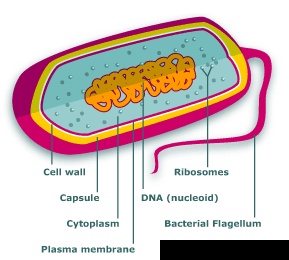
A cell without a nucleus.
a)
Eukaryotic
b)
Prokaryotic
c)
Heterotroph
18.
Which of the following is not a characteristic of a Prokaryotic cell?
a)
unicellular
b)
floating DNA
c)
very small
d)
complex
19.
Which of the following is a characteristic of both Eukaryotic and Prokaryotic cells?
a)
ribosomes
b)
nucleus
c)
membrane bound organelles
d)
simple
20.
Prokaryotic cells include bacteria.
a)
True
b)
False
21.
Unicellular means
a)
single-celled
b)
unicycle
c)
multi-celled
d)
united cells
22.
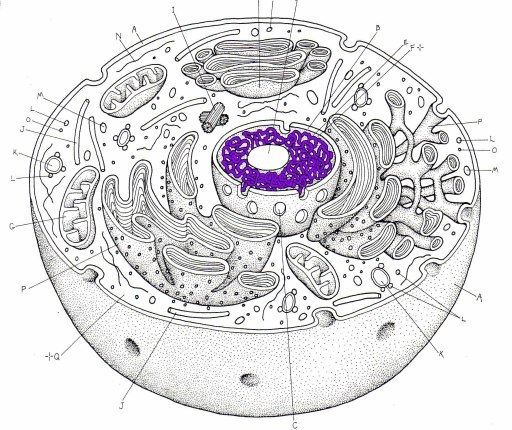
Which type of cell?
a)
Prokaryote
b)
Eukaryote
23.
Both prokaryotes and eukaryotes have a nucleus.
a)
True
b)
False
24.
What kind of cell is this?
a)
Eukaryotic
b)
Prokaryotic
25.
What is multicellular? 
a)
one cell 
b)
no cells 
c)
many cells 
d)
no nucleus 
26.
Plants and animal cells are examples of ___ cells 
a)
prokaryotic cells 
b)
eukaryotic cells 
27.
Animal, fungi, plant, and protista cells are all examples of which type of cell?
a)
Eukaryotic
b)
Prokaryotic
c)
Both prokaryotic and eukaryotic
28.
This domain is characterized by bacteria that can live in extreme environments, such as hot springs.
a)
Archaea
b)
Bacteria
c)
Eukarya
d)
Prokarya
29.
 You would find mushrooms and molds in which kingdom?
a)
Plantae
b)
Protists
c)
Fungi
d)
Animalia
30.
In which kingdom do I belong if I am unicellular, autotrophic, and eukaryotic?
a)
Archaebacteria
b)
Protista
c)
Animalia
d)
Plantae
31.
What is the difference between Archaebacteria and Eubacteria?
a)
Eubacteria are eukaryotic.
b)
Archaebacteria are multicellular.
c)
Archaebacteria can live in extreme environments.
d)
Archaebacteria are found everywhere.
32.
All of the following have a nucleus except...
a)
bacteria
b)
animals
c)
plants
d)
protists
33.
Which kingdom contains multicellular, heterotrophic organisms whose cells have NO cell walls?
a)
Protista
b)
Fungi
c)
Plantae
d)
Animalia
34.
When DNA is contained in a nucleus, the cell is...
a)
eukaryotic
b)
prokaryotic
c)
unicellular
d)
multicellular
35.
Animals must eat other organisms for food, so they are classified as...
a)
heterotrophs
b)
autotrophs
c)
eukaryotic
d)
prokaryotic
36.
This organism is best classified as...
a)
prokaryotic, unicellular, and heterotrophic
b)
eukaryotic, unicellular, heterotrophic
c)
eukaryotic, unicellular, autotrophic
d)
prokaryotic, unicellular, autotrophic
37.
These organisms are best classified as...
a)
eukaryotic, multicellular, and heterotrophic
b)
eukaryotic, multicellular, and autotrophic
c)
eukaryotic, unicellular, and heterotrophic
d)
prokaryotic, multicellular, and heterotrophic
38.
Identify the kingdom...
Rod-shaped prokaryotes swabbed from a kitchen faucet.
a)
Archaebacteria
b)
Eubacteria
c)
Protista
d)
Fungi
39.
Identify the kingdom...
Microscopic unicellular organism found in a mud puddle.  Organism's DNA is contained in a nucleus and it moves by beating tiny hairs in the water.
a)
Archaebacteria
b)
Eubacteria
c)
Protista
d)
Fungi
40.

How many kingdoms are there?

a)

2

b)

4

c)

6

d)

5

41.

Examples are mushrooms and mold

a)

Fungi

b)

Protista

Protista

c)

Plantae

d)

Animalia

42.
Examples are tomato plants and oak trees
a)
Fungi
b)
Plantae
c)
Protista
d)
Animalia
43.
Tigers, Jellyfish, Gorillas and Sponges are all part of kingdom _______.
a)
Animalia
b)
Plantae
c)
Fungi
d)
Bacteria
44.
What do protists, plants, fungi, and animals ALWAYS have in common? They are all...
a)
Multicellular
b)
Eukaryotic
c)
Prokaryotic
d)
Consumers
45.
What kingdoms are PROKARYOTIC?
a)
plant and animal
b)
protist and fungus
c)
archaebacteria and eubacteria
d)
archaebacteria and protist
46.
What is true about bacteria?
a)
they are eukaryotic
b)
they are multicellular
c)
they have a nucleus
d)
they have DNA
47.
I have a nuclear membrane, can do photosynthesis and am multicellular. What kingdom do I belong to?
a)
Animalia
b)
Archaebacteria
c)
Plantae
d)
Protista
48.

In the chemical formula C12H22O11C_{12}H_{22}O_{11}  , how many elements are there?

a)

1

b)

2

c)

3

d)

4

49.

In the chemical formula C12H22O11C_{12}H_{22}O_{11}  , how many C atoms are there?

a)

12

b)

22

c)

11

d)

45

50.

In the chemical formula C12H22O11C_{12}H_{22}O_{11}  , how many O atoms are there?

a)

12

b)

22

c)

11

d)

45

51.

In the chemical formula C12H22O11C_{12}H_{22}O_{11}  , how many H atoms are there?

a)

12

b)

22

c)

11

d)

45

52.

What is the TOTAL number of atoms in the chemical formula C12H22O11C_{12}H_{22}O_{11}  ?

a)

12

b)

22

c)

11

d)

45

53.

Which of the following substances CANNOT be broken down into simpler substance? ?

a)

NaNa  

b)

H2OH_2O  

c)

C6H12O6C_6H_{12}O_6  

d)

COCO  

54.

How does a balanced chemical equation satisfy the Law of Conservation of Mass?

a)

During a chemical reaction, matter is destroyed.

b)

During a chemical reaction, the total number of atoms increases.

c)

 During a chemical reaction, one or more new substances are formed.

d)

During a chemical reaction, the total amount of matter stays the same.

55.

Jin bought a heat pack that weighs 15 g. He shook it so it would release heat to warm his hands. The release of heat indicates a chemical reaction took place in a closed system. What would be the mass of the heat pack after the chemical reaction?

a)

5 g

b)

10 g

c)

12 g

d)

15 g

56.
Matter can not be created nor destroyed: it can only be
a)
Destroyed a little bit
b)
Invisible
c)
Transformed, changed
d)
None of the above
57.
The number to the lower side of an element is a 
a)
Subscript
b)
Superscript
c)
Coefficient
d)
Charge
58.
The number in front of a compound or element is a 
a)
Subscript
b)
Coefficient
c)
Superscript
d)
Charge
59.
A chemical reaction is balanced when
a)
both sides have the same elements
b)
Both sides have the same  number of atoms
c)
Same subscripts
d)
Same coefficients
60.
If reaction starts with 20g of reactants it should produce 
a)
a total of 40g of products
b)
a total of 10g of products
c)
a total of 80 g of products
d)
a total of 20g of products
61.
What is the Law of Conservation of mass?
a)
Mass is created in a chemical reaction
b)
Mass is created in a physical change
c)
New chemicals formed from a chemical reaction have a larger overall mass than the original reactants
d)
Mass is never created or destroyed
62.
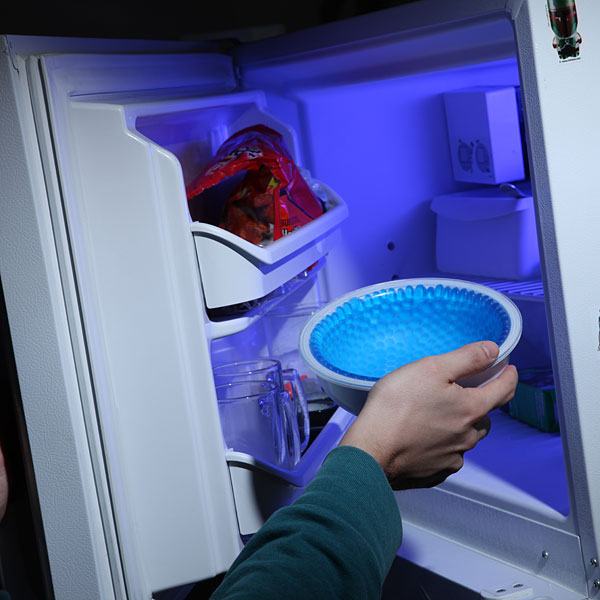
Maria fills a bowl with 200 g of water. She puts the bowl of water in the freezer, and the water freezes. Which will most likely be the mass of the frozen water?
a)
50 g
b)
100 g
c)
200 g
d)
400 g
63.

How many atoms do you have in the compound 2MgCl2?

a)

2 atoms

b)

4 atoms

c)

6 atoms

d)

8 atoms

64.

How many Ca (Calcium) atoms are found in Ca(OH)2?

a)

5 atoms

b)

3 atoms

c)

2 atoms

d)

1 atom

65.

How many Nitrogen (N) atoms are in 4NH3?

a)

4

b)

1

c)

3

d)

12

66.

How many Hydrogen (H) atoms are in 4NH3?

a)

4

b)

1

c)

3

d)

12

67.

In the equation shown, what are the reactant(s)?

a)

N2 + H2

b)

NH3

68.

In the equation shown, what are the product(s)?

a)

N2 + H2

b)

NH3

69.

Is this equation balanced?

a)

Yes

b)

No

70.

Is this equation balanced?

a)

Yes

b)

No

71.

Is this equation balanced?

a)

Yes

b)

No

72.

To balance an equation you should:

a)

ONLY change subscripts.

b)

ONLY change coefficients.

c)

Change BOTH subscripts and coefficients.

73.
Is this equation balanced?
a)
yes
b)
no
c)
Not enough information