
 Worksheets
MIDTERM EXAM CE CHEM FOR ENGINEERS
Total questions: 50
Worksheet time: 2hrs 26mins



H
S
O
2Ca(s) + O2(g) --> 2CaO(s), calcium is __________
which element, if any, is oxidized?
4Fe + 3O2 --> 2Fe2O3
2CaO--> 2Ca + O2
In which substance does sulfur have a negative oxidation number?
CaSO4
S
SO2
Na2S
Which of the following species is the strongest oxidizing agent under standard-state conditions?
Ag+(aq)
H2(g)
H+(aq)
Cl2(g)
Al3+(aq)
Which statement is true for a spontaneous redox reaction carried out at standard-state conditions?
E°red is always negative.
E°cell is always positive.
E°ox is always positive.
E°red is always positive.
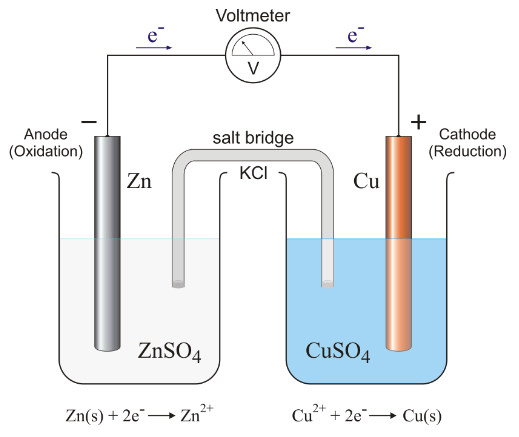
Which is the incorrect statement about voltaic cells?
Oxidation occurs at the cathode (positive electrode)
Electricity is produced as the result of spontaneous exothermic chemical reactions
Reduction occurs at the cathode (positive electrode)
Voltaic cells are also called galvanic cells
Explain the function of a salt bridge in a voltaic cell
provides an electrical connection between the two half-cells to complete the circuit
provides an pathway for electrons to flow to each of the half-cells
allows ions to flow into or out of the half-cells to balance out the charges in the half-cells
prevents the flow of the anions and cations from the salt used in the salt bridge to the two half-cells

A voltaic cell made up from an iron half-cell and a copper half-cell is operated.
What is the correct overall equation for the reaction in this cell?
Fe2+(aq) + Cu(s)
-> Fe(s) + Cu2+(aq)
Fe(s) + Cu2+(aq)
-> Fe2+(s) + Cu(s)
Fe2+(aq) + Cu2+(aq)
-> Fe(s) + Cu(s)
In the standard notation for a voltaic cell, the single vertical line "|" represents:
gas electrode
a phase boundary
a salt bridge
In this voltaic cell notation:
Pt | H2(g) | H+(aq) || Fe3+(aq), Fe2+ (aq) | Pt
Why Fe3+(aq) and Fe2+ (aq) are separated by a comma instead of a single vertical line which represents phase boundary?
they are in different phase
the comma is a more representative notation
they are in the same phase
In an electrolytic cell the electrode at which the electrons enter the solution is called the ______ ; the chemical change that occurs at this electrode is called _______.
anode, oxidation
anode, reduction
cathode, oxidation
cathode, reduction

Pb + 2Ag+ → Pb+2 + 2Ag
The chemical species being reduced is
Ag
Pb
Pb+2
Ag+
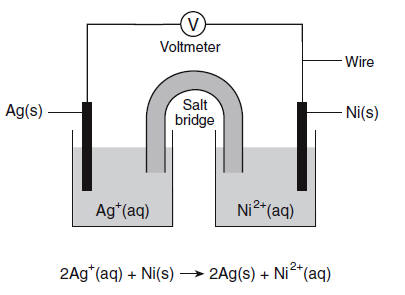


-0.41V
-0.27 V
+0.27 V
+0.41 V

The relevant standard electrode potentials for this cell are shown below.
Cr3+(aq) + 3e- ⇌ Cr(s) E= − 0.74 V
Ag+(aq) + e− ⇌ Ag(s) E = + 0.80 V
Calculate the emf of the cell shown in the diagram.
+1.54 V
-1.54 V
+ 0.06 V
- 0.06 V
Calculate the cell potential of a galvanic cell that uses the two half equation below
Sn2+ + 2e- --> Sn4+ E0 = -0.14 V
Mg2+ + 2e- --> Mg E0 = -2.37 V
-2.23 V
-2.51 V
+ 2.23 V
Using the following standard reduction potentials
Fe3+(aq) + e --> Fe2+(aq) + e E0 = +0.77V
Ni2+ + 2e --> Ni E0 = -0.26V
Ni + 2 Fe3+ --> Ni2+ + 2 Fe2+
Calculate the standard cell potential for the above galvanic cell
-1.8V
+1.8V
+0.51 V
Which is the correct line notation for the cell?
Ag+ I Ag II Ni I Ni2+
Ag I Ag+ II Ni I Ni2+
Ni I Ni2+ II Ag+ I Ag
Ni2+ I Ni II Ag+ I Ag
What would be the theoretical cell potential of the electrochemical cell
Ni I Ni2+ II Ag+ I Ag
Ag+ + e- → Ag Eo = + 0.80V
Ni2+ +2e- → Ni Eo= -0.25V
1.05V
-1.05V
0.55V
-0.55V
How much energy is needed to raise the temperature of 5.0 grams of lead from 25°C to 35°C? [specific heat (c) = 0.129 J/(g•°C)]
6.45 J/(g•°C)
6.45 J
16.1 J/(g•°C)
d.16.1 J
The unit of specific heat capacity is...
Jkg−1
JK−1
J°C−1
Jkg−1K−1
When a substance changes from solid to liquid it is known as
Fusion
Freezing
Vaporization
Condensation
Which of the following is NOT a characteristic of Evaporation?
Thermal energy is supplied by the surroundings
Temperature remains constant
No bubbles are formed in the liquid
Takes place only at the liquid surfaces.
I have 10kg of ice at -10˚C and I want to convert it all to water. The specific heat of ice is 2.1kJ/kg and the latent heat of fusion is 335kJ/kg. How much heat will I need?
210kJ
3350kJ
210 + 3350 = 3560kJ
210 + 3350 + 2100 = 5660kJ
How much heat energy is required to melt 5 kg of ice? Specific latent heat of ice = 336 J/g.
168 J
1.68 x 10³ J
16.8 x 10³ J
1.68 x 10⁶ J
A piece of aluminum with a mass of 20.0 grams is heated from 30 oC to 95 oC. If the specific heat of aluminum is 0.904 J/goC, how much heat is gained by the aluminum?
1717.60 J
1175.20 J
963.68 J
542.4 J
What is material science?
Focus is on how to translate or transform materials into useful devises or structures.
Involves designing or engineering the structure-property correlations of a material to produce a predetermined set of properties.
A branch of science that focuses on materials; interdisciplinary field composed of physics and chemistry.
Relationship between the synthesis and processing, structure and properties of materials.
These are the components of material science tetrahedron EXCEPT ...
Performance
Properties
Processing
Structure
Characterization
There are 5 classification of material science. Metal,.............,ceramics, composites, advanced material.
A. Biomaterial
B. Polymer
C. Smart material
D. Semiconductor
These are the reasons why you need to study material science and engineering EXCEPT
able to select the best material for certain application
able to create a new material
able to predict the properties of new found material
able to select the most expensive material for certain application
A good electrical and heat conductor, strong and ductile. This statement refers to :
metal
polymer
ceramic
glass
These are the characteristics of polymeric materials EXCEPT
Lightweight
Low densities
Good thermal insulator
Good electrical conductor
Copper, titanium and nickel are the ________________ materials.
polymer
metal
semiconductor
composites
A group of crystalline inorganic materials characterized by good strength, especially in
compression, and high melting temperatures. Many ceramics have very good electrical and thermal
insulation behavior.
(a)
A group of materials formed from mixtures of metals, ceramics, or polymers in such
a manner that unusual combinations of properties are obtained (e.g., fiberglass).
(a)
A combination of at least two materials, one of which is a metal whose properties are different from its original form.
Metalloid
Ceramic
Alloy
Nanomaterial

